


Significantly smaller than any case we’ve tested so far. The question is how this smaller size will affect cooling efficiency. Motherboard compatibility is narrower—the largest that fits is Mini-ITX, but the CPU cooler can still be tall, the graphics card long, and the PSU can even be full-size ATX. Yes, even that has a place in the DeepCool CH160. Even a case this small has enough space for large components.
Results: Maximum performance
What about the system fans? We tested the DeepCool CH160 case in a fan configuration with one intake and one exhaust. In the graphs, this is labeled as “1+1,” which means one intake fan to one exhaust fan. Since both are controlled simultaneously with the same PWM signal, the airflow in the case is approximately balanced.
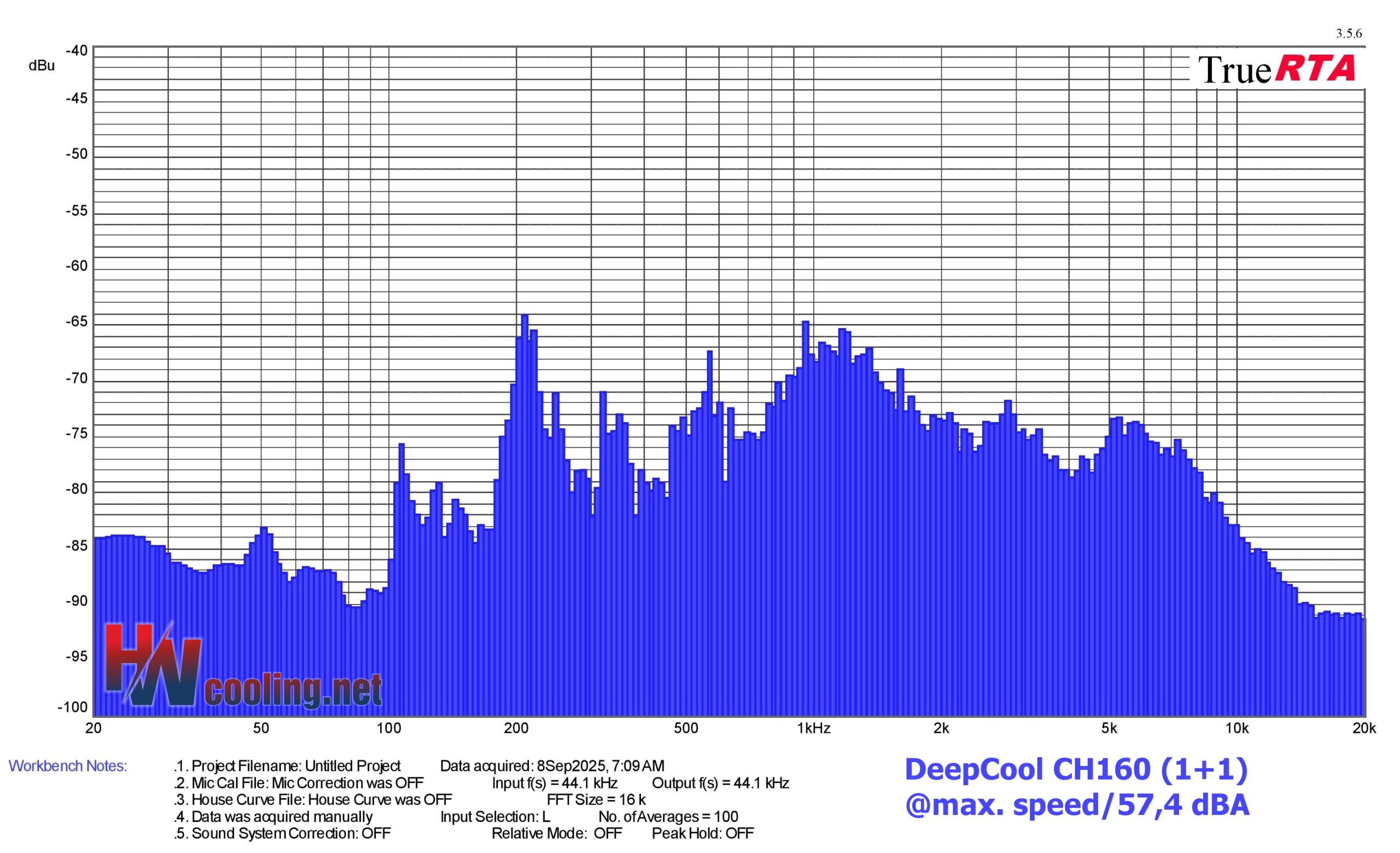
Comment on vibrations: We did not detect vibrations anywhere on the case – neither on the front, top, nor rear panels. The DeepCool FT12 fans used here showed minimal to negligible vibrations, as also confirmed in separate standalone vibration tests.
Why is there a missing value in the chart for a case? One possible reason is that the fans couldn’t be set to the required mode—either because the minimum RPM was too high or the maximum RPM was too low. Another reason could be that the available cooling performance was insufficient for one of the test components, which led to thermal throttling. Temperature values are always recorded (and compared) at comparable performance levels.


It’s great that they offer a mesh side panel variant.
That really is a nice variant. 🙂
I don’t know to what extent the perforated side panel can help cooling, but it probably depends on the situation. With a top-flow CPU cooler there will likely be some benefit, and possibly even without it (for the graphics card, for example). But who knows… with side perforations, case pressure certainly drops to some extent, and with it also the airflow from the system fans. It would probably need to be tested, and hopefully we’ll get to it sometime. It won’t be with the DeepCool CH160 cases, but maybe with some others that also have multiple side panel variants. We’ll see…
… next up in our case testing, we’ll be looking at how the CH260 performs passively, or rather what kind of drop in cooling performance can occur compared to a configuration with added fans. 🙂
I am looking forward! I think the mesh panel can be useful in a transport use case, as indicated by the handle on top. Anyway, it’s great to have a choice.
I agree. The Mesh variant definitely makes sense for logistical reasons as well—a metal side panel won’t shatter under harder impacts. 🙂
–“…we’ll be looking at how the CH260 performs passively, or rather what kind of drop in cooling performance can occur compared to a configuration with added fans.”
👍