




We start the new stage of CPU cooler tests on HWCooling with a duel of two AIO liquid coolers. Both the Navis F360 and the Lumen S36 V2 represent the cheapest coolers with a 360mm radiator that Fractal Design (Lumen S36 V2) and Endorphy (Navis F360), respectively, have. Sure, these aren’t downright cheap coolers, but both are associated with very high cooling performance.
Conclusion
Both liquid coolers are built for superior cooling performance. However, it should be noted that the Endorfy Navis F360 cooler often performs better, although this fact does not affect the performance of even the most powerful CPUs of today on the test platform. Not even at lower noise levels, where the results of the tested coolers are very similar.
In “36 dBA” mode, the difference between the Endorfy Navis F360 and the Fractal Design Lumen S36 V2 is minimal and in practice, it will be variously reversed (in favour of one or the other cooler) by such details as the technique of applying thermal paste, its quantity or even whether you go one thread tighter or looser when tightening. In short, at lower noise levels, when the coolers can be evaluated as already relatively quiet, the cooling performance is remarkably even.
The bigger differences between the coolers are at higher fan speeds, where the Navis F360 has the upper hand (in higher noise levels). At “45 dBA” at high CPU performance on the Intel LGA 1851 platform, quite significantly so. Towards the maximum cooling performance, this difference (unfavorable to the Fractal Design cooler) decreases, but this is at the expense of higher noise levels. The Lumen S36 V2’s disadvantage at maximum speed is already smaller (than in modes at comparably higher or medium noise levels), but that’s at about 6 dBA higher operating noise. Of course, this figure applies to our particular noise measurement methodology and is not comparable with other methodologies.

The advantages of the FD Lumen S36 V2 are evident in situations where lower operating noise is required and yet still high cooling performance. As mentioned earlier, the differences of the tested coolers (Navis F360 and Lumen S36 V2) are becoming blurred at lower noise levels. Plus, the Fractal Design liquid cooler has a quieter pump, allowing control to run quieter overall than with the Navis F360. Naturally, the pump itself can also be regulated and slowed down in various ways (which we don’t do in our tests), but that’s at the expense of the intensity of the fluid flow, which results in cooling performance dropping faster than just reducing the speed of the fans on the radiator. In the quietest comparable mode (with a noise level) of 36 dBA that the Navis F360 can be set to, the cooling performance of the Lumen S36 V2 on the Ryzen 9 9950X is already clearly higher. For the quietest possible operation on the AMD AM5 platform, the Fractal Design cooler seems to be the more attractive option. However, it should be added that CPU model to CPU model can also differ depending on whether they have both core chiplets (CCD) active or just one.
The ability to cool the VRM also needs to be evaluated from the tests. The Endorfy Navis F360 cooler does this better. At comparable noise levels, the VRM is always cooler (and the airflow around the heatsinks more intense). What also refers to the higher efficiency of Fluctus 120 PWM fans (compared to Aspect 12 PWM) are the separate fan tests. However, Fractal Design is not satisfied with this conclusion and you can look forward to new fans under this brand coming soon, which we assume will be more aerodynamically efficient.
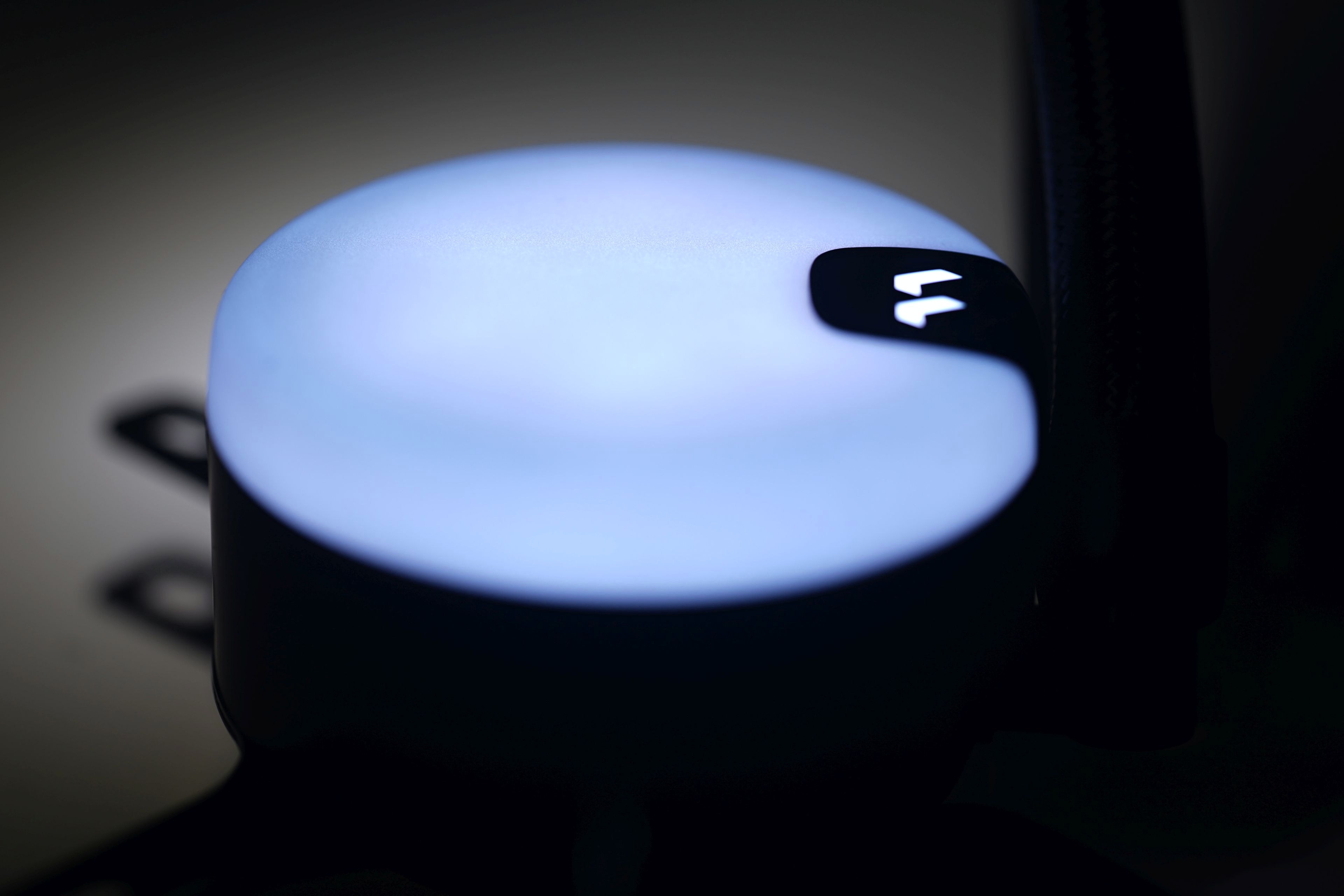
The reason to pay extra for the FD Lumen S36 V2 now can also be in its lighted block. The Navis F360 doesn’t have lighting, or not in the tested variant (and for RGB LEDs you’d have to reach for the more expensive Navis F360 ARGB model). Although the Endorfy cooler has a significant edge on the Intel LGA 1851 platform at higher speeds, the Lumen S36 V2 from Fractal Design is shaping up to be better for quiet cooling of the AMD AM5 platform. If we had to give one cooler the “Smart buy!” award, a more suitable candidate for it would probably be the Navis F360. In the end, however, we’ll stick with the “Approved” award in both cases. The Endorfy solution has a relatively noisier pump and has an edge especially at higher fan airflow, while with the Fractal Design cooler everything is actually the opposite. It thrives more on the AMD (AM5) platform and at lower fan speeds. So we are waiting for a cooler that combines all the good features of the two tested, and avoids the worse ones.
English translation and edit by Jozef Dudáš
| Endorfy Navis F360 |
| + Very high cooling performance... |
| + ... also suitable for the most powerful Intel Core Ultra 9 or AMD Ryzen 9 9000 processors |
| + Cooling performance is particularly outstanding at higher fan speeds |
| + Attractive price/cooling performance ratio for a liquid cooler |
| + Fans with above-standard aerodynamic efficiency |
| + Easy and quick installation... |
| + ... and a robust, metal backplate |
| - Relatively noisier pump... |
| - ... because of the above, it cannot be adjusted to run very quietly |
| Approximate retail price: 98 EUR |
| Fractal Design Lumen S36 V2 |
| + Very high cooling performance... |
| + ... also suitable for the most powerful Intel Core Ultra 9 or AMD Ryzen 9 9000 processors |
| + Cooling efficiency is particularly outstanding at higher fan speeds |
| + Relatively lower price (considering AIO type liquid coolers) |
| + Easy and quick installation... |
| + ... and a robust, metal backplate |
| + ARGB lighting (liquid block cover) |
| - Relatively "weaker" for the Intel LGA 1851 platform (for the standards of 360 mm coolers)... |
| - ... cooling performance per decibel is particularly lower at higher speeds |
| Orientačná koncová cena: 140 eur/3522 Kč |



Results on the AMD AM5 platform have been added. This way everything is complete, including the evaluation (and the final verdict). Although, yes, for now we only have two coolers to compare, and a more complete picture of how each cooler stacks up against its competitors will only emerge over time. 🙂