

A major drawback of the exceptionally powerful GeForce RTX 5090 is the high power demands of its large GB202 chip. Even when equipped with a premium air cooler, the card still requires robust system cooling to handle its nearly 600W heat output. However, AiO liquid cooling models can offer even better thermal performance, thanks to their larger radiators with three 120mm fans, which expel hot air directly outside the case.
Closing summary
Asus originally set the recommended price at 3,100 USD. Currently, the manufacturer offers the card in its e-store for 3,409.99 USD. This converts to approximately 3,860 EUR or 97,600 CZK including tax. In our market, few retailers list the price openly, but those that do typically offer it at slightly lower figures, usually around 82,000 to 85,000 CZK.
It’s hardly meaningful to discuss the price or the price-to-performance ratio in the current situation, where basic RTX 5090 models are available in stock for similar prices, while most better-equipped, unavailable models don’t even have listed prices. Hopefully, this will be resolved over time.
However, we can expect the price premium over a standard air-cooled RTX 5090 to be extreme—significantly higher than the actual performance gains delivered by the improved cooler and factory overclocking.
What likely won’t see dramatic changes are the performance and operating characteristics. Clock speeds are noticeably higher than those of the Founders Edition, and the power limit is set at 600W—the theoretical maximum of the 12V-2×6 connector. Given these parameters, one might expect dual power connectors and perhaps an even higher power limit for overclocking. However, this would mostly appeal to record-breaking enthusiasts. For typical use, further increasing power consumption for minimal performance gains isn’t worthwhile. If owners do decide to tweak settings, they’ll more likely focus on reducing power draw instead.
The operating characteristics match the card’s premium features – despite operating at the 600W limit, the cooler in Q mode is exceptionally quiet. In terms of noise levels, it outperforms most graphics cards on the market, including many with significantly lower performance. Its acoustic profile is similar to the 300W Radeon RX 9070 XT Pulse (which stands out for its quiet operation among other cards) despite offering double the performance. Temperatures remain so low that reducing fan speeds further would be possible, though at that point the power delivery coils become audible. It’s unfortunate that the radiator fans can’t be set below 1000 RPM. The card is only completely silent in passive cooling mode – once the fans spin up, it remains audible even under light loads. A BIOS update could theoretically address this, though it’s uncertain whether such an update will ever come.
Systems with traditional air-cooled RTX 5090 models will generally be louder anyway – even if the card itself is quiet, the heat it generates still needs to be exhausted from the case, which can’t be done completely silently. The only thing missing for perfection is the ability to compare this card with other liquid-cooled models – competing manufacturers offer similar solutions with AIO coolers featuring triple-fan setups.
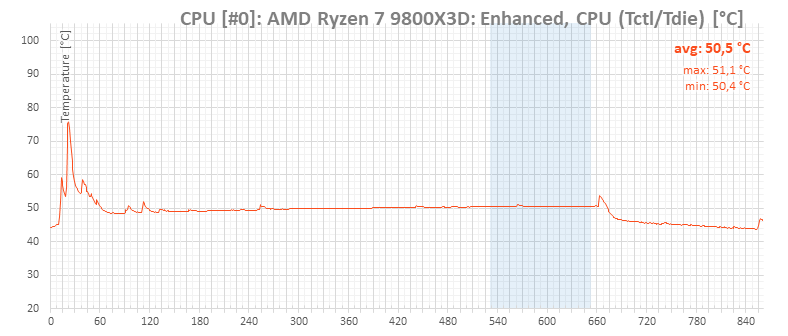
The advantage of an AIO-cooled RTX 5090 in reducing case air temperature becomes particularly evident when looking at CPU temperatures. The first graph below shows temperature readings for a Ryzen 7 9800X3D cooled by a Noctua NH-D15 G2 from our RTX 5090 Founders Edition test. During a ten-minute F1 2024 benchmark, maximum CPU temperatures exceeded 66°C, with peaks above 70°C.

With Asus’s liquid-cooled RTX 5090, the CPU temperature under the same load is about 15°C lower. This clearly demonstrates that the card doesn’t contribute to heating up the case interior.
In the default Performance mode (P mode), the card’s noise level becomes rather average, and the benefits aren’t really worth it—you get slightly lower temperatures and just a few extra dozen megahertz.
If we set aside the exorbitant price, the Asus Astral LC GeForce RTX 5090 OC Edition delivers performance that surpasses even typical RTX 5090 standards, while maintaining low temperatures and noise levels that outperform most cards on the market—including many with much lower performance. For these reasons, it deserves our top-notch award.
Pros and cons
+ Unmatched gaming and application performance
+ Performance increase exceeds air-cooled RTX 5090 models
+ Cooler has massive headroom, remains quiet in Q mode even under load
+ 32 GB memory
+ Support for DLSS 4 and other proprietary Nvidia technologies
+ Significant ray tracing performance improvement over previous generation
+ Power connector monitoring
– Price
– Significantly noisier in P mode with negligible performance difference
– Substantial premium over base models, poor price/performance ratio
– Power consumption at the limit of connector specifications
– Average coil whine noise levels
– No headroom in power limit
English translation and edit by Jozef Dudáš
Nvidia GeForce RTX 5090 graphics cards can be purchased in the Datacomp e-store.

⠀