A major drawback of the exceptionally powerful GeForce RTX 5090 is the high power demands of its large GB202 chip. Even when equipped with a premium air cooler, the card still requires robust system cooling to handle its nearly 600W heat output. However, AiO liquid cooling models can offer even better thermal performance, thanks to their larger radiators with three 120mm fans, which expel hot air directly outside the case.
With high-power graphics cards, we’re accustomed to their massive size. Water cooling allows moving the passive components elsewhere, making the card itself smaller. The Asus ROG Astral LC GeForce RTX 5090 is somewhat deceptive in photos. Due to proportions resembling lower mid-range cards, it appears smaller than it actually is. The card’s dimensions are 288×154×48 mm – about 1 cm shorter and 2 cm wider than the RTX 5090 Founders Edition.


The card’s back is protected by a metal backplate.


Through the fan blades, you can see the fins of the massive metal casting that cools components not served by the water block. The fan has an impeller diameter of 10.5 cm.


The radiator features standard-sized 120mm fans with a proprietary connector handling power delivery, RPM monitoring, and ARGB LED lighting control. Only one fan’s speed is monitored.
This design eliminates cable clutter – just a single cable with a magnetic connector runs under the sleeve of one hose. Power and control signals for other fans come from a connector at the opposite end. The frame magnets are strong enough to hold all three fans together.

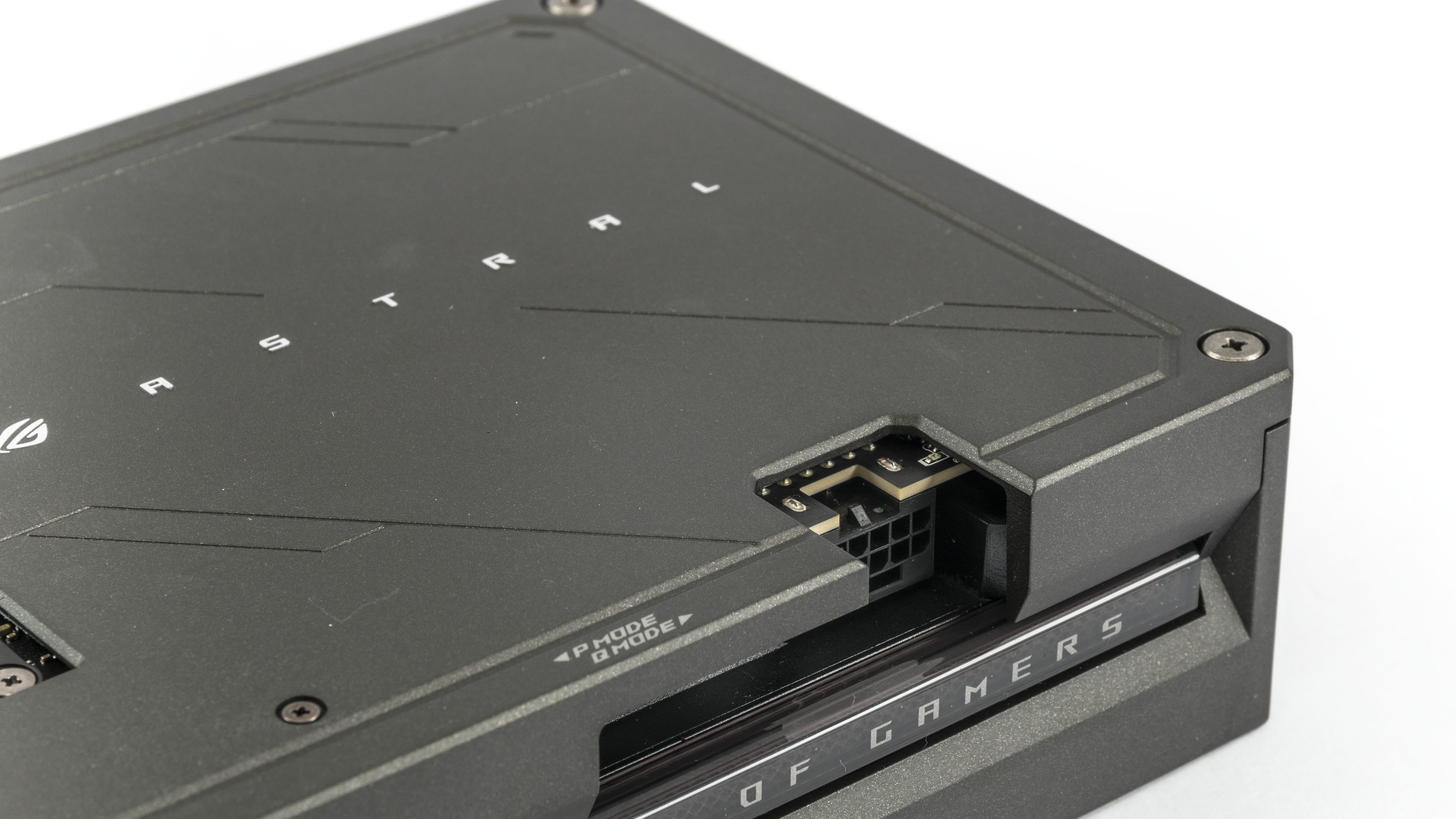
Beside the auxiliary power connector are two system fan headers controllable via Asus GPU Tweak III based on GPU load, plus a BIOS switch.

The radiator with fans measures 400mm long, 120mm wide, and an unusually tall ~7cm (fans are standard 25mm height). This height creates compatibility issues in most compact cases for top mounting when using larger air CPU coolers.
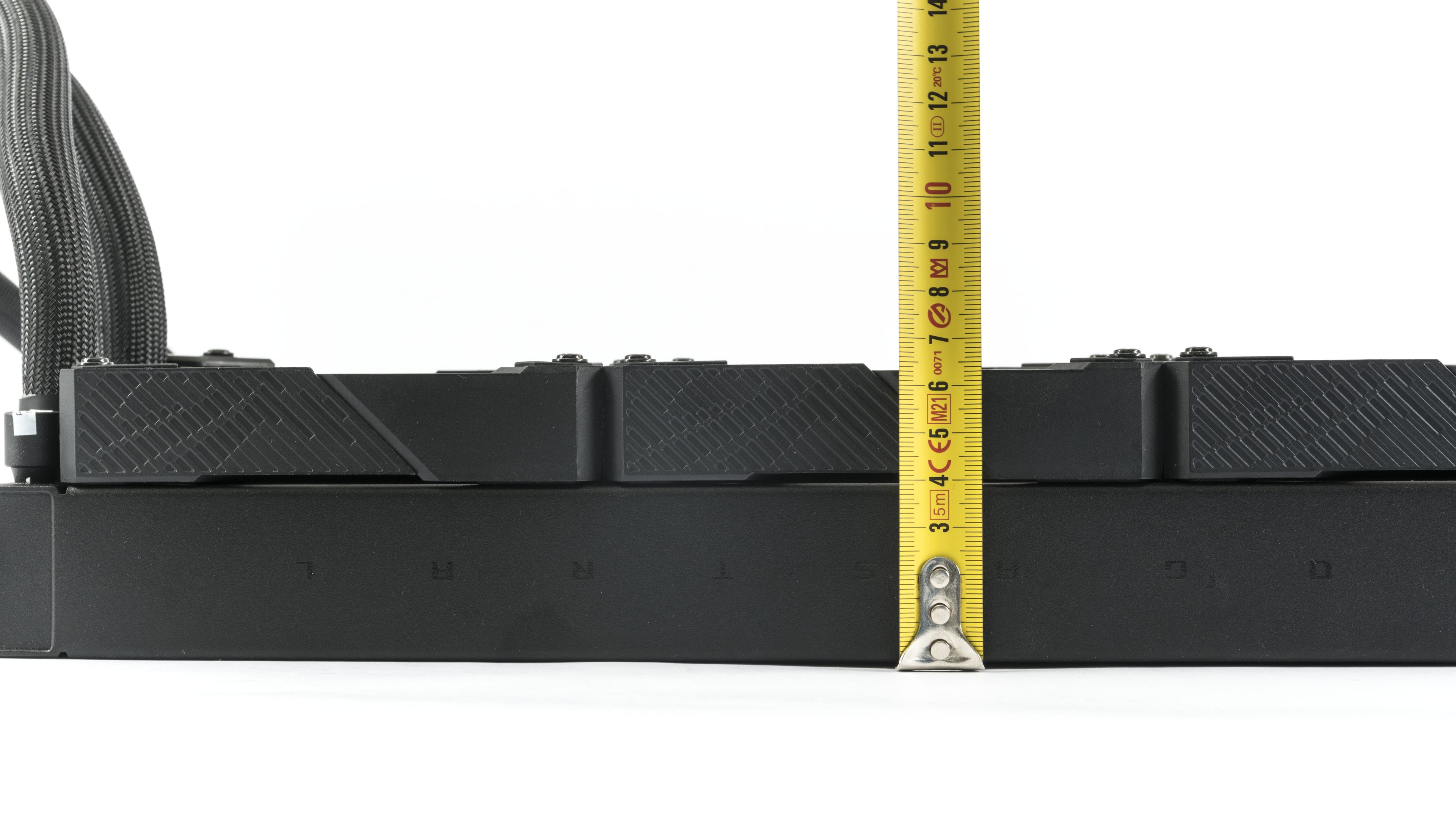
Even in the spacious Meshify 2 case, the radiator couldn’t fit alongside a Noctua NH-D15 G2 cooler during testing, requiring external placement atop the case. Front, bottom or side mounting are alternatives, but top placement remains the most logical and common scenario.
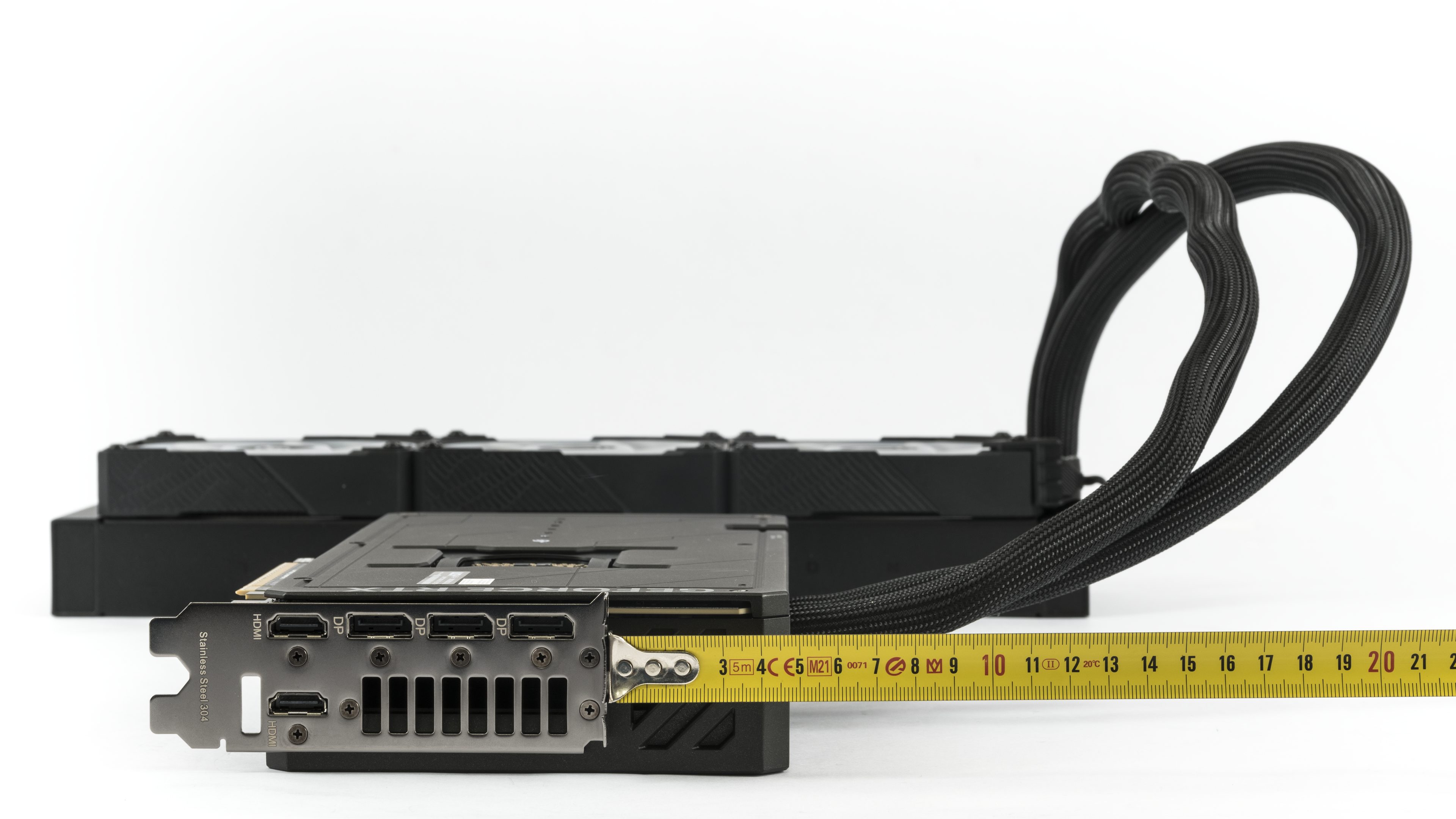

The rear I/O breaks from convention – alongside the standard three DisplayPort 2.1b (UHBR20) and one HDMI 2.1b, Asus added a second HDMI port in the second row. While still limited to four active displays maximum, this allows connecting two HDMI monitors without adapters – unlike standard cards.

The auxiliary power is provided by a single 12V-2×6 connector. Compared to other cards, it has the advantage of allowing monitoring of current through individual wires, helping detect potential power issues early. The disadvantage is that this requires monitoring software – it doesn’t work as automatic protection that would cut power if problems occur.
Now to the test results.
⠀