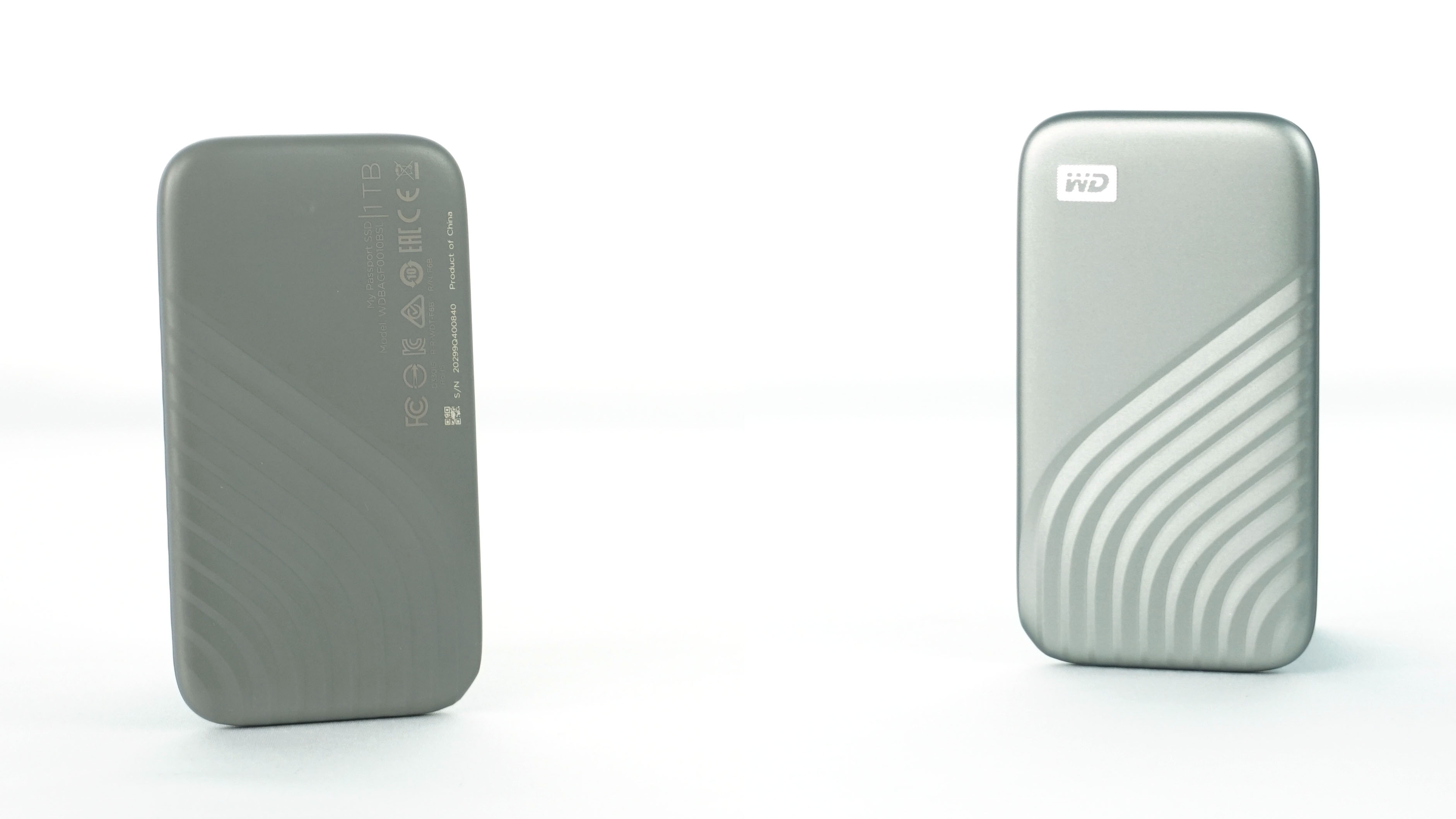
WD My Passport SSD 2020 – 2nd generation of the pocket SSD

WD with the My Passport line is one of the largest manufacturers of external storage. I myself have three pieces with a capacity of 2–4 TB. In 2017, they launched the My Passport SSD, which belonged to the first generation of external SSDs. It impressed us mainly with its unique design and compact dimensions, but unfortunately it never got into my hands. However, this is now changing, as we have received an upgraded version with the same name for 2020.

Read: practical tests

The tests consist of sequentially moving directories from a RAM disk to an SSD. The files in these directories vary in size. From the largest 9 GB one (when most SSDs reach maximum performance), they gradually decrease to very small (12–59 kB ones) – in such operation, the performance is usually relatively low.


Reading tests are a bit tighter than writing. WD wins the 9 GB one by 5%, we see a 1% difference at 24–36 MB. 5–10 MB one is more suitable for My Passport with a lead of 21%, but in 427–1235 KB, the PXD is 17% faster for a change. The biggest difference is again seen in the smallest files, where the PXD dominates again. My Passport took 16 minutes to complete this test, the T5 and SanDisk up to 40. However, the PXD only took a little over two minutes, which is a really huge difference.

Read: synthetic tests

The results are from the AS SSD benchmark. The size of the library is set to 1 GB, which means that the measured values do not yet reflect the limitations resulting from the full SLC buffer, which is an integral part of most fast, cheaper SSDs with TLC memory.


Synthetic read tests are in favor of My Passport with one exception. However, the differences in sequential, 4K (64 threads) and access time are only 1–2%, which means nothing in real life. 4K read is the only one in which the PXD wins, quite significantly with a 28% difference.


SSDs getting cheaper is almost over: Big price jump from summer on

At the beginning of the year, we reported a price drop forecast for SSDs and other storage devices based on NAND Flash memory. Unfortunately, it seems this downward price trend won’t last for long, and the bottom will likely be reached by early summer. After that, the trend is expected to reverse, and prices will unfortunately start to rise again. The window to snag extra terabytes at a bargain prices won’t last long. Read more “SSDs getting cheaper is almost over: Big price jump from summer on” »

Something for Everyone: A Guide to Patriot SSDs for M.2 NVMe

Patriot continues to expand its SSD lineup and has models for all types of users. We’ll discuss the specs and features of affordable PCIe 3.0 solutions, high-performance PCIe 4.0 SSDs, and the latest PCIe 5.0 models that deliver top-notch performance and innovative cooling. The lineup also includes fast and compact SSDs for space-constrained devices or gaming consoles. Read more “Something for Everyone: A Guide to Patriot SSDs for M.2 NVMe” »

Rare host: How does an SSD work in the Asus Dual RTX 4060 Ti?

Among RTX 4060 Ti graphics cards, Asus has multi-functional designs with an M.2 slot for NVMe SSDs. These, unlike other models, don’t waste the potential of the PCI Express ×16 interface so significantly. To evaluate this design, partial results from motherboard tests are now extremely useful. Those results that relate to the M.2 slot speeds and the efficiency of SSD coolers. After all, the Asus Dual RTX 4060 Ti SSD also competes in both disciplines. Read more “Rare host: How does an SSD work in the Asus Dual RTX 4060 Ti?” »

Leave a Reply

Your email address will not be published. Required fields are marked *
