While the more powerful GeForce RTX 50 models face no direct competition, AMD has positioned two strong contenders against the RTX 5070—the Radeon RX 9070 and RX 9070 XT. Both offer slightly better value and more memory. Your choice depends on whether you need a graphics card purely for gaming or also for professional applications, and how reliant you are on Nvidia’s broader, more polished ecosystem with proprietary technologies.
The card is equipped with a large triple-slot cooler featuring three low-profile fans. The shroud is made of metallic gray plastic but is reinforced with metal elements, so it doesn’t flex in your hands. The fans, with dual ball bearings, blow air onto a heatsink with transverse fins.


The rear of the PCB is covered by a metal backplate. The most interesting detail here is the print—a colorful imitation of embossing that, from most angles, looks like actual shaped metal.

Only when you look at the cutout for the cooler clip, against the light, or touch the cover do you realize it’s just a print. A silly detail, but it’s amusing.


The fans have impeller diameters of 10 cm and a height of about 11 mm.


The fans are counter-rotating. The middle one rotates in the opposite direction. At the rear, under the third fan, there’s a large vent. Through it, heated air can freely flow through the cooler.


For what is supposed to be a more affordable model, the card is still quite large. It’s 33 cm long. It extends about 3.5 cm beyond the bracket in width and occupies three full slots in height (measuring 6 cm), so plan for a fourth free slot for air intake. The power connector is located near the edge, so keep in mind that you’ll need some space under the side panel to avoid bending the auxiliary power cable too sharply.


With a weight of 1.54 kg, it’s a solid middleweight contender.

The connector setup is above average. On the bracket, in addition to the usual three DisplayPort 2.1b and one HDMI 2.1b, there’s a second HDMI connector. This isn’t for connecting five monitors simultaneously but to avoid needing adapters. Only four outputs can function at the same time.

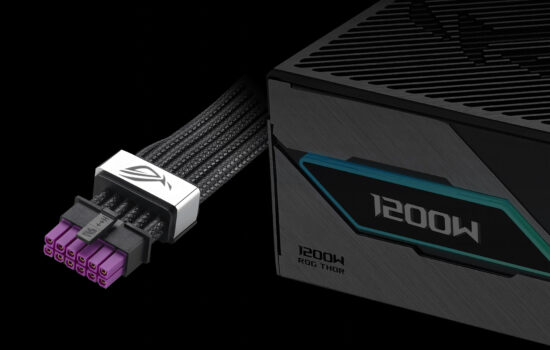
For additional power, there’s a 16-pin 12V-2×6 connector. It has a thermal pad and a diagnostic LED that should signal power issues. It’s more for indicating problems with unplugging or faulty small signal pins. It likely won’t detect if 20 A is flowing through a single wire.
Using the included adapter, you can also connect the card with two classic 8-pin connectors.

⠀