So, now we get to see what the grooves on the entire surface of the blades, which are typical of BeQuiet! fans, are worth! Judging by the geometry, we were initially concerned that the results might go in a similar direction to the Arctic BioniX F120. But it’s a lot better than that, and the 120 mm Pure Wings 2 even achieves a top price/performance ratio while running very quietly. The best of the fans tested so far.
Pure Wings 2 fans represent the cheapest option in the BeQuiet! lineup. The manufacturer doesn’t indicate in the basic features overview whether the fan is closer to being used in computer cases (as a system fan) or on cooler radiators, but it is used both here and there. BeQuiet! has the Pure Wings 2 fan in a 120 mm format both on the heatsink of Pure Rock 2 and Shadow Rock Slim 2 or Shadow Rock LP coolers and in Pure Base and Silent Base cases. So we will consider it as a universal fan.
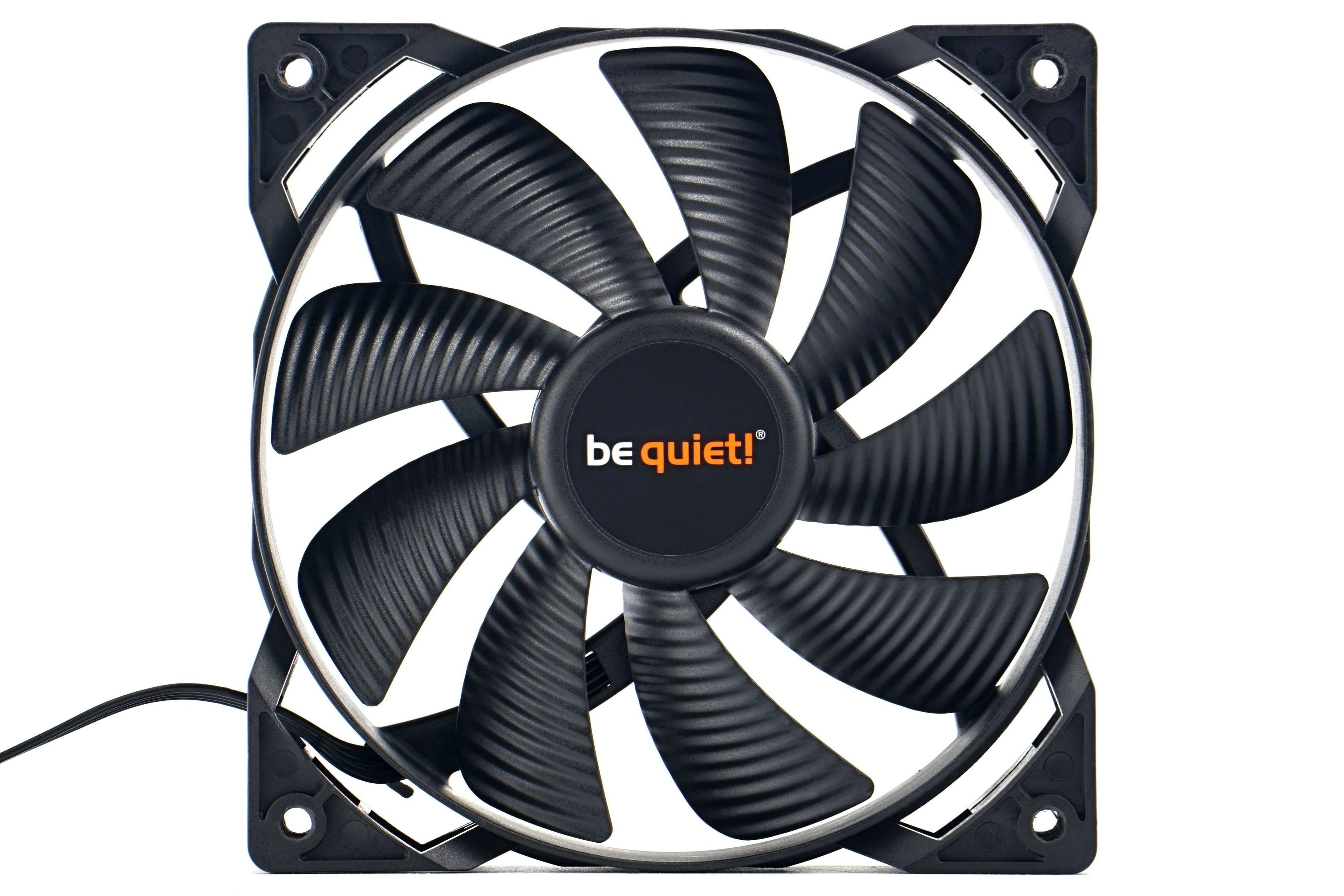
Apart from the “bumpy” surface, the rotor’s shape is somewhat reminiscent of the Arctic BioniX F120’s design, which we didn’t evaluate very favourably.Pure Wings 2 blades are in the same number (9) and are also slimmer, with proportionally larger spacing.

This “looser” cross-section goes hand in hand with achieving lower static pressure and therefore higher airflow loss against obstacles. Naturally, dust filters are also considered to be obstacles, which the fan must also overcome. Compared to the BioniX F120, there are a few details where the Pure Wings 2’s design differs. And in the right direction.
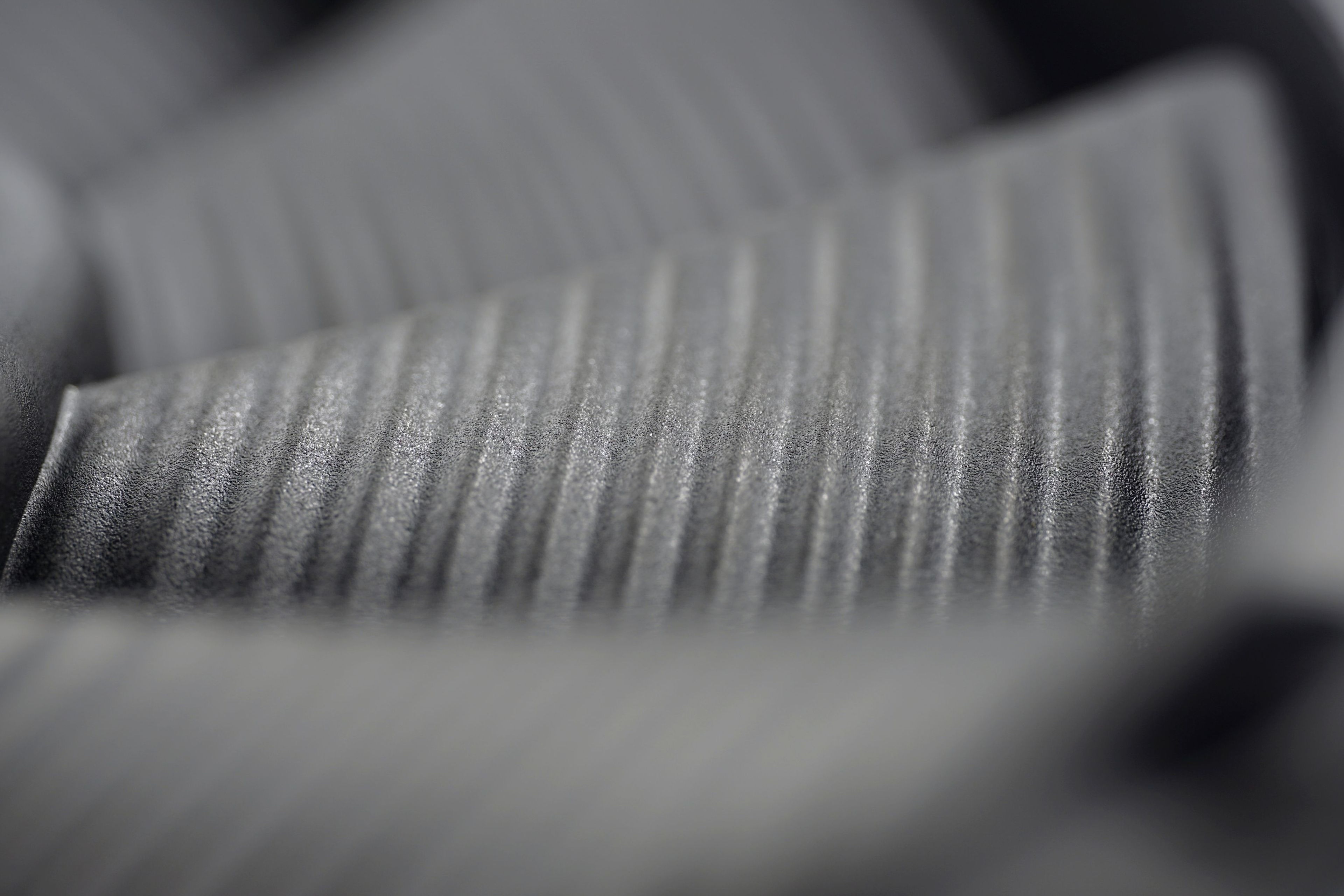
The slope of the blades is at a slightly sharper angle, all edges (including corners) are rounded (on the BioniX F120 they are sharp) and the main thing – Pure Wings 2 does not have a smooth surface, but there are grooves on it. This from both sides of the blades.

This is to suppress unwanted turbulence and thus reduce noise at comparable or even higher airflow. On the leading side (front), the grooves also cause some laminarisation of the air. And the more laminar the flow at the intake, in front of the rotor, the greater the volume of air that can flow through the fan.
Admittedly, the flow in front of and behind the rotor still has a turbulent characteristic, but less wild than that of fans with plain blade surfaces, without grooves. Some manufacturers also write about flow acceleration elements in connection with similar ducts. Acceleration is supposed to always occur at higher efficiencies. This means that the airflow increases more significantly than the noise level.

Strong competitors to the Pure Wings 2 (120 mm) for similar money include the SilentiumPC Fluctus 120 PWM or even the Noctua NF-P12 redux PWM fans. But the least you will pay is for Pure Wings 2.
The design of the Pure Wings 2 is relatively simple, befitting the lower price. The frame, for example, does not have anti-vibration pads (but we can already note that it does not even need them for extremely precise workmanship). The cable is plain but practical – flat and extra long at 45 cm. Only self-tapping screws are included in the accessories.

A complete listing of the manufacturer’s basic parameters can traditionally be found in the table below. The 120 mm Pure Wings 2 is available in four variants. The basic division is based on the method of speed control, i.e. PWM or DC, and then on the speed achieved.
If 1500 rpm of theBL039 (PWM) or the BL039 (DC) is not enough, there are also faster variants, the BL081 (PWM) and the BL080 (DC) capping at 2000 rpm. However, these can also have higher starting speeds. In the following analysis, we test the slower BL039 variant (with a max. of 1500 rpm) with PWM.
| Brand and model of fan | Paper specicifations * | Price [EUR] | ||||||||
| Format (and thickness) in mm | Connecting | Speed [rpm] | Airflow [m3/h] | Static pressure [mm H2O] | Noise level [dBA] | Bearings | MTBF [h] | |||
| Motor | RGB LED | |||||||||
| BeQuiet! Pure Wings 2 (BL039) | 120 (25) | 4-pin (PWM) | N/A | 1500 | 87.00 | 1.25 | 19.2 | rifle | 80 000 | 11 |
| Gigabyte Aorus 120 ARGB | 120 (25) | 4-pin (PWM) | 3-pin (5 V) | 800–1700 | 31.47–69.40 | 0.37–1.48 | 7.3–28.6 | sleeve | 73 500 | 25 |
| Arctic BioniX P120 A-RGB | 120 (30) | 4-pin (PWM) | 3-pin (5 V) | 400–2300 | 81.55 | 2.10 | 33.4 | fluid | N/A | 21 |
| Akasa OTTO SF12 | 120 (25) | 4-pin (PWM) | N/A | 0–2000 | 164.84 | 3.59 | 7.1–31.7 | ball | 80 000 | 22 |
| Cooler Master SickleFlow 120 ARGB | 120 (25) | 4-pin (PWM) | 3-pin (5 V) | 680–1800 | 105.34 | 2.50 | 8.0–27.0 | rifle | 160 000 | 15 |
| Alphacool SL-15 PWM | 120 (15) | 4-pin (PWM) | N/A | 600–1800 | 71.40 | 1.20 | 32.0 | ball | 50 000 | 11 |
| Arctic BioniX F120 | 120 (25) | 4-pin (PWM) | N/A | 200–1800 | 117.00 | 2.10 | 20.0 | fluid | N/A | 10 |
| SilverStone SST-AP123 | 120 (25) | 3-pin (DC) | N/A | 1500 | 96.84 | 1.46 | 23.8 | fluid | 50 000 | 25 |
| Noctua NF-P12 redux-1700 PWM | 120 (25) | 4-pin (PWM) | N/A | 400–1700 | 120.20 | 2.83 | 25.1 | SSO | 150 000 | 13 |
| SilentiumPC Fluctus 120 PWM | 120 (25) | 4-pin (PWM) | N/A | 300–1800 | N/A | N/A | N/A | fluid | 100 000 | 12 |
| MSI MEG Silent Gale P12 | 120 (25) | 4-pin (PWM) | N/A | 0–2000 | 95.48 | 2.21 | 22.7 | hydrodynamic | 50 000 | 31 |
| Asus ROG Strix XF120 | 120 (25) | 4-pin (PWM) | N/A | 1800 | 106.19 | 3.07 | 22.5 | „MagLev“ | 400 000 | 23 |
| Akasa Vegas X7 | 120 (25) | 4-pin (PWM) | 4-pin (12 V) | 1200 | 71.19 | N/A | 23.2 | fluid | 40 000 | 11 |
| Reeven Coldwing 12 | 120 (25) | 4-pin (PWM) | N/A | 300–1500 | 37.54–112.64 | 0.17–1.65 | 6.5–30.4 | sleeve | 30 000 | 12 |
| Reeven Kiran | 120 (25) | 4-pin (PWM) | shared | 400–1500 | 110.10 | 2.95 | 33.6 | fluid | 120 000 | 17 |
| SilentiumPC Sigma Pro 120 PWM | 120 (25) | 4-pin (PWM) | N/A | 500–1600 | 79.00 | N/A | 15.0 | hydraulic | 50 000 | 7 |
| SilentiumPC Sigma Pro Corona RGB 120 | 120 (25) | 4-pin (PWM) | 4-pin (12 V) | 1500 | 56.58 | N/A | N/A | hydraulic | 50 000 | 12 |
| SilverStone SST-AP121 | 120 (25) | 3-pin (DC) | N/A | 1500 | 60.08 | 1.71 | 22.4 | fluid | 50 000 | 18 |
| SilverStone SST-FQ121 | 120 (25) | 7-pin (PWM) | N/A | 1000–1800 | 114.68 | 0.54–1.82 | 16.4–24.0 | fluid | 150 000 | 20 |
| Xigmatek XLF-F1256 | 120 (25) | 3-pin (DC) | N/A | 1500 | 103.64 | N/A | 20.0 | rifle | 50 000 | 16 |
* When reading performance values, a certain amount of tolerance must always be taken into account. For maximum speeds, ±10 % is usually quoted, minimum speeds can vary considerably more from piece to piece, sometimes manufacturers will overlap by as much as ±50 %. This must then also be adequately taken into account for air flow, static pressure and noise levels. If only one value is given in a table entry, this means that it always refers to the situation at maximum speed, which is achieved at 12 V or 100 % PWM intensity. The manufacturer does not disclose the lower limit of the performance specifications in its materials in that case. The price in the last column is always approximate.