


Computex is not just for the industry giants. Alongside major manufacturers, smaller brands regularly showcase unconventional designs and innovative engineering to capture attention. Some of these concepts prove to be developmental dead ends, while others pioneer features that later integrate into mainstream products. Even if not every innovation succeeds, many certainly deserve recognition.
In this loose continuation of Computex coverage, we’ll look at products that likely won’t revolutionize cooling, but instead aim to stand out through unusual structural solutions or design. This year’s show brought several such curiosities—from unconventional PC cases to dynamic ferrofluid elements and even wooden or holographic embellishments for CPU coolers.
Formula V Line: Tilting Fans and Variable Layout
We covered the Formula V Line brand on HWCooling earlier this year. Since then, the manufacturer has introduced additional products, with the Air Power G10 case being the main attraction at Computex. It aims to stand out with a solution practically unseen in standard ATX cases—a trio of tilting front fans.
Tilting Fans

Each of the three 120 mm fans is mounted on an independent bracket that allows the airflow direction to be adjusted roughly ten degrees upward or downward. In theory, this makes it possible to direct a greater volume of fresh air directly toward the graphics card or, conversely, toward the CPU cooler, depending on the system configuration.
On paper, it’s an interesting idea that sets Formula V Line apart from virtually all competitors. However, it’s also a solution whose benefits will need to be verified through measurements. A ten‑degree change in airflow direction may not have enough impact within the case to significantly affect component temperatures. The opposite scenario also cannot be ruled out—where the altered airflow disrupts the established front‑to‑back circulation inside the case.
Internal Variability
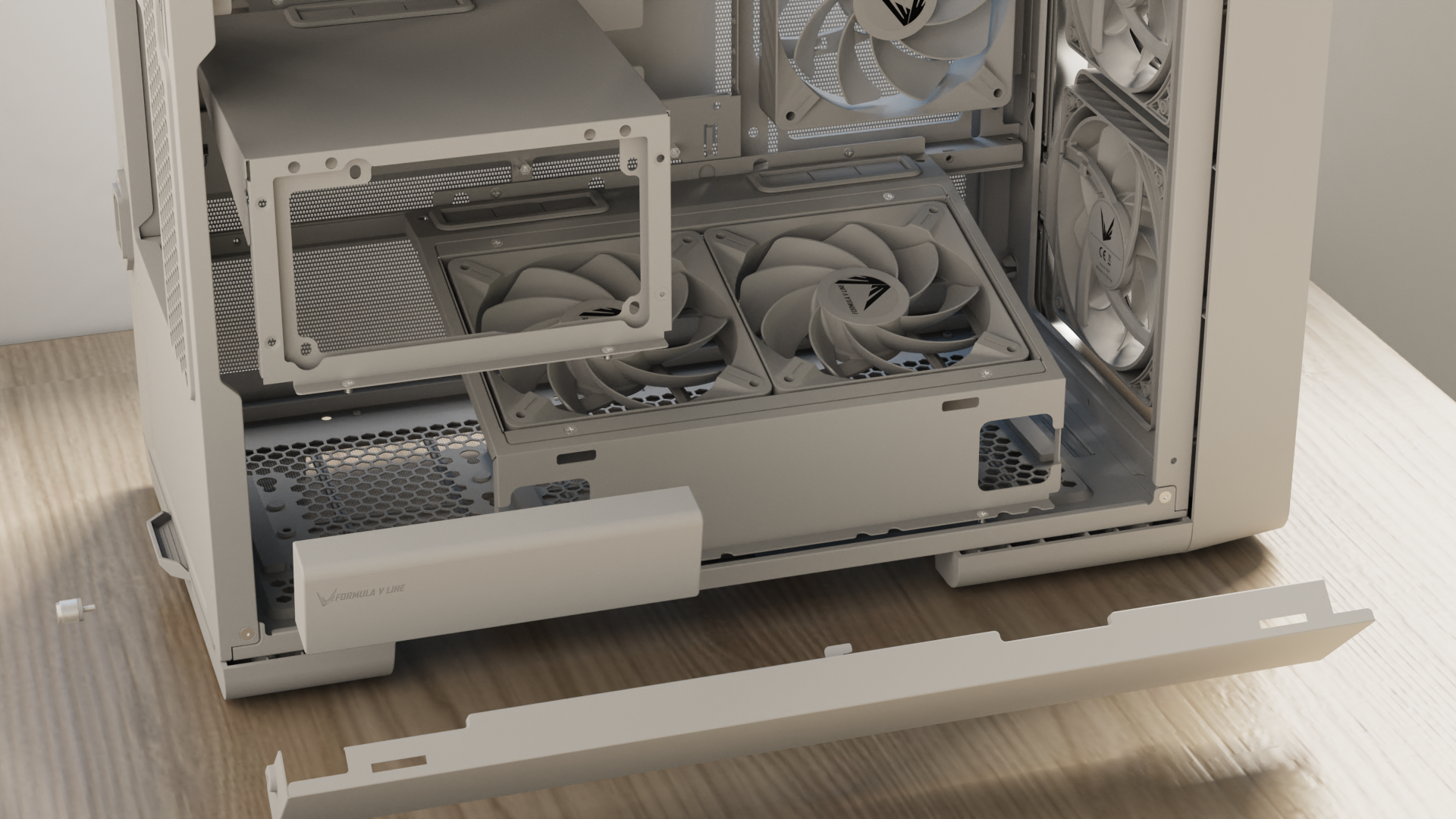
The second innovation in this case is considerably more intriguing, even if it’s not immediately obvious. The manufacturer designed the lower chamber to be modular, allowing the PSU position and the lower fan bracket to be swapped. While this is a less flashy modification than tilting fans, it may have a more noticeable practical impact on configuration flexibility.
The Air Power G10 also doesn’t forget the standard features expected of a modern upper‑midrange case. It supports 360 mm radiators, graphics cards up to around 420 mm in length, tool‑less panel removal, and individual dust filters for each front fan, making cleaning easier.
Other Interesting Cases

Alongside the Air Power G10, Formula V Line also introduced an updated larger panoramic case, the Crystal U7, and a smaller “fish-tank” Crystal Z3.
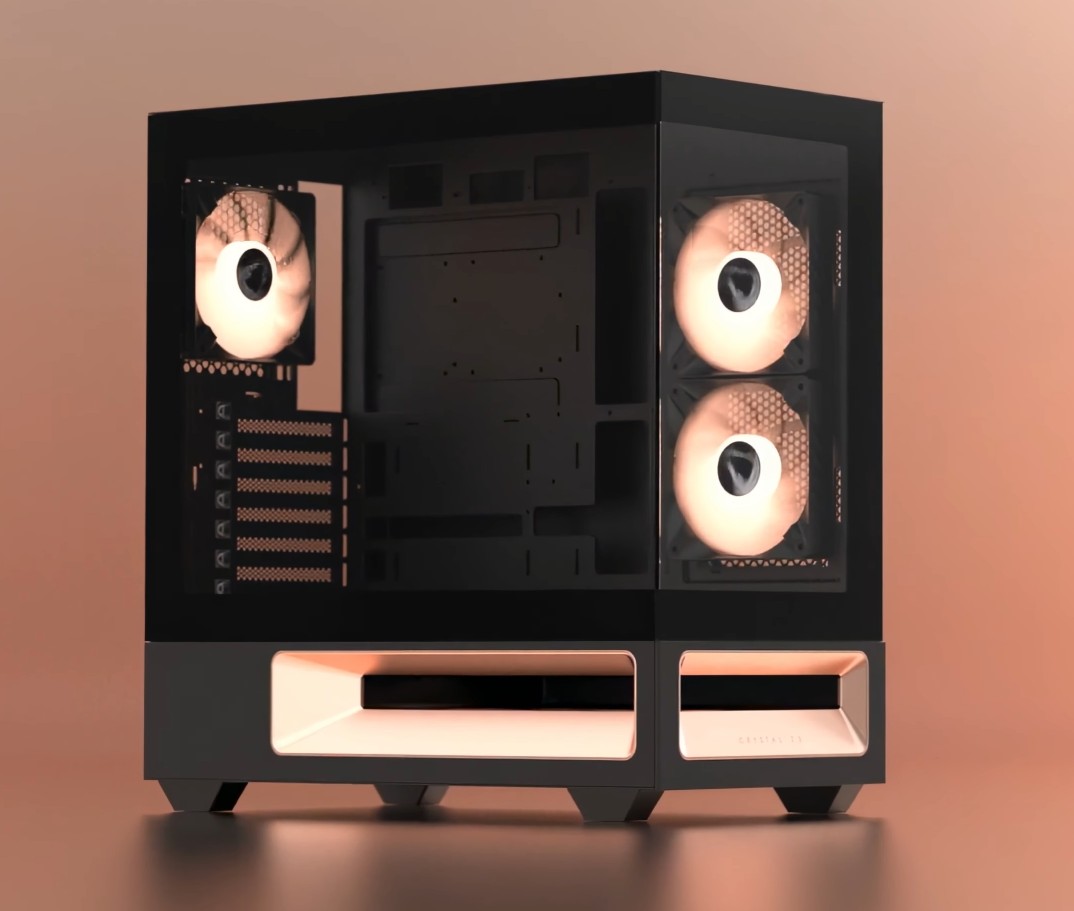
Unlike the Air Power G10, however, the Crystal U7 and Z3 do not bring any major structural innovation. Instead, they expand the manufacturer’s lineup in a segment that is currently extremely popular among case makers. Their success will therefore depend mainly on build quality, pricing, and internal layout details—which cannot yet be reliably assessed from photos, even if they look promising at first glance.

Xeron: A New Brand Likely Made up of Experienced Gamers
One of the complete newcomers at Computex was Xeron. The manufacturer itself reveals little about its background. It only states that the team consists of people with long‑term experience in developing cases, coolers, and power supplies, but does not disclose specific names or previous affiliations. Some insight comes from the registration of the XERON trademark for the European market, filed by Guangdong SOHOO Technology Co., Ltd. The brand is therefore backed by a Chinese manufacturer that has been involved in PC hardware for more than two decades and, in addition to OEM production, also owns the GameMax brand. Xeron can thus be seen more as an extension of an existing portfolio than a completely new company built “from scratch.”

Interestingly, while GameMax traditionally targets the more budget‑oriented segment, Xeron has presented itself far more ambitiously from the start. It emphasizes original case design, more premium craftsmanship, and a complete ecosystem of components for enthusiasts. Although GameMax has also been moving toward higher market segments and more innovative designs in recent years, its name is still associated mainly with lower‑priced products. Xeron may therefore represent an opportunity to appeal to more demanding customers with a new brand free of this historical baggage.
S‑Lab: More Architecture Than a Traditional PC Case
The case attracting the most attention at the booth was the S‑Lab. Xeron clearly didn’t settle for another variation of today’s popular panoramic cases, but instead attempted to create a striking design element. The dominant feature of the construction is a structural frame shaped like the letter S.

Both the front and side panels are glass, while the frame itself remains prominently exposed. The result resembles more of an exhibition piece than a traditional PC case. Xeron even uses the term Art Gallery Design, which may sound somewhat marketing‑driven, but accurately reflects the manufacturer’s intent to make the PC a part of interior design rather than just a technical device.
Fortunately, the practical side wasn’t forgotten. Despite the large glass surfaces, airflow is not limited to narrow side vents. Air enters through an open channel running along the structural frame. The graphics card receives its own air intake from the bottom of the case, while the rest of the interior is supplied with air from the side and exhausted by a rear fan. The overall layout suggests that the manufacturer primarily expects liquid cooling, for which a dedicated chamber is reserved in the upper part of the structure.

The design also supports motherboards with rear‑facing connectors (BTF, Project Zero, and similar solutions), which are gradually becoming standard even outside the highest‑end case segment.
C‑Lab: An Even Bolder Concept
If the S‑Lab is visually unmistakable, the C‑Lab goes even further. It is a semi‑open design where the main chamber is literally inserted between two aluminum frames. This approach is intended more for showcase builds than everyday use, but it demonstrates that the manufacturer is seeking its own design identity rather than producing yet another variation of today’s popular “fish-tank” cases.

A Complete Ecosystem from Day One
Alongside the cases, Xeron also introduced a full lineup of additional components. The LUX Vision liquid coolers stand out with a large curved AMOLED display on the pump block. The MAX A62 air cooler belongs to classic dual‑tower designs. There were also power supplies with capacities up to 3000W, complemented by fans, thermal pastes, liquid metal, and more.
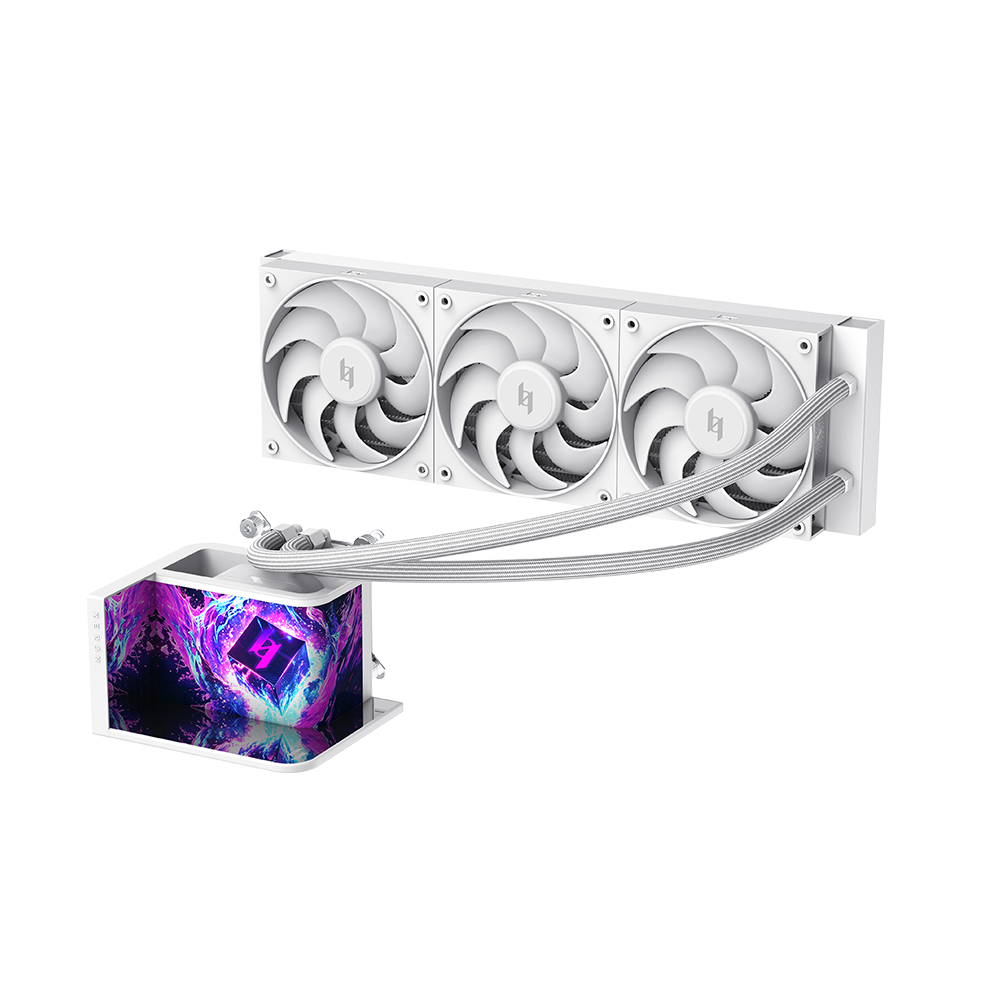
The manufacturer aims to cover all major PC component categories. However, the greatest opportunity for differentiation currently lies in its cases, which were undoubtedly the most interesting part of its Computex debut.
Amiiba: Ferrofluid as a Design Element
Another newcomer at Computex was Amiiba, which chose a highly unconventional way to stand out—building its identity around the visual effect of ferrofluid. The magnetic liquid, which forms characteristic spikes and constantly shifting shapes under the influence of a magnetic field, became the main design motif of the entire product line.

Unlike earlier experiments involving ferrofluid in cooling technology, Amiiba does not claim that it improves cooling performance. Its role is purely aesthetic, serving more as an alternative to LCD displays or RGB lighting than as a new functional component.

Attention also goes to the 31‑liter micro‑ATX case Ferra, where it’s not just a static decoration. The shape of the ferrofluid can be altered not only with a magnet but also with an integrated electromagnet controlled by a signal from a built‑in microphone. The liquid therefore reacts indirectly to the sound in the room. It’s the same principle used by standalone ferrofluid visualizers or various DIY projects. It has no practical benefit, but as an interactive design element it’s a fairly original solution.
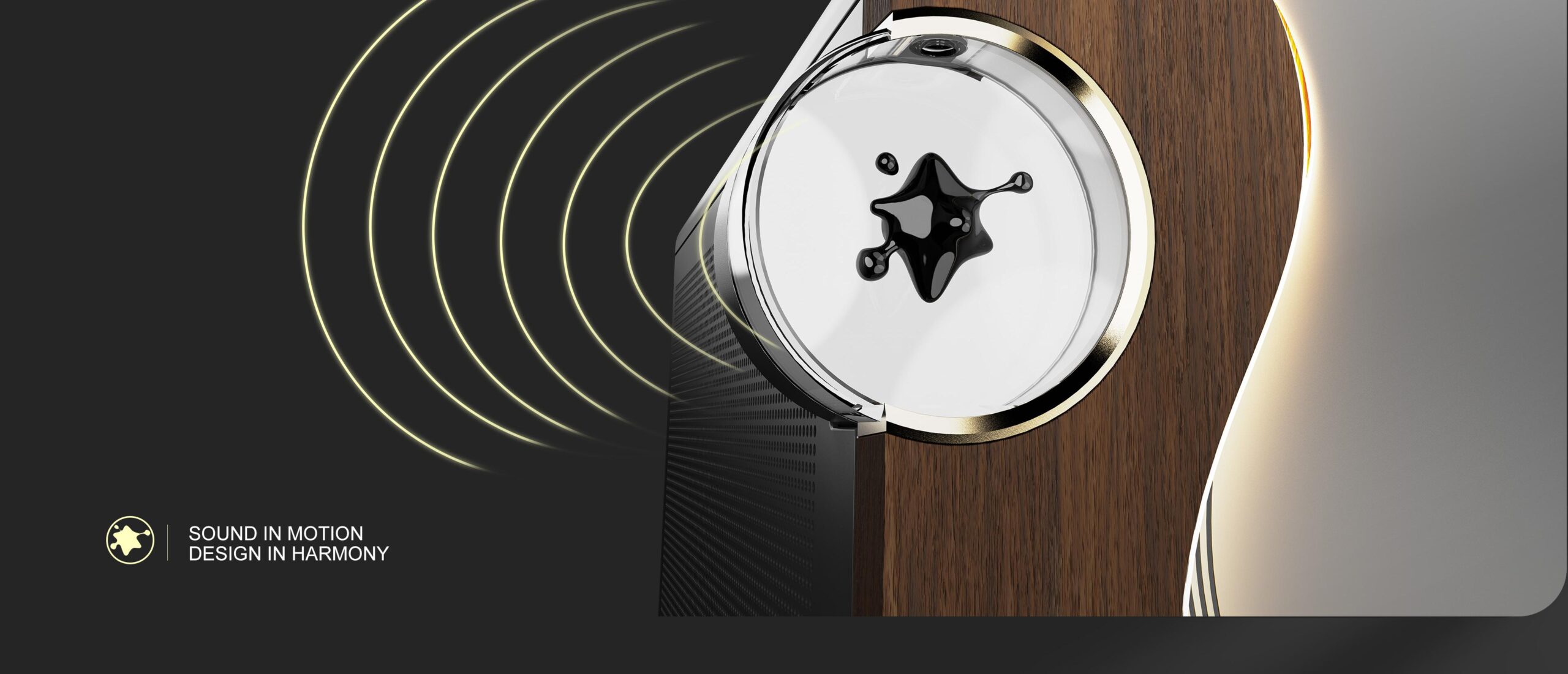
Amiiba did not show just one concept. It introduced several product lines—from air and liquid coolers to fans, cases, and peripherals, all sharing ferrofluid modules in various forms. Whether such an approach will catch on remains to be seen. From a functional standpoint, ferrofluid brings virtually no advantage, but among this year’s Computex novelties it is undoubtedly one of the more original ways to stand out from the competition.
Einarex: “Wood” on a Cooler
The new generation of the HaloX liquid cooler attracted attention. At first glance it features a classic display on the pump block, but the structure itself is more interesting. The pump cover is hollow, forming a kind of frame around the display instead of a traditional solid block.

Another novelty was air coolers with decorative elements imitating wood. Wood is appearing more and more often in PC components, but on CPU coolers it remains relatively unusual (even though we’ve seen it before).

As with Einarex’s implementation, it’s not a functional element but an aesthetic addition meant to better fit builds oriented toward natural materials.
TRYX: After Crossflow Comes “Holography”
TRYX is no longer a complete newcomer, and we’ve covered the brand on HWCooling. Since entering the market, it has tried to define itself through unconventional solutions meant to distinguish the manufacturer from the crowded competition. However, bold concepts don’t always deliver the expected results. A good example is the Crossflow fan introduced last year. The cross‑flow airflow concept generated a lot of interest, but some tests did not confirm a significant benefit over classic axial fans.
That didn’t discourage TRYX from further experimentation, although this time it’s not about performance but design. At Computex 2026, it introduced a new generation of Panorama and Flova liquid coolers, whose main attraction is what the manufacturer calls the first holographic display integrated into a pump block. It’s not a hologram in the true sense, but a spatial image created by combining transparent layers and optical elements. The resulting effect appears more convincing than a traditional LCD display.
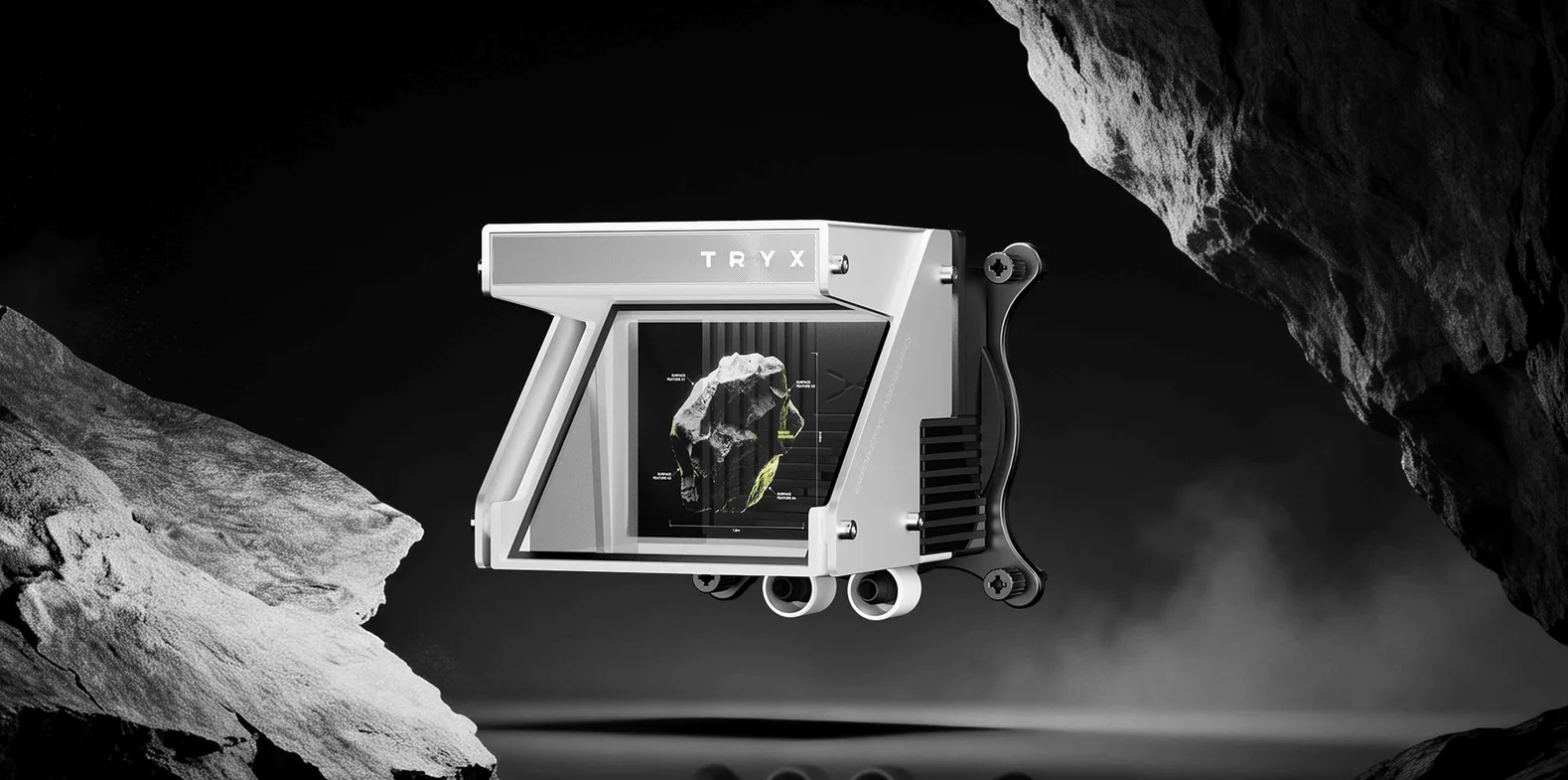
Alongside the coolers, TRYX also introduced the new LUCA Compact case. It’s a more compact panoramic design supporting BTF‑type motherboards and similar rear‑connector PCB layouts. In this case, however, the manufacturer opted more for an evolution of an existing concept rather than a major structural innovation.

Computex 2026 once again showed that interesting ideas don’t originate only in the booths of the biggest manufacturers. Whether tilting fans, ferrofluid, or holographic displays become dead ends in development or appear in future products remains to be seen. Even solutions that ultimately don’t catch on bring something new—and hopefully something interesting.
English translation and edit by Jozef Dudáš


