


Nvidia’s clearly intended the DLSS 5 game AI image-enhancement technology to be exclusive for GeForce GPUs—as with previous DLSS versions—if not outright a “vendor lock-in” to stifle competition. Ironically, it currently seems to be the DLSS tech easiest to get running on competing hardware, hough actual practical viability of the unofficial ports remains unclear. And modders have now managed to get it running on Intel GPUs as well.
Shortly after the official release of DLSS 5 (which was preceded by a leak of the relevant libraries roughly a week before), a software project emerged that gets the entire filter and the AI model it is based on running on AMD graphics cards with RDNA 3 and 4 architectures. It turns out that Intel’s Arc GPUs may not be left out either. A project by a developer using the nickname Uzbekunknown has appeared on Github under the name “DLSS-NR-on-Intel”, with precisely the goal that is stated in its name.
This project does not work directly with Nvidia’s existing code, but is a reimplementation of the entire DLSS 5 filter (or “neural rendering”, as Nvidia calls it) running natively on Intel GPUs, specifically on those based on the Xe2 (“Battlemage”) architecture. At the same time, it should use Nvidia’s original trained model, while the algorithms providing the infrastructure around it have been recreated. The code was reportedly created entirely using “vibe coding”, it’s AI-generated using of assistants such as Claude and Astra.
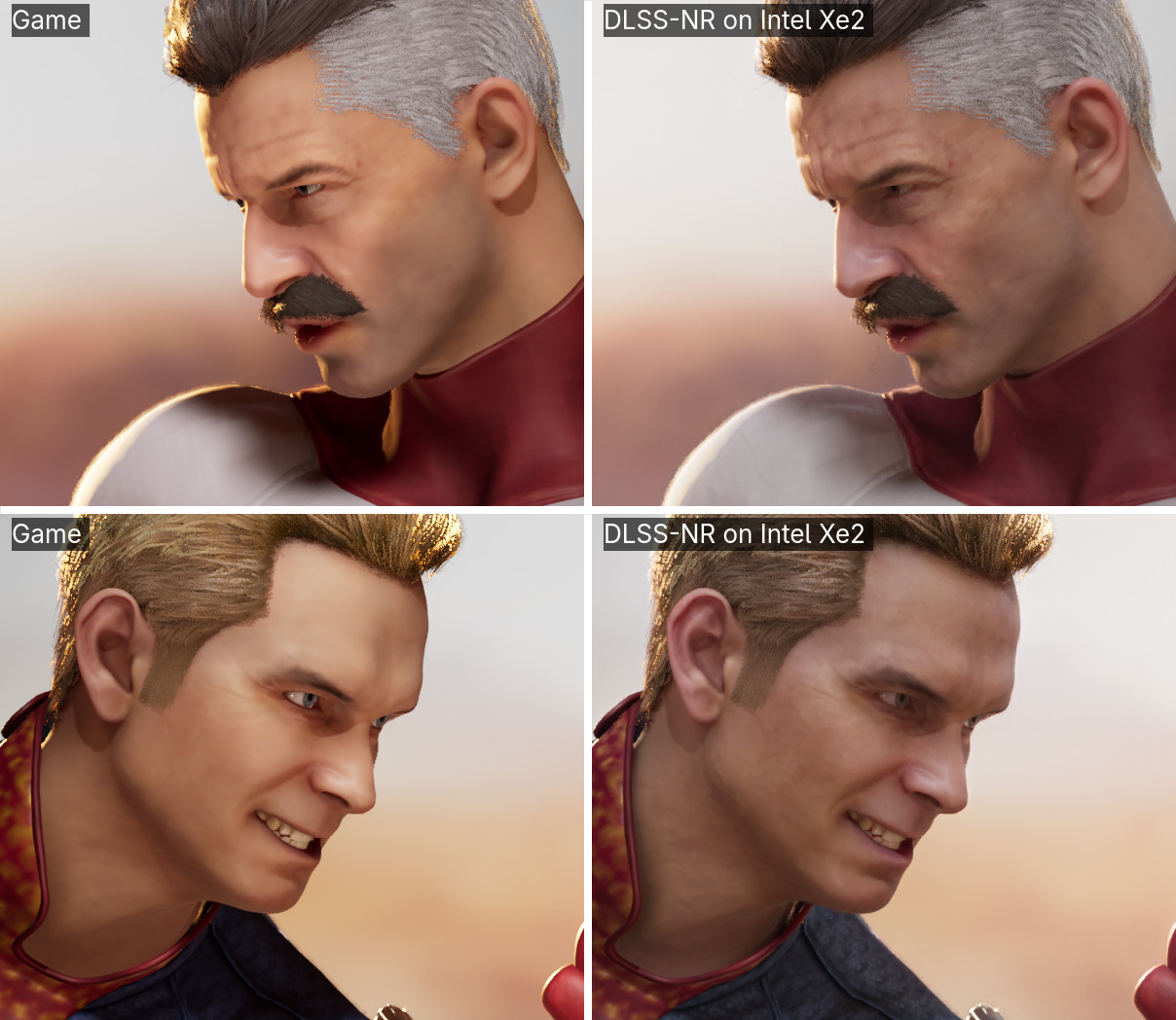
According to the author, the goal of the project is experimentation rather than providing something resembling a “product”. It is therefore a question of whether this code will ever eventually turn into something that Intel Arc graphics card owners could actually use. The reimplementation does not yet produce fully exact results, and performance is also quite low. On the integrated Intel Arc 140V GPU (which is found in the low-power Intel Core Ultra 200V “Lunar Lake” processors for notebooks), the frame rate reaches just 10.5 FPS when rendering a truly minimal resolution (640 × 360 pixels). This is a figure measured in Tekken 7.
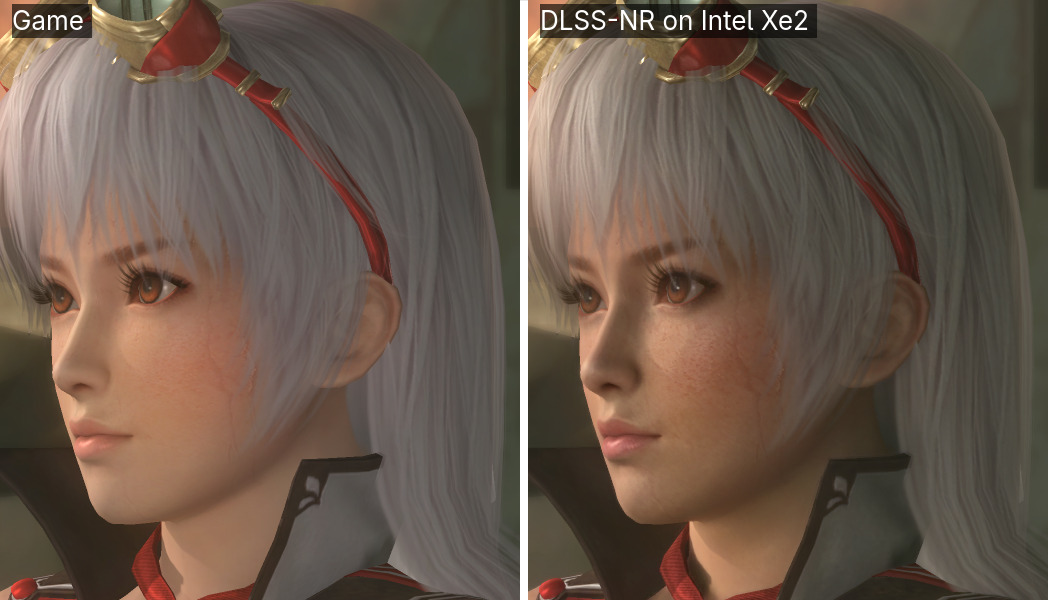
According to the project description (which is also AI-generated), the code should work not just on the integrated Arc graphics in Lunar Lake SoCs, but also on discrete GPUs—namely the Arc B580 and Arc B570 graphics cards—but testing requires Linux and using a Python environment. It is also necessary to obtain the original DLSS 5 files from Nvidia, for example from a game that includes them. For obvious reasons, the authors of these mods cannot distribute these files containing the AI model itself.

AI assistants have generally enabled various programmers (and even less technically proficient users) to create relatively large hobby software projects, which can be seen in many different areas, but this approach has its limits. Vibe coded projects may have various details left unfinished or containing bugs, and for them to remain viable, it is probably still necessary for a human developer to oversee the codebase and its development and to actually understand the “slop” code and be familiar with how it works so that they can maintain and develop it over the long term.
If a practical port of DLSS 5 to Intel GPUs is to emerge, it will therefore probably have to be backed by someone with a genuine long-term interest in the project who is willing to pursue this goal over the long term—whether an individual or perhaps a development team. Projects that are merely experimentation making use of AI assistants’ ability to quickly produce relatively extensive code (but with possible rough edges or internal issues) requiring only minimal human effort, often remain just that: experiments that are eventually abandoned.
Nevertheless, even the proof of concept provided by such a project can serve as inspiration for more serious attempts, because it shows that the idea in question can actually be implemented.
Sources: GitHub, VideoCardz
English translation and edit by Jozef Dudáš
#10240;⠀

