

While most manufacturers focus on more expensive models, Gainward also puts effort into graphics cards for customers who value performance per dollar over premium features. And even though its basic models can’t match the noise or temperature levels of pricier cards with coolers twice the size, they often hold their own against mid-range models. The same goes for the RTX 5060 Ti Python III, priced at a suggested 429 USD.
Fan behavior, noise level
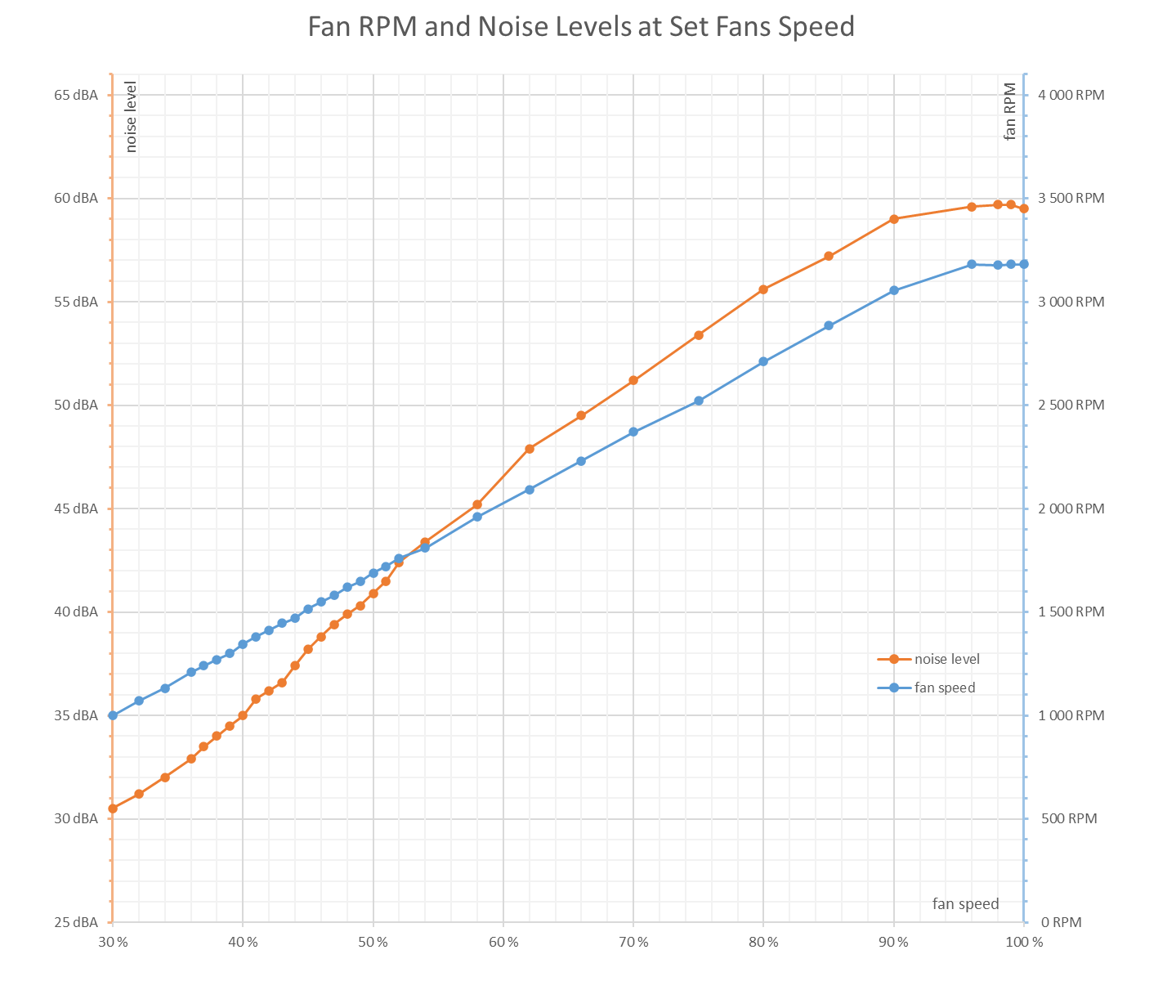
The card is equipped with three small fans. Smaller blade surfaces mean they generate less aerodynamic noise at the same RPM compared to large fans. In terms of design, they fall into the more budget-friendly category, which becomes apparent in their uneven acoustic behavior at higher speeds.
Under low load, the card is passively cooled with the fans switched off. With manual control, you can set fan speed between 30–100%. At the minimum 30%, the fans spin at 1300 RPM and the sound level meter registers 32.6 dBA. At minimum RPMs, they’re quiet, though the bearings or motors aren’t entirely inaudible. However, under light load, this isn’t an issue as the fans remain off.
At full speed, the cooler hits around 3600 RPM and 60.4 dBA.
Under sustained load, the fans reach around 1850 RPM, with the sound level meter indicating about 39.8 dBA. In terms of noise, this is rather average. For a 180 W card, it’s not great, but considering this is an entry-level model expected to retail close to the MSRP, it’s not all that bad either.
Only when manually increasing the rear fan speed past 2200 RPM does something on the cooler begin to resonate, producing a fluctuating irregular tone. This can be mitigated by covering part of the perforation at the rear, though it may be an issue specific to this particular unit.
Cyberpunk 2077, RT Medium, 3840 × 2160
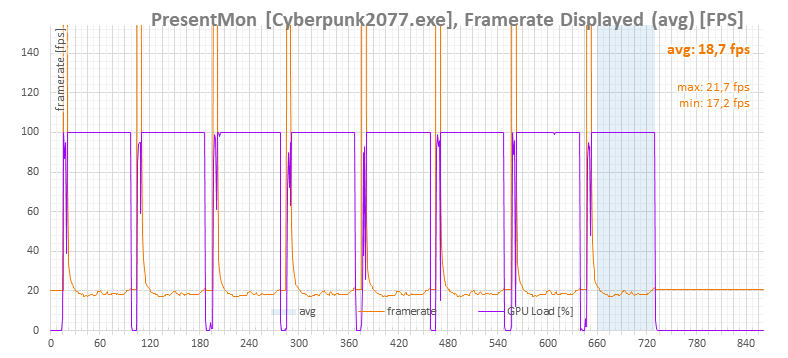
The first set of measurements is from the Cyberpunk 2077 benchmark with RT Medium settings at a resolution of 3840 × 2160 pixels. With this setup, the GPU is under full load. The test consists of eight consecutive benchmark runs.
The graph always shows the final run, from which the average value for the warmed-up card is calculated.
The GPU clock speed fluctuates between 2685 and 2707 MHz, averaging at 2702 MHz.

The card maintained operation just a few watts shy of the 180 W power limit throughout the test.
The dark color in the graph represents the total system power consumption measured with a UT71E multimeter. The total system draw (dark green) under load is excellent compared to what we typically see with higher-end cards. However, keep in mind that at lower resolutions, power consumption may be slightly worse due to increased CPU load.

Average GPU temperatures peaked at a pleasant 71.3 °C during testing. According to monitoring data, memory temperatures were a few degrees higher but still within a safe range. Given these temperatures, the fans could have possibly run a bit slower, which would have made the card quieter.

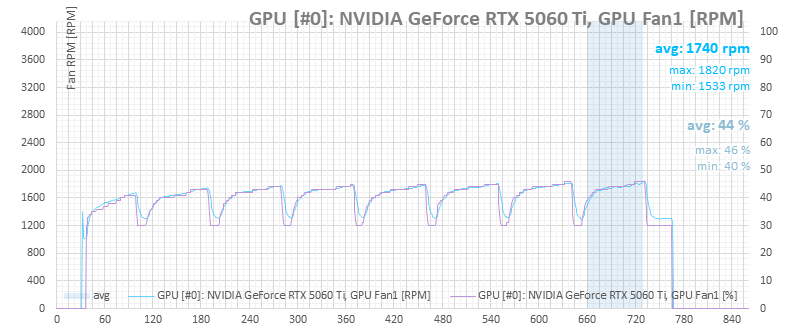
In Cyberpunk 2077 benchmark testing, the duration of each loop prevented the fans from reaching the same high RPMs as in later tests. They peaked around 1820 RPM.

⠀