While most manufacturers focus on more expensive models, Gainward also puts effort into graphics cards for customers who value performance per dollar over premium features. And even though its basic models can’t match the noise or temperature levels of pricier cards with coolers twice the size, they often hold their own against mid-range models. The same goes for the RTX 5060 Ti Python III, priced at a suggested 429 USD.
Operating characteristics – F1 24
The next tests are from the F1 24 benchmark at 3840 × 2160 resolution with Ultra settings. This benchmark consists of five laps on the Singapore map in wet conditions. Unlike other benchmarks, it applies continuous load – there is no reduction in stress between loops, and the card remains heated throughout.
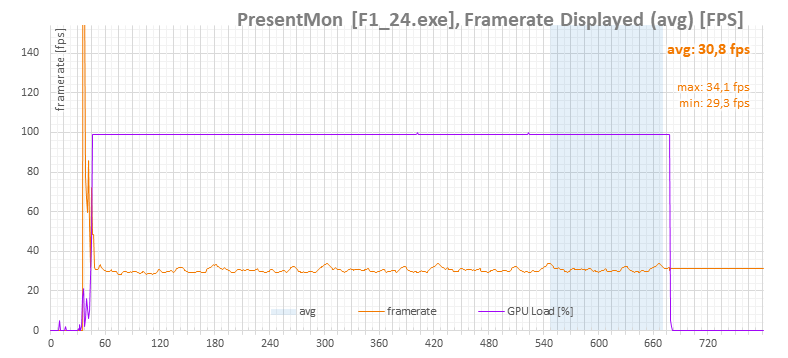
Clock speeds differed from Cyberpunk 2077 by only a few megahertz, averaging at 2697 MHz and remaining fairly stable. This suggests that clock speeds are not primarily limited by power, but rather by other constraints (such as GPU voltage).
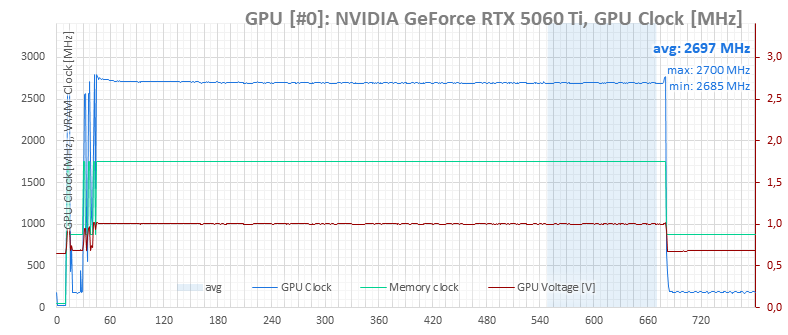
This is evident in the card’s monitored power consumption values (light green). Here, power draw oscillates between 169 and 176 W.

Temperatures of both the GPU and memory remained good even under sustained load.
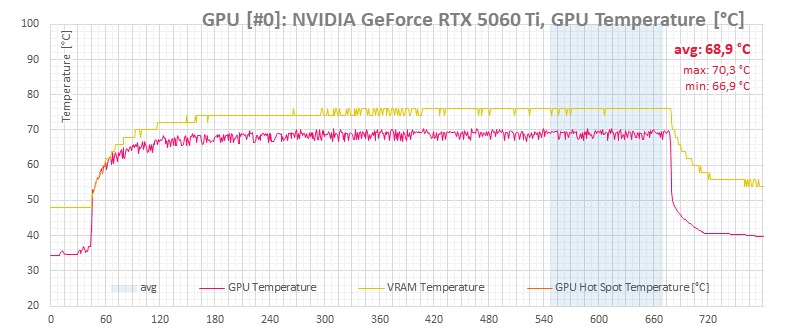
Once warmed up, the fans increased slightly to 1850 RPM.

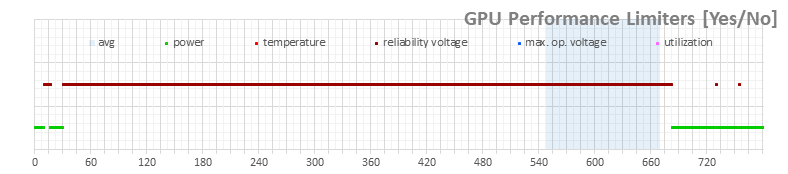
According to diagnostics, the primary limiting factor appears to be the GPU voltage cap.
⠀