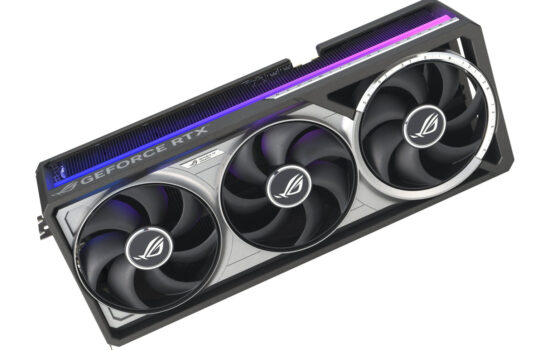


A few days ago, we reported that the previously canceled GeForce RTX 5080 Super card is once again on track for launch. It was expected to be the fastest model in the Blackwell refresh lineup, but Nvidia is apparently preparing another model above it. However, it will not officially carry the “Super” designation, since it will be a cut-down sibling of the flagship GeForce RTX 5090. As such, it could prove to be an attractive card for gamers.
With the GeForce RTX 5000 generation (and the previous generation as well), Nvidia did not base more than one graphics card on the flagship GPU in its lineup. While most GPUs are offered both as an expensive fully enabled (or nearly fully enabled) version and a somewhat cut-down, less expensive version (for example, the RTX 5080 and RTX 5070 Ti based on the GB203 GPU), Nvidia did not bother doing the same with the flagship GB202 chip and used it only only in the expensive GeForce RTX 5090 in the gaming portfolio, despite the large performance gap this has opened between it and the RTX 5080. According to information from GameGPU, the company is now planning to fill that gap with a new RTX 5090 SE model.
The GeForce RTX 5090 SE is said to use a cut-down version of the GB202 GPU with 110 SM blocks enabled out of 192 (57%), for a total of 14,080 shaders based on the Blackwell architecture. By comparison, the GeForce RTX 5090 has 170 SMs enabled (88.5%, 21,760 shaders). This configuration also means 110 RT cores and 440 Tensor cores. At the same time, the memory bus would be reduced to 384 bits and the L2 cache to 80 MB, compared to the RTX 5090’s 512-bit bus and 128 MB of L2 cache. The number of ROPs is not yet known.
The odd part is that the GeForce RTX 5090 SE is reportedly set to launch with 32GB of GDDR7 memory running at an effective 28,0 GHz speed, just like the GeForce RTX 5090—even though a 384-bit memory bus normally cannot support such a capacity. Assuming this is not an error, the only explanation would be the use of a problematic mixed-capacity memory configuration, where part of the memory consists of 16 Gb chips as on the RTX 5090, while the remainder uses 24 Gb GDDR7 chips.
In practice, this could be achieved by equipping four of the twelve memory chips (forming a 384-bit memory interface) with 16 Gb (2 GB) devices, providing 8 GB of memory. The remaining eight chips would be 24 Gb (3 GB) devices, contributing another 24 GB, for a total capacity of 32 GB. However, this comes with significant drawbacks because memory accesses rely on interleaving (similar to RAID 0 striping across storage drives) between the individual chips for reads and writes. Due to the differing capacities, though, full interleaving cannot be maintained across the entire memory space. As a result, only the first 24 GB would offer full bandwidth, since that portion can be interleaved across all twelve chips. Once memory accesses reach the capacity provided by the larger 24 Gb chips (that is, addresses between the 2 GB and 3 GB portions of those chips), interleaving is possible only across those larger chips.
The memory subsystem therefore behaves non-uniformly—the first 24 GB has a 384-bit bus width (providing a bandwidth of 1,344 GB/s), while the remaining 8 GB operates over a 256-bit bus (with bandwidth reduced to just 896 GB/s). In games, which typically allocate smaller amounts of memory, this may not be a major issue initially, provided the drivers manage memory intelligently. Nevertheless, some performance penalties could be associated with this design.

The performance difference compared to the RTX 5090 will likely be substantial, although the reduced number of compute units will probably be partially offset by higher clock speeds for the remaining ones. The card is also expected to carry a fairly high price tag, reportedly 1,500 USD—the same launch price Nvidia charged for the flagship Ada Lovelace model, the GeForce RTX 4090, in 2022, and roughly three-quarters of the GeForce RTX 5090’s official launch price in 2025. In retail, however, RTX 5090 prices have generally climbed much higher—often to double that amount or even more—because companies and professional users are buying them for AI workloads (and Nvidia, naturally, doesn’t complain about the higher revenues resulting from demand inflating prices).
It remains an open question whether real-world prices for the GeForce RTX 5090 SE will also become significantly inflated in a similar manner, given the appeal of its 32 GB memory capacity for AI applications—even with its less-than-ideal implementation. Perhaps Nvidia would have been better off equipping the card with 24 GB of memory and a lower price (or alternatively more compute units) instead, which would have been a better compromise for gaming and reduced this risk. It is possible, however, that Nvidia has AI users more in mind than gamers with this card.
500 W of power consumption
The GeForce RTX 5090 SE is also said to retain fairly high power consumption despite the substantial reduction in compute units. Its TDP is reportedly 500 W. At least some custom models can be expected to ship factory overclocked, however, meaning that cards actually sold at retail may have even higher TDP ratings. As a result, this card will most likely continue to carry a risk of the 12V-2×6 power connector overheating and melting, albeit with a somewhat lower probability. That is, unless Nvidia allows these models to use power delivery via three 8-pin connectors instead. Most likely, however, the cards will reuse the PCB and cooling solutions designed for the RTX 5090, including the problematic 12+4-pin power connector.
Since this report comes from a less well-known and less established source, it is best to treat the information with a grain of salt for now. It should also be noted that Nvidia changes its plans fairly frequently, so even if the card is indeed under development, there is no guarantee that the company will ultimately bring it to market.
Sources: GameGPU, techPowerUp
English translation and edit by Jozef Dudáš
⠀