GeForce RTX 5070 Gaming OC 12G represents a mid-range model from Gigabyte’s RTX 5070 lineup. Thanks to its large, efficient cooler and dual BIOS with a silent mode, fan speeds hover around 1500 RPM under load, keeping the cooler quieter than most current cards. It also features prominent ARGB LED lighting and a sturdy metal anti-sag brace included in the accessories.
A detailed description of the new technologies brought by Nvidia’s new graphics cards has been compiled by Jan Olšan in the article Blackwell: GeForce RTX 5000 architecture and innovations. It introduces the individual graphics chips Nvidia is using in the new cards, the new GDDR7 memory type, and also covers changes in cache memory, GPU compute units, updates to shaders and tensor cores, as well as improved compute units for ray tracing. The new generation of GeForce also brings support for new standards such as DisplayPort 2.1b and PCI Express 5.0.
With the new generation of cards, DLSS capabilities are evolving as well. It now supports Multi Frame Generation, which allows the generation of up to three intermediate frames, and introduces Nvidia Reflex 2, the second generation of its latency-reduction technology. This includes Frame Warp, which adjusts object and camera motion in rendered frames based on the player’s most recent input device movement data received just before the already rendered frame is displayed. A more detailed explanation can be found in the aforementioned article.
The GeForce RTX 5070 uses Nvidia’s third released chip based on the Blackwell architecture. It carries the code name GB205 and comes equipped with 6144 stream processors, 192 texture units, and 80 raster units. Unlike higher-end models with a 256-bit bus and 16 GB memory, it features a narrowed 192-bit memory bus, resulting in a reduced total memory capacity of 12 GB.
For a detailed comparison of RTX 5070 specifications with similar GeForce models, refer to the table below. We now turn our attention to the Gigabyte card itself.
| RTX 5070 Ti | RTX 5070 | RTX 4070 Ti Super | RTX 4070 Ti | RTX 4070 | |
| Shader cores | Blackwell | Blackwell | Ada Lovelace | Ada Lovelace | Ada Lovelace |
| Nvidia CUDA cores (SP) | 8960 | 6144 | 8448 | 7680 | 5888 |
| RT cores | 133 TFLOPS | 94 TFLOPS | 102 TFLOPS | 93 TFLOPS | 67 TFLOPS |
| Tensor Cores | 1406 AI TOPS | 988 AI TOPS | 706 AI TOPS | 641 AI TOPS | 466 AI TOPS |
| Boost Clock | 2,45 GHz | 2,51 GHz | 2,61 GHz | 2,61 GHz | 2,48 GHz |
| Base Clock | 2,3 GHz | 2,16 GHz | 2,34 GHz | 2,31 GHz | 1,92 GHz |
| Memory | 16 GB GDDR7 | 12 GB GDDR7 | 16 GB GDDR6X | 12 GB GDDR6X | 12 GB GDDR6 12 GB GDDR6X |
| Memory Bus Width | 256-bit | 192-bit | 256-bit | 192-bit | 192-bit |
| Memory Bandwidth | 896 GB/s | 672 GB/s | 672 GB/s | 504 GB/s | 504 GB/s |
| Max. resolution | 4K at 480Hz or 8K at 120Hz with DSC | 4K at 480Hz or 8K at 120Hz with DSC | 4K při 240 Hz at 8K or 60 Hz with DSC, HDR | 4K at 240 Hz or 8K at 60 Hz with DSC, HDR | 4K at 240 Hz or 8K at 60 Hz with DSC, HDR |
| Standard Display Connectors | 3× DisplayPort, 1× HDMI | 3× DisplayPort, 1× HDMI | 3× DisplayPort, 1× HDMI | 3× DisplayPort, 1× HDMI | 3× DisplayPort, 1× HDMI |
| PCI Express | Gen 5 | Gen 5 | Gen 4 | Gen 4 | Gen 4 |
| Nvidia Encoder | 2× 9th gen. | 1× 9th gen. | 2× 8th gen. | 2× 8th gen. | 1× 8th gen. |
| Nvidia Decoder | 1× 6th gen. | 1× 6th gen. | 1× 5th gen. | 1× 5th gen. | 1× 5th gen. |
| length | by manufacturer | 242 mm | by manufacturer | by manufacturer | 244 mm |
| width | by manufacturer | 112 mm | by manufacturer | by manufacturer | 112 mm |
| height | by manufacturer | 2 slots | by manufacturer | by manufacturer | 2 slots |
| Total Graphics Power | 300 W | 250 W | 285 W | 285 W | 200 W |
| Supplementary Power Connectores | 2× 8pin PCIe (adapter) or 1× 300 W PCIe Gen 5 | 2× 8pin PCIe (adapter) or 1× 300 W PCIe Gen 5 | 2× 8pin PCIe (adapter) or 1× 300 W PCIe Gen 5 | 2× 8pin PCIe (adapter) or 1× 300 W PCIe Gen 5 | 2× 8pin PCIe (adapter) or 1× 300 W PCIe Gen 5 |
Gigabyte GeForce RTX 5070 Gaming OC 12GB
The tested GeForce RTX 5070 Gaming OC, designated GV-N5070GAMING OC-12GD, sits roughly in the middle of Gigabyte’s RTX 5070 lineup. Below it are cards from the Eagle and WindForce series; on a similar level is the Aero model, and topping the range is the Aorus GeForce RTX 5070 Master 12G.

This card comes factory overclocked. The listed typical boost clock is raised from the reference 2570 MHz to 2662 MHz. Actual clocks may be even higher, depending on load and chip power consumption. Detailed clock speed behavior can be found in the operating characteristics sections of this review.
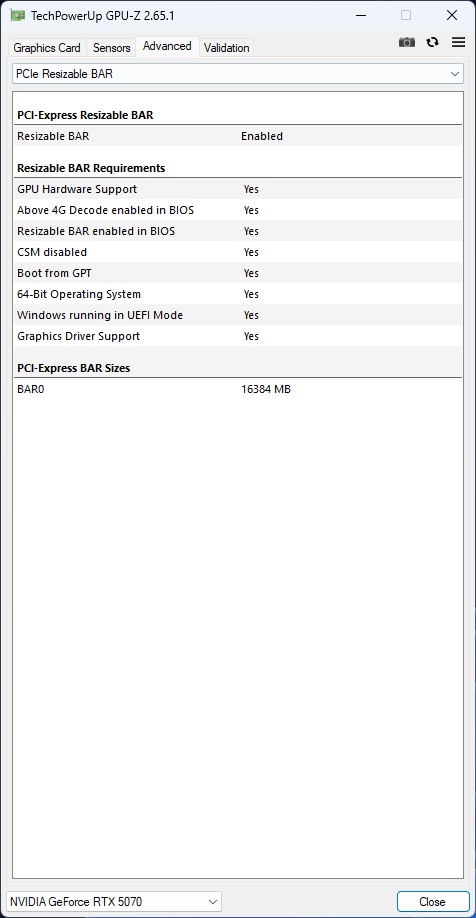
The card includes two BIOS modes, labeled Performance and Silent. By default, it runs in Performance mode, but users can switch to Silent via a switch next to the power connector. The GPU-Z screenshots below first show the specs and BIOS data in Performance mode, followed by Silent. Core specs such as clock speeds or power limits are identical in both BIOSes. The key difference lies in the fan speed curve, adjusted according to temperature sensors on the card.
In both BIOS modes, the boost clock is raised from the reference 2512 MHz to 2625 MHz, while GDDR7 memory runs at the standard 28 Gb/s.

The power limit is set to the reference 250 W, but it can be adjusted within a range of 175–300 W, or -30% to +20%. In monitoring tools, the card’s three fans are divided between fan 1 and fan 2 interfaces, with two fans connected via a splitter.


The latest beta version of HWiNFO provides more data from the card than GPU-Z. Monitoring sensors available are visible in the included screenshot.

In Silent mode, the only visible difference in GPU-Z data is the BIOS version label; all other parameters remain unchanged.



The rear of the packaging highlights the features and technologies utilized by the card. Gigabyte emphasizes the card’s exterior with strong lighting. In addition to the logo, translucent rings around the fan cutouts are illuminated by ARGB LEDs. The card is equipped with a Windforce cooling system featuring a new generation of proprietary fans. The cooler uses composite heatpipes and a large coldplate that covers both the GPU and memory. Much of the heatsink is left open for airflow. The rear metal backplate, with bent edges and attachment to the mounting bracket, reinforces the card.


The included accessories comprise the usual leaflets and quick installation guide, a power adapter with two traditional 8-pin connectors to one 16-pin 12V-2×6 connector, and most notably, an adjustable anti-sag bracket. This helps prevent PCB damage that can occur with heavier cards where most of the weight rests on the PCI Express slot.

⠀