The last of the dozen ATX 3.0 PSUs that we’ll be looking at in comparison tests is the Gigabyte GP-UD850GM PG5W. We have this one available in the “rarer” white variant, and if there’s anything else these Gigabyte (UD850GM) PSUs have going for them, it’s an attractive price. It is decidedly the cheapest PSU we will test. And among other things, it also has a smaller footprint with extra compatibility.
From the outside…
The GP-UD850GM PCIe 5.0 PSUs come in several variants. Aside from revision 1, there’s then revision 2, which is also available in white in addition to black. You will come across a power supply with a white housing here and there, but it is still a bit of a rarity.

Design-wise, in terms of the housing, you’re dealing with a shorter power supply (140 mm in length) with a honeycomb-shaped grille. The walls between the cells are quite narrow though, so most of the total area is open, for ventilation.

The housing is otherwise quite simple, with no added features that would increase the price. It should be as low as possible, even one level lower than the Chieftec Polaris 3.0 (PPS-850FC) and the FSP Hydro G Pro ATX3.0 power supplies. Around 115 EUR. Efficiency is also supposed to fit into the 80 Plus Gold range.


Like all ATX 3.0 power supplies, this one also comes with the option to connect a cable with a 12VHPWR connector, or two 12VHPWR connectors – the 16-pin connector is on both ends. Gigabyte refers to it as 600-watt because it’s designed to handle a sustained 55A load.

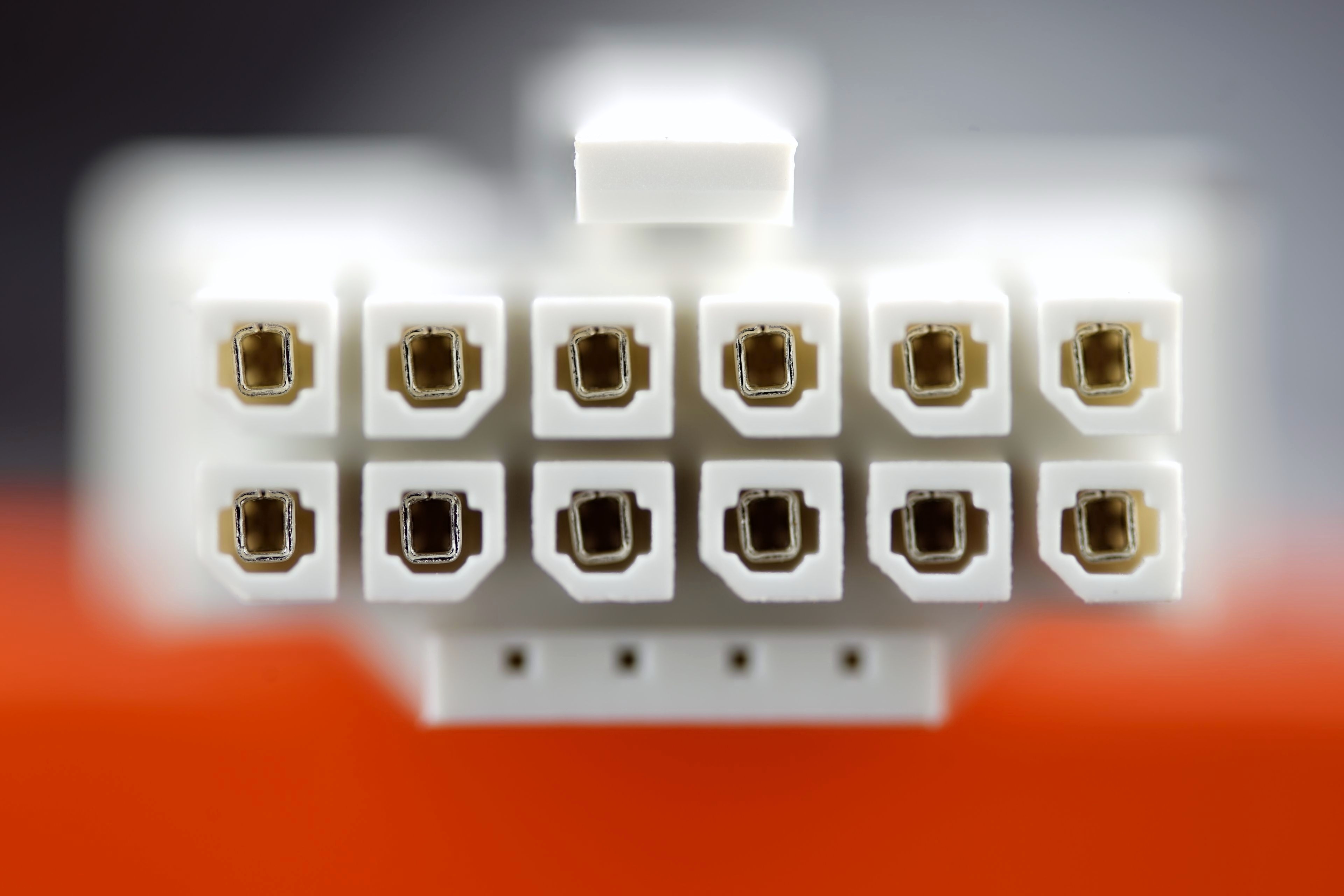

However, as with other 850 W power supplies, it should be taken into account that in the case of full power output, there is only 15.8 A left for the rest of the hardware powered by the 12-volt rail. Gigabyte clearly indicates this in the table on the sticker of the power supply, where the total current load on the 12-volt rail is indicated and then how much of it the 12VHPWR connector can safely handle to power a graphics card with an Nvidia GPU. For Radeon (and older or “weaker” GeForce) owners, the power supply has four 6+2-pin connectors. So with a margin even for the RX 7900 XTX models.

For the “PG5W” variant, all cables are white, including their connectors. Except for the 16-pin cable (with the wires retained in a mesh), all cables are flat.

… and from the inside
The power supply is cooled by a 120 mm Yate Loon D12SH-12 fan with hydraulic bearings. This fan is supposed to have a maximum (at 12V) of 2200 rpm, but it’s possible that the Gigabyte power supply won’t let it run that high. It’s not clear from the marketing materials what speeds are achieved at what loads, but up to 170W the cooling should be passive. The fan switches only after that, and in the 170–680 W range Gigabyte shows a stagnant noise level (how high, we’ll see in tests…), which is supposed to increase more significantly from 680 W upwards.
Another thing worth mentioning about the fan is that it is not a design that you would normally buy in a store. The Yate Loon D12SH-12 fan, while sold separately, is without a shield to direct airflow to the critical components that need to be cooled the most. That shield is a fixed part of the design here, so it is not a typically screw-on accessory as with the vast majority of other power supplies.

The coolers on the transformers look robust and the fins are nicely articulated. But there is always the question of whether this is more due to the fact that extra cooling is required due to lower efficiency, or whether it is oversized in this way to keep things as quiet as possible. But that will become clear from the upcoming tests.

You have seen the large capacitor Nippon Chemi-Con KMW (at 400 V, capacity 820 μF) many times on primary filtration. The secondary is more varied, combining CapXon, Taepo capacitors, and there are also Lelon RXW105 capacitors on a vertical PCB with connectors, which are supposed to feature high reliability and low resistance.


| Brand and model of the PSU | Basic parameters from the manufacturer | Price [eur] | ||||||||||
| Power output [W] | Continuous current load [A] | 80 Plus | Connectors | AWG | ||||||||
| +12 V | +5 V | +3.3 V | 16-pin * | 6+2-pin * | 8/4+4-pin | SATA | 4-pin Molex | |||||
| Gigabyte GP-UD850GM PG5W | 850 | 70.8 | 20.0 | 20.0 | Gold | 1+0× | 4+0× | 2× | 8× | 3× | 18–16 | 115 |
| SilverStone DA850R Gold | 850 | 70.5 | 20.0 | 20.0 | Gold | 1+0× | 4+0× | 2× | 8× | 6× | 18–16 | 180 |
| Corsair RM850x Shift | 850 | 70.8 | 20.0 | 20.0 | Gold | 1+0× | 4+0× | 2× | 12× | 8× | 18–16 | 190 |
| Cooler Master GX III Gold 850 | 850 | 70.8 | 20.0 | 20.0 | Gold | 1+0× | 3+0× | 2× | 8× | 4× | 18–16 | 170 |
| FSP Hydro G Pro ATX3.0 | 850 | 70.8 | 20.0 | 20.0 | Gold | 1+0× | 3+0× | 2× | 10× | 3× | 18–16 | 150 |
| Chieftec Polaris 3.0 (PPS-850FC) | 850 | 70.8 | 22.0 | 22.0 | Gold | 1+0× | 2+0× | 2× | 12× | 4× | 18–16 | 152 |
| Asus ROG Strix 850G Aura | 850 | 70.8 | 22.0 | 22.0 | Gold | 1+0× | 1+2× | 2× | 5× | 4× | 18–16 | 208 |
| Seasonic Vertex GX-850 | 850 | 70.0 | 20.0 | 20.0 | Gold | 1+0× | 3+0× | 2× | 8× | 3× | 18–16 | 200 |
| Enermax ERT850 EWT | 850 | 70.5 | 20.0 | 20.0 | Gold | 1+1× | 4+0× | 2× | 12× | 6× | 18–16 | 160 |
| BeQuiet! Dark Power 13 | 850 | 70.0 | 24.0 | 24.0 | Titanium | 1+0× | 4+0× | 2× | 12× | 3× | N/A | 250 |
| DeepCool PX1000G | 1000 | 83.3 | 22.0 | 22.0 | Gold | 1+0× | 3+0× | 2× | 7× | 4× | 18–16 | 180 |
| MSI MPG A850G | 850 | 70.8 | 22.0 | 22.0 | Gold | 1+0× | 4+2× | 2× | 7× | 4× | 18–16 | 169 |
* The number of PCI Express connectors is given as the sum of native and shared connectors (the second number after the “+” sign). Native connectors are those that are the same on both sides. Shared ones are then connected via different connectors on the power supply side, for example, a single 300-watt 16-pin (12VHPWR) is created by using two 6+2-pin connectors, and vice versa – a 16-pin connector can be used to connect a cable with two 6+2-pin connectors.
English translation and edit by Jozef Dudáš