

Gigabyte offers four Radeon RX 9060 XT models in its Gaming series. We’ll take a look at the top one – the 16GB Gaming OC model with factory overclocking. It features a Windforce cooler with three fans and delivers a step above the basics in both cooling and noise levels. It’s priced right in the middle compared to other models, and the same goes for its features – it may not match premium cards, but it’s clear that Gigabyte didn’t cut corners to save costs.
The card is equipped with a cooler featuring three fans. The heatsink shroud is made of black plastic, complemented by elements of dark gray and dark translucent plastic.


The backplate on the rear side of the PCB is metal. In the rear third, it has a large cutout that allows some of the heated air to flow through and above the card.


From above, you can see that the pass-through heatsink extends beneath the entire rear fan. The middle fan spins in the opposite direction. Where the blades of adjacent impellers meet, they don’t clash but instead push air in the same direction. As a result, the fan speeds fluctuate less and the cooler’s acoustic profile is more balanced.
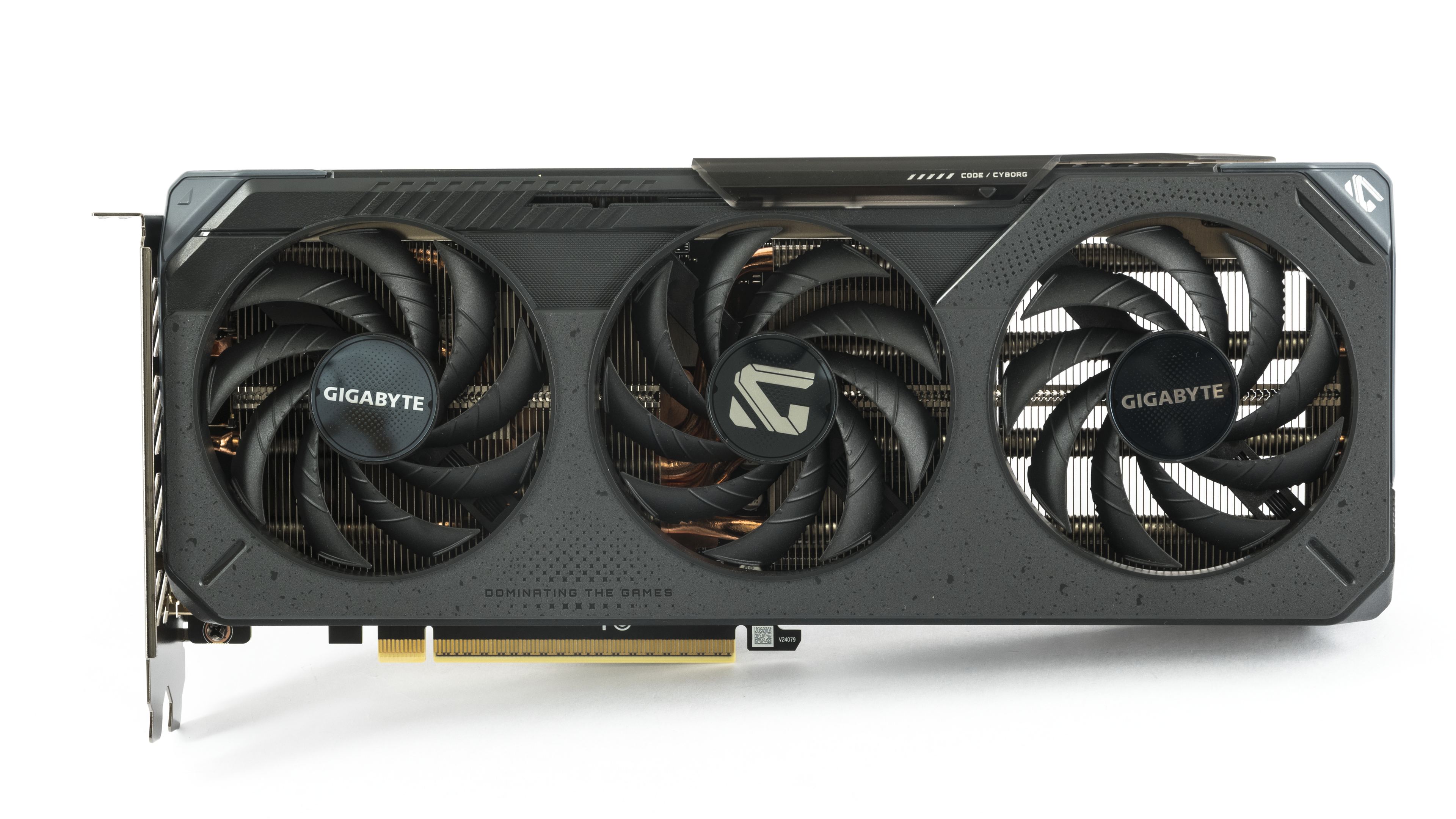

The heatsink fills most of the space under the shroud. Unlike the already tested cards from Asus or Sapphire, you’ll notice that the fins of the rear block behind the PCB are extended all the way to the backplate.


The cooler fits within the space of two slots. There are no mounting holes on the rear panel for securing the card, but the card itself is relatively compact and lightweight, so you likely won’t feel the need to screw it down at the back.


Close-ups reveal the cooling of the MOSFETs and coils on the power delivery. Heat is transferred from the MOSFETs via thermal gel to the base of the large heatsink.


The fans are tiny – keep that in mind when looking at fan speed graphs. The impeller diameter is about 75 mm, with a height of around 7 mm. They have a very low profile and narrow blades. To achieve similar airflow as fans with larger blades, they’ll need to spin faster. In other words – even at high RPMs, they will be quieter than fans with bigger blades.


On the side of the card, there’s a sliding cover made of transparent plastic that can be moved over a translucent plastic window illuminated with ARGB LEDs. You can choose whether the Gigabyte logo or just a colored strip lights up at the rear.


The card weighs only 828 g. Even though it looks large due to the three fans, it ranks among the lighter models.

The card’s length from the bracket is roughly 28.2 cm. It barely exceeds the bracket in width by even a centimeter. In height, it’s approximately four centimeters and fits within the space of two slots.


Instead of the usual four outputs, Radeon RX 9060 XT cards offer only three. Gigabyte opted for one HDMI 2.1b connector and two DisplayPort 2.1b connectors with UHBR13.5 support. Compared to RX 7000 with UHBR10, this is an improvement; compared to GeForce RTX 50 with UHBR20, it’s a slight downgrade. But for a card like the RX 9060 XT, the lower DisplayPort bandwidth won’t be an issue, as it’s not meant for 4K gaming at extreme frame rates.

For auxiliary power, a single 8-pin connector oriented with the latch facing upwards is sufficient.

We’ve covered the design, now let’s take a look at the test build and test results.
⠀