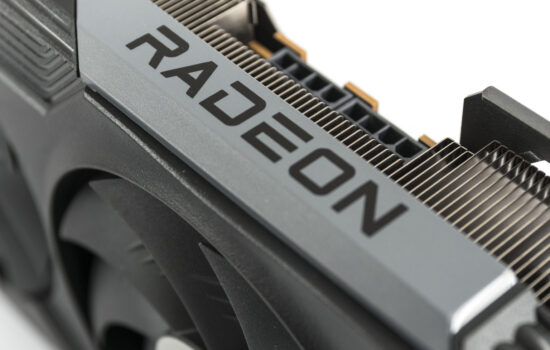
At the top of Asus’ new Radeon lineup is the TUF Gaming Radeon RX 9060 XT 16GB GDDR6 OC Edition. A large cooler with three fans, combined with a smaller, more power-efficient GPU, allows the card to deliver excellent cooling and low noise levels. It’s one of the quietest and best-performing RX 9060 XT models available. The only downside is its price, which reaches the level of entry-level GeForce RTX 5060 Ti 16GB cards.
While Nvidia has been launching one GeForce model after another for several months, AMD took a break following the release of the Radeon RX 9070 XT and RX 9070, saving the unveiling of its next RX 9000-series Radeon for Computex. There, it introduced the RX 9060 XT with the new, smaller Navi 44 chip as a competitor to the recently launched GeForce RTX 5060 Ti and GeForce RTX 5060.
The Radeon RX 9060 XT cards are designed for gaming at 1440p and 1080p resolutions. They will be available in two variants with 8 GB and 16 GB of memory. The 8 GB version is suitable for titles and settings that aren’t demanding on video memory and for lower 1080p resolution. It’s ideal for players focused on achieving high frame rates at lower graphic settings – typically how esports games are played. The more expensive 16 GB version is better suited for 1080p and 1440p gaming with high-quality graphics, including ray tracing.
The key innovations and changes that the new generation of Radeons, including the RX 9060 XT, bring compared to the RX 7000 series include:
- Improved ray tracing: The third generation of RT accelerators offers double the performance compared to the previous generation.
- Enhanced AI acceleration: Second-generation AI accelerators with significantly higher performance per unit and support for new data types such as FP8
- FidelityFX Super Resolution 4 (FSR 4): Advanced supersampling and frame generation using AI.
These new technologies and improvements introduced with the latest Radeons are discussed in more detail in our article dedicated to the RDNA4 architecture, which we published alongside the release of the Radeon RX 9070 XT and RX 9070.
We also already covered the basic specs of the Navi 44 and the RX 9060 XT at the cards’ unveiling. You’ll find the specifications in the table below, so here’s a quick summary – the new Navi 44 chip in the Radeon RX 9060 XT features 2048 stream processors, 128 texture units, and 64 raster units. The memory bus is 128 bits wide and connects the chip to either 8 or 16 GB of GDDR6 memory running at 20 Gb/s.
There likely won’t be many stock-clocked models available; that’s why the table includes specs for factory-overclocked models. Keep in mind that with higher clocks, the power limit also goes up – in the middle column is an example from XFX, whose listed power draw increases from 160 to 180 W. The specs of the 8GB variant are similar to the base 16GB version, but the listed power draw is 10 W lower.

The new Navi 44 GPU is essentially half of the Navi 48 from the higher-end Radeon RX 9070 XT in terms of compute units, memory bus width, and infinity cache size.

The Radeon RX 9060 XT cards are equipped with a PCI Express 5.0 x16 interface. In this regard, they have an edge over their direct Nvidia counterparts, which have a PCIe 5.0 interface trimmed down to just eight lanes. In certain scenarios, this could result in a smaller performance drop when the card is installed in older motherboards with PCIe 4.0 or 3.0 interfaces.
We’ll start by testing one of the base models from Sapphire, which should be available for the MSRP of 350 USD.
The next Radeon RX 9060 XT we’ll be looking at comes from Asus and belongs to the higher-end TUF series. Within Asus’ current lineup, it’s the top model – below it are two Prime series cards with 8 and 16 GB of memory and the 8GB Dual Radeon RX 9060 XT.
ASUS TUF Gaming Radeon RX 9060 XT 16GB GDDR6 OC Edition
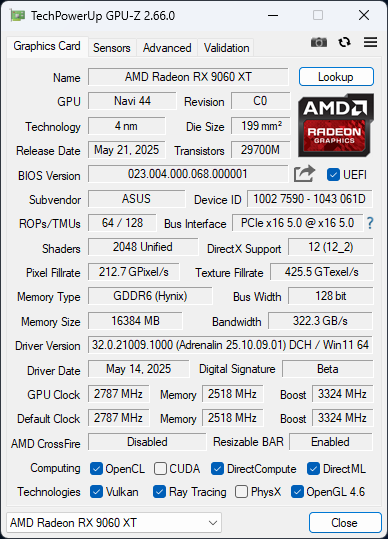
The card tested comes factory overclocked, with the game clock increased from the reference 2530 MHz to 2787 MHz and the boost clock raised from up to 3130 to 3324 MHz. The specified power draw is also noticeably higher than with the Sapphire card; according to HWiNFO, it’s 182 W.

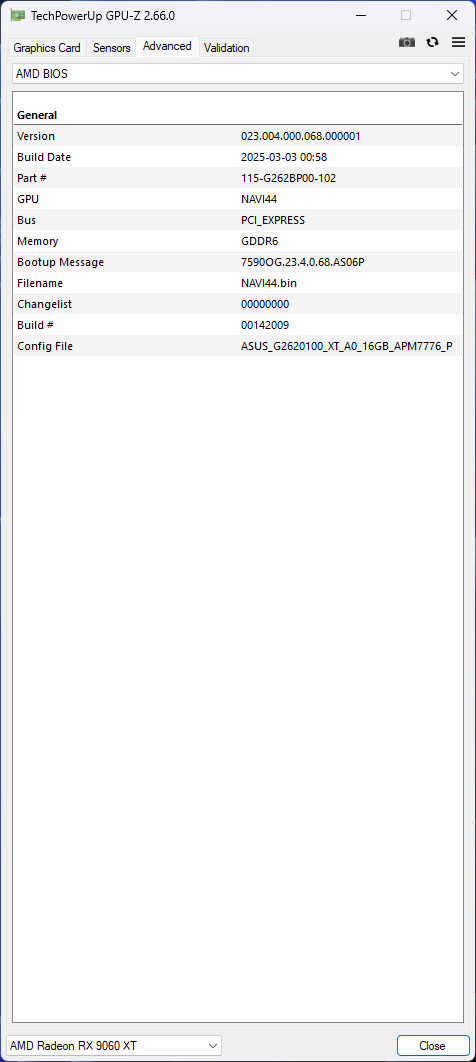
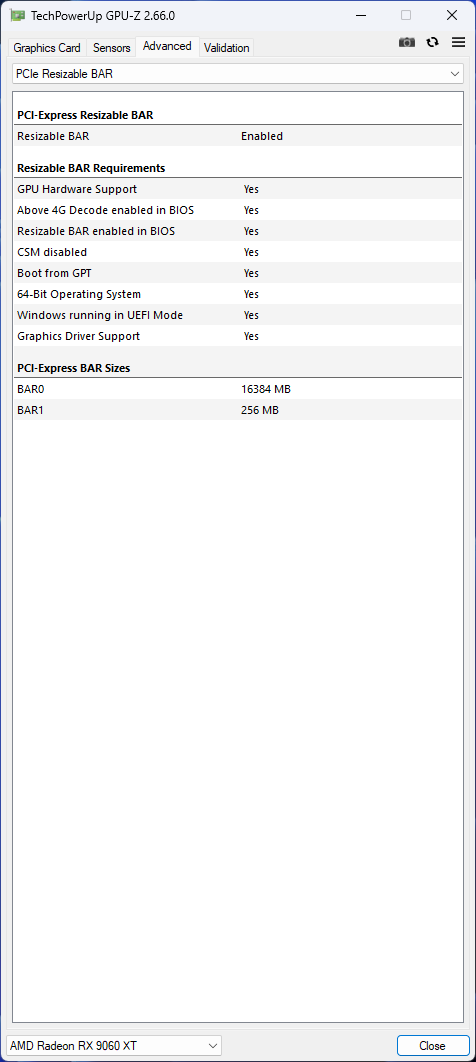
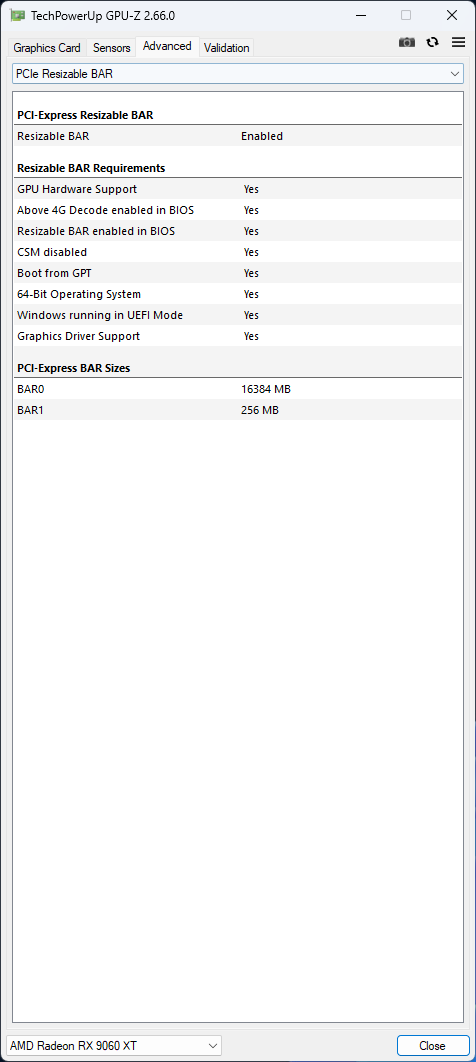
The new version of GPU-Z, version 2.66.0, already recognizes these cards. The card features a dual BIOS. By default, it operates in P mode. You can switch to Q mode, in which only the fan curve regulation differs – other parameters remain the same. Below is the first set of screenshots from P mode, followed by those from Q mode. Testing was performed in the quieter Q mode.
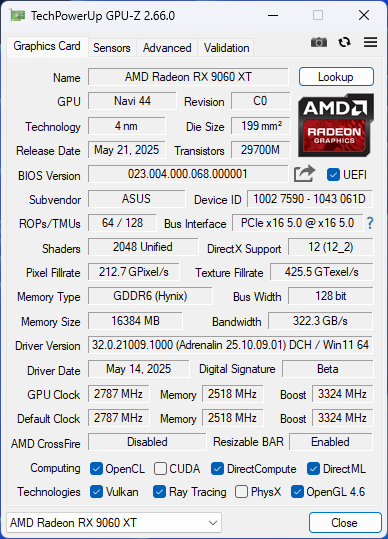
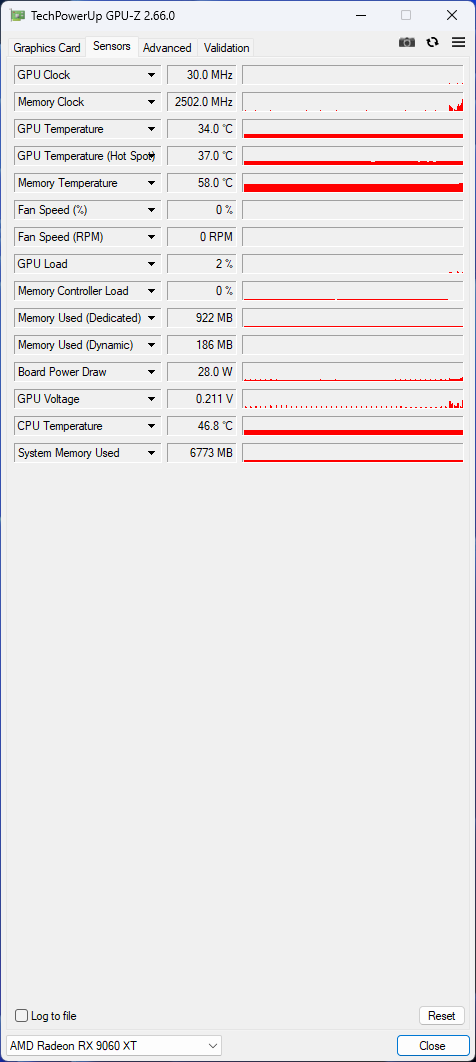
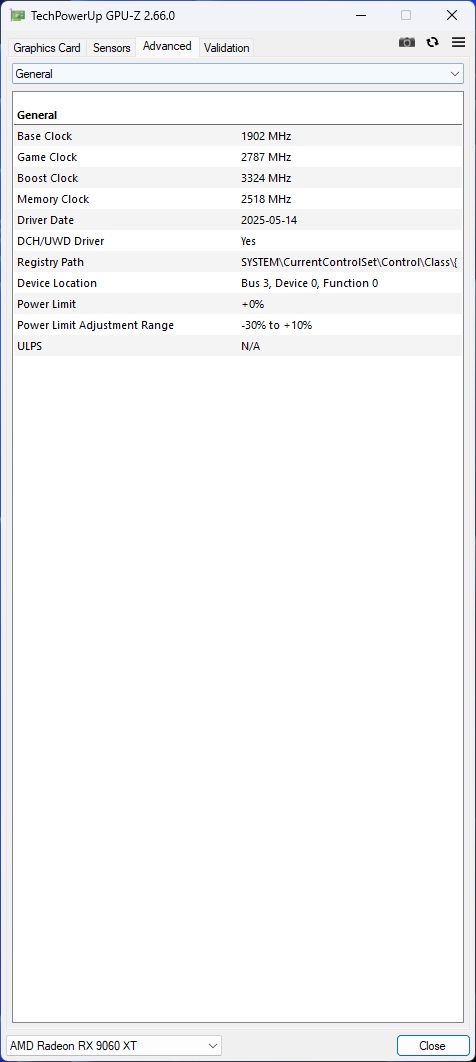
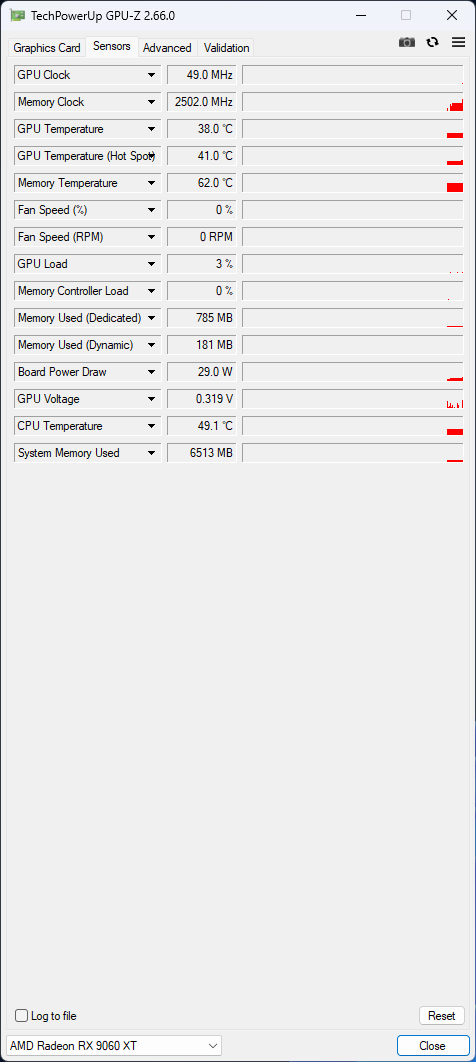
In GPU-Z monitoring, you can observe basic parameters and sensor data. All three fans are connected to a single output, so you can only track the speed of one of them. The power limit can be adjusted in a range from -30% to +10%.
HWiNFO reads significantly more data from the card than GPU-Z. The sensors currently available for monitoring are shown in the screenshot below.

Another set of screenshots from Q mode follows. You won’t see a difference in GPU-Z; only the fan control curve changes.


The difference in fan speed regulation curves depending on temperature is visible in the tuning section of the AMD software – P mode is on the left, Q mode on the right.


On the back of the box, the manufacturer highlights not only AMD’s standard features and technologies but also Asus’ proprietary ones. There’s an emphasis on durability, including the use of high-quality coils, MOSFETs, capacitors, and dual ball bearing fans. An automated production process contributes to greater reliability. The cooling system uses MaxContact technology, a backplate with a vent for better airflow, and Axial-tech fans. There’s also mention of the GPU Tweak III software for clock tuning, cooling control, monitoring, and lighting customization.


The included accessories are the usual flyers, cards, and manuals – plus a cable tie made of double-sided Velcro and a magnetic TUF badge. It’s a nice touch – if you ever tire of having it on your case, you can simply remove it without having to clean up any sticker residue.

⠀