At the top of Asus’ new Radeon lineup is the TUF Gaming Radeon RX 9060 XT 16GB GDDR6 OC Edition. A large cooler with three fans, combined with a smaller, more power-efficient GPU, allows the card to deliver excellent cooling and low noise levels. It’s one of the quietest and best-performing RX 9060 XT models available. The only downside is its price, which reaches the level of entry-level GeForce RTX 5060 Ti 16GB cards.
Fan behavior, noise level
The fan speed can be adjusted in the range of 30–100%, which corresponds to fan speeds of approximately 585–3450 RPM (28.9–51.9 dBA).
At minimum speed, the noise meter recorded 29.3 dBA, which is below its measurable range. At maximum, the noise level reached 57.4 dBA.
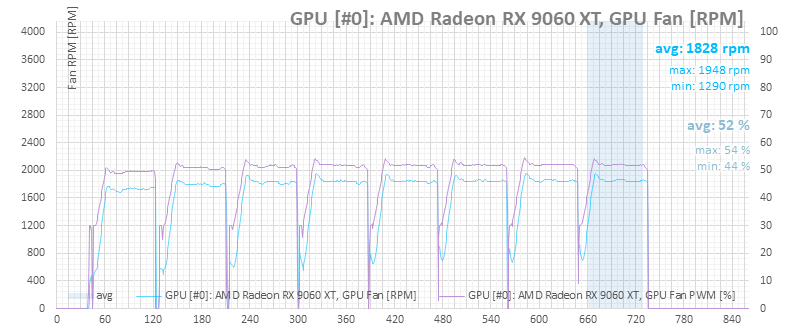
In P mode, under load in the thermal tests, the fans ran at maximum speeds ranging from 1850 to 1950 RPM. That translates to a noise level of around 40.1–42.3 dBA. These are typical values for average cards – no longer quiet, but not excessively loud either. That’s not exactly a compelling reason to pay extra for a TUF model.
But you’d probably choose a TUF card for its quiet cooling. In Q mode, it’s practically a different card in terms of acoustics. Across all tests, maximum fan speeds were between 1140 and 1200 RPM, corresponding to measured noise levels of 30.9–31.3 dBA. At this point, the cooler can be described as exceptionally quiet, although we’ve seen lower RPMs on other Asus cards. In this mode, you’re more likely to be bothered by coil whine from the power delivery than by the cooler’s fans.

Cyberpunk 2077, RT Medium, 3840 × 2160
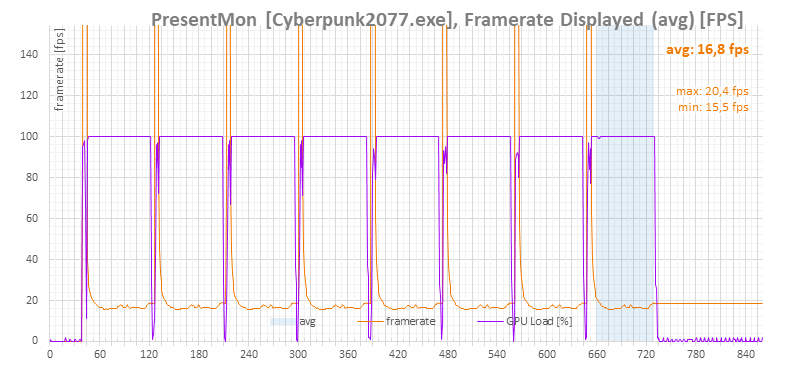
The first test data comes from Cyberpunk 2077 with RT Medium settings at 3840 × 2160 resolution. The test consists of eight consecutive benchmark loops. The graph shows the final loop, from which the average value of a warmed-up card is calculated.
Frame rates indicate that a less demanding test setup might be more appropriate for evaluating operating characteristics. Still, the GPU is fully loaded and running right at its power limit.
The clock speed of the warmed GPU ranges from 2834 to 2997 MHz, averaging at 2902 MHz.
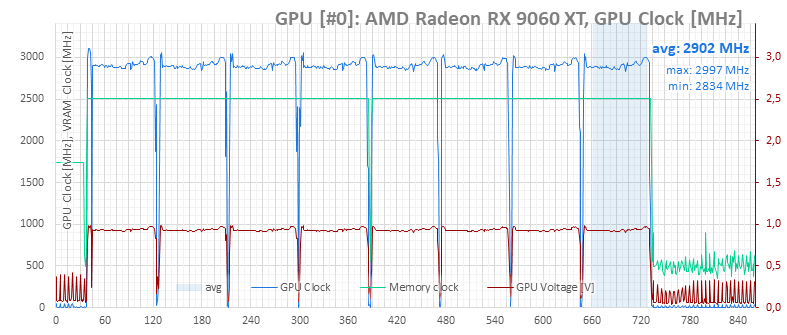
According to power monitoring (light green data line), the card stayed right at its 182W power limit.
The dark-colored line in the graph shows the total power consumption of the PC as measured by a UT71E multimeter. The average system power consumption under load was just 286.6 W, a relatively low total helped by reduced CPU load.

Higher fan speeds do help with temperatures: the GPU peaked at 54.0 °C, memory at 84 °C, and the hotspot at 76 °C during the measured section.

Still, it’s clear that the fans are spinning faster than necessary at these temps. While the cooling performance improves slightly, the difference is negligible, unlike the increased noise level.
⠀