


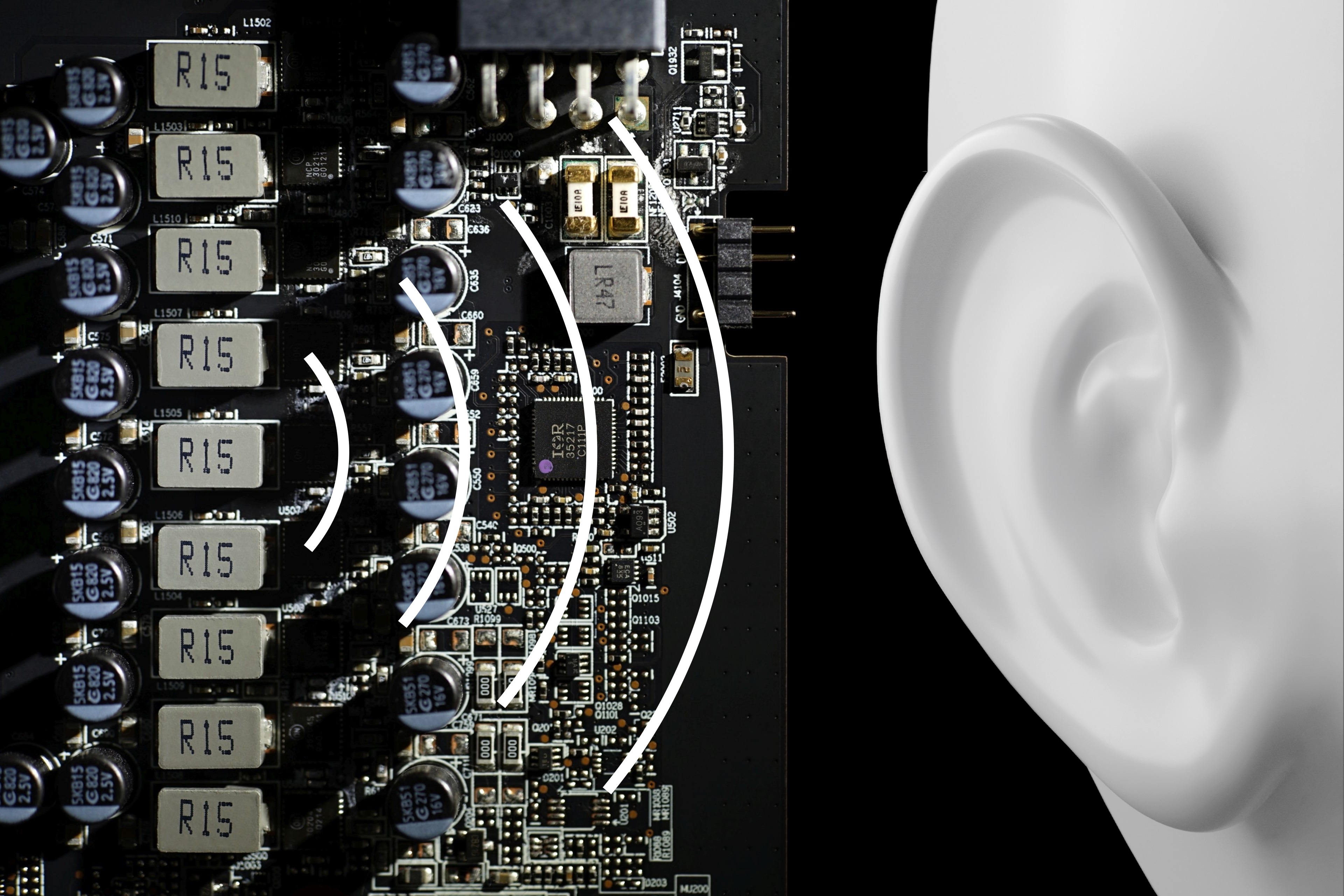
The number of graphics cards tested over the recent period has reached a number after which we can pause a bit and specifically focus on the noise level of their coils. The latter has always been recorded in standard measurements, but in large tests with lots of other information, this unique data was getting lost. That is why it will now, within the scope of this article, be limited to these only. So which of the modern graphics cards has the quieter coils?
Situation 3: CS:GO (2160p)
Thanks to a reader nicknamed “the patient“, you now also have spectrograms with a noise level scale and a Y-axis label. These elements had to be added separately, in an external application, because they were not included in the cutouts (4–20 kHz) of the complete spectrograms (20 Hz–20 kHz).


| Graphics card | Dominant sound freq. and noise level (CS:GO@2160p) | ||
| Frequency [Hz] | Noise level [dBu] | ||
| MSI RTX 3060 Ti Gaming X Trio | 6639,8 | -82,6 | |
| Gigabyte RTX 3060 Eagle OC 12G | 4305,4 | -85,0 | |
| Gigabyte Aorus RTX 4080 Super Master 16G (OC) | 5583,4 | -83,8 | |
| Gigabyte RTX 4090 Gaming OC 24G (OC) | 5747,0 | -85,8 | |
| MSI RTX 3050 Ventus 2X 8G OC | 18245,6 | -84,4 | |
| Gigabyte RTX 4060 Windforce OC 8G | 4305,4 | -79,9 | |
| MSI RTX 3070 Gaming X Trio | 6267,2 | -82,9 | |
| MSI RTX 3090 Gaming X Trio | 4561,4 | -78,9 | |
| Asus Dual RTX 4070 12G (P) | 7671,3 | -82,2 | |
| MSI RTX 4070 Ti Suprim X 12G (G) | 5747,0 | -83,6 | |
| MSI RTX 4060 Ti Gaming X Trio 8G | 5424,5 | -77,5 | |
| Sapphire RX 7800 XT Nitro+ (P) | 6834,4 | -80,7 | |
| MSI RTX 4070 Ti Super Ventus 3X (BIOS v3) | 10540,1 | -77,8 | |
| Asus TUF RTX 3080 O10G Gaming (P) | 7671,3 | -82,2 | |
| Sapphire RX 7700 XT Pure | 6639,8 | -80,8 | |
| Gigabyte RX 7900 GRE Gaming OC 16G (OC) | Gigabyte RX 7900 GRE Gaming OC 16G (OC) | 5270,0 | -81,1 |
| AMD Radeon RX 6800 | AMD Radeon RX 6800 | 10240,0 | -77,5 |
| Sapphire RX 6600 XT Pulse | Sapphire RX 6600 XT Pulse | 6088,7 | -80,9 |
| Gigabyte Aorus RTX 3080 Xtreme 10G (OC) | Gigabyte Aorus RTX 3080 Xtreme 10G (OC) | 5424,4 | -64,9 |
| Sapphire RX 6650 XT Nitro+ (P) | Sapphire RX 6650 XT Nitro+ (P) | 7240,8 | -80,8 |
| Nvidia RTX 4070 Super FE | Nvidia RTX 4070 Super FE | 5270,0 | -76,2 |
| Sapphire RX 7900 XT Pulse | Sapphire RX 7900 XT Pulse | 7896,1 | -79,1 |
| Sapphire RX 7600 Pulse | Sapphire RX 7600 Pulse | 7240,8 | -80,1 |
| Sparkle Arc A580 Orc | Sparkle Arc A580 Orc | 15792,2 | -76,9 |
| Gigabyte Aorus RX 7900 XTX Elite 24G (OC) | Gigabyte Aorus RX 7900 XTX Elite 24G (OC) | 5747,0 | -69,5 |
| AMD Radeon RX 6800 XT | AMD Radeon RX 6800 XT | 7034,643 | -72,8 |
| MSI RTX 4080 16GB Suprim X (G) | MSI RTX 4080 16GB Suprim X (G) | 11830,8 | -76,4 |
| Sapphire RX 6700 XT Nitro+ (P) | Sapphire RX 6700 XT Nitro+ (P) | 6088,7 | -74,9 |
| Sapphire RX 6900 XT Toxic LE (P) | Sapphire RX 6900 XT Toxic LE (P) | 8863,1 | -71,0 |
| Sapphire RX 7600 XT Pulse | Sapphire RX 7600 XT Pulse | 6088,7 | -73,7 |


So, there are now additionally spectrograms with the scale and the Y axis label (with the noise level) in the article. Thanks to “the patient” for adding it quickly. 🙂
Pretty incomplete when PASSIVE (KalmX) GPU versions from Palit not included in such test..
Yes, a Palit KalmX graphics card would have been great for a test, I agree. Unfortunately, we couldn’t get our hands on one. It’s similar to when people point out the absence of Thermalright products in our tests. Their availability in our CZ/SK market is quite limited, which makes them harder to source. Even though our magazine is localized into English, many companies still consider HWCooling as a “Slovak” medium with a smaller reach. That’s the reality. 🙂
What I’m wondering is why the PWM fan peak doesn’t show up at all in the graphs? I’ve had a Zotac 5070 Ti, a KFA 5070 Ti, and an ASUS 5070 Ti, and all of them produced a strong peak between 13 kHz and 15 kHz as soon as the fans started spinning — sometimes even without any GPU load, just because the fans were running. On my current KFA 5070 Ti OneClick OC, that’s even around 35 dB near the card. Unfortunately, I have tinnitus, and frequencies like that trigger it badly, especially when they’re that “loud.” But in your charts, I don’t see those fan peaks at all — did you measure differently, or somehow filter them out?
— „What I’m wondering is why the PWM fan peak doesn’t show up at all in the graphs?“
Yeah, I reckon what you are missing is the results is not there due to the diversity of testing methodologies. Other people will test fans differently than we do. 🙂