





Intel is expected to launch the second generation Arc gaming graphics cards late this year, or early 2025. Their Alchemist generation suffered from various flaws (high idle power consumption, for example) and a less mature ecosystem but it’s still the most successful (and the only usable yet) attempt to produce an alternative to GeForce and Radeon graphics cards. The next generation, Battlemage, could hopefully take it further.
In fact, Intel has already outed the first demonstration of Battlemage GPU capabilities, as the architecture is used as an integrated GPU in the new Lunar Lake mobile processors that went on sale last month in the first laptops. Lunar Lake has 1024 shaders of the Xe2 LPG architecture (Xe2 is the alternative designation, standalone Battlemage GPUs will have the Xe2 HPG architecture) and seems to be able to compete with RDNA 3.5 architecture in AMD’s previously released Ryzen AI 300. Performance of both solutions with the 1024 shader configuration is very close and at least in some benchmarks Intel even takes the lead, although Lunar Lake may be achieving this thanks to the advantage of using faster memory.
However, this suggests that Battlemage graphics cards could be successful in a standalone desktop version as well, and there’s currently another leak of a Battlemage GPU benchmark that seems to show these graphics cards reaching very respectable clock speeds, which could make them a lot more competitive against Alchemist.
Desktop GPU at 2.85 GHz
In August, information surfaced on the internet about a Battlemage GPU with 14 Xe Cores (1792 shaders), which was apparently a stripped down version of a GPU that should physically consist of 20 Xe Cores (2560 shaders). Now Battlemage has popped up again, this time in the Geekbench benchmark database and it’s apparently a card with the full 20 Xe Cores and 2560 shaders enabled. Geekbench reports this configuration as 160 “Compute Units”. This number apparently corresponds to the number of EUs, which is an older way of labeling compute units in Intel GPUs, but in Battlemage, one EU apparently has 16 shaders instead of the 8 used previously.
But the most interesting figure is the clock speed that Geekbench identifies for the GPU – according to its detection, the GPU clock speed was 2850 MHz. This could probably be the boost clock speed that the GPU has set, but it still looks quite promising. Relatively low clock speeds have been keeping the performance of the relatively wide Alchemist GPU down, and fixing this issue could help Intel a lot.
According to the Geekbench detection, the GPU has about 12 GB of memory (which would mean a 192-bit memory bus), so it should be a mainstream card, as the number of compute units suggests. Leaks suggest Battlemage to be capable of 19.0 GHz memory clock speed, which would give the card a bandwidth of 456 GB/s.
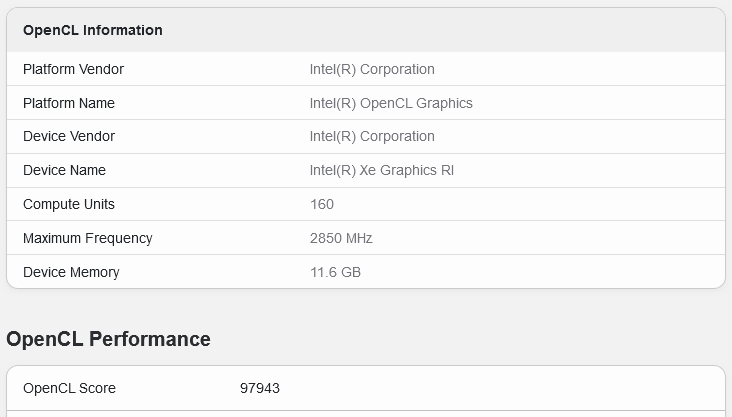
The GPU is a desktop card: it was tested with an Intel Core i5-13600K processor in an MSI Pro Z790-A Wifi board. It is listed as Intel Xe Graphics RI and it is not clear if it is an ES sample or actually a configuration that will be released as is. The finalised model names for graphics cards are only set by the drivers (this one could be named Arc B750 for example). According to PCI ID 8086:E20B, it should be the “Battlemage G21” or BMG-G21 GPU.
The BMG-G21 could probably be a relatively cheaper variant of Battlemage. It’s unclear whether the Battlemage generation will still also have a cheaper low-end model, like the Alchemist generation (cards like the Arc A380 with the ACM-G11 chip). However, according to earlier reports, there should hopefully be a more powerful version in the form of the BMG-G31 chip. That die apparently is to provide 32 Xe cores again, which would be 4096 shaders, and 256-bit memory width. Thanks to the improved architecture, higher GPU clock speeds, and GDDR6 memory (at 19.0 GHz it would achieve a bandwidth of 608 GB/s, and at 20.0 GHz then 640 GB/s), graphics cards with this chip should have significantly better performance than the Arc A770.
When these graphics cards will come out is not yet clear, but according to various behind-the-scenes reports, Intel wants to release them ideally before the end of November to still make it in time for the pre-Christmas shopping period. This information is what Intel representatives allegedly shared at a seminar hosted by Asus over the summer. These graphics cards could therefore possibly hit the market before the end of the year. How important and interesting of a hardware launch it will end up being, we’ll see.
Sources: VideoCardz, Geekbench
English translation and edit by Jozef Dudáš
⠀


