


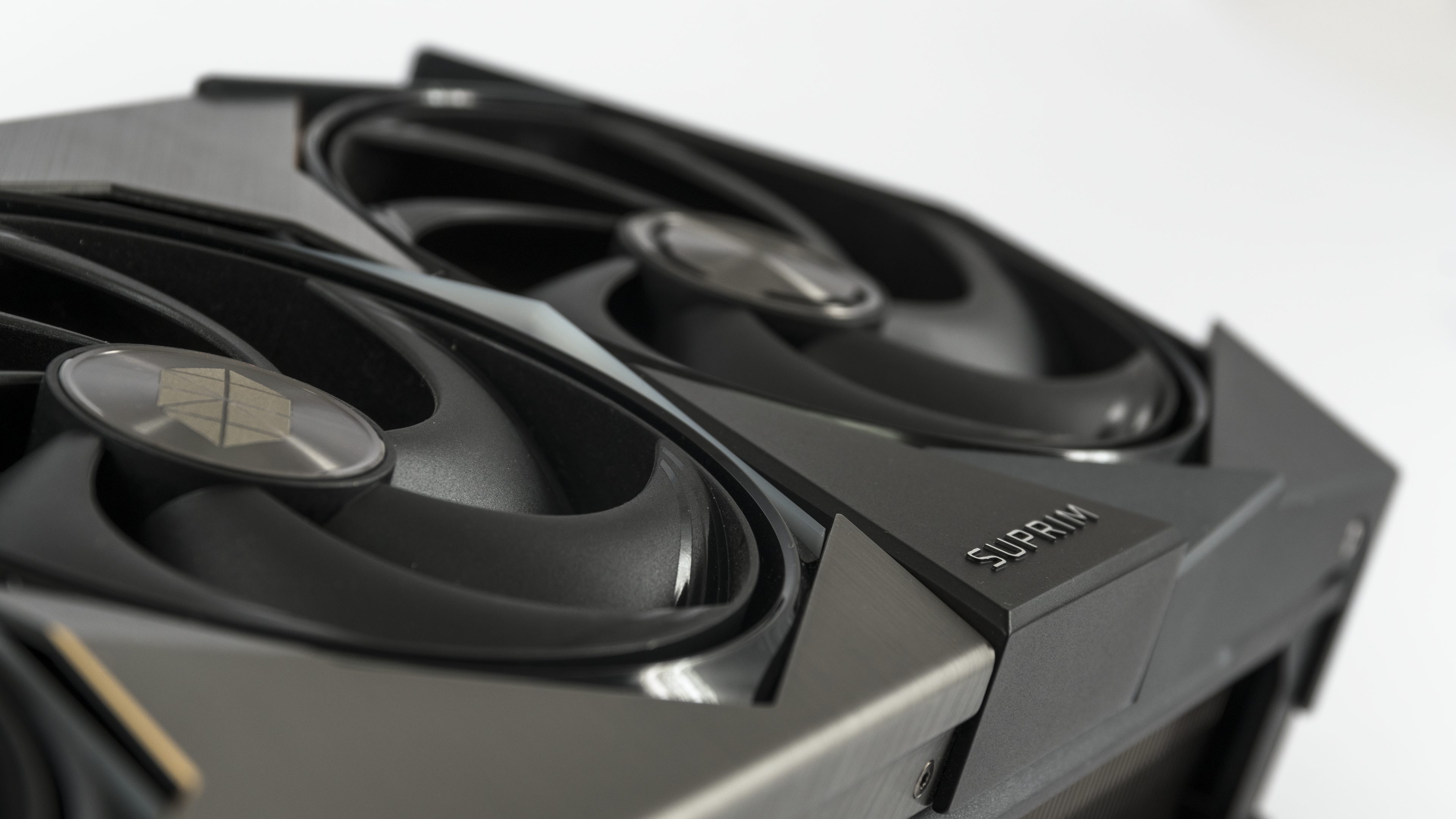
The GeForce RTX 5080 Suprim SOC features a vapor chamber cooler just as massive as the one found on the 600W RTX 5090 Suprim SOC. With this extra cooling capacity, the fans on the more efficient RTX 5080 can run at lower speeds, resulting in excellent thermals and minimal noise. However, this high-end cooling solution also drives up the price—you’re paying a premium for one of the best factory-overclocked RTX 5080 cards available.
Fan behavior, noise level
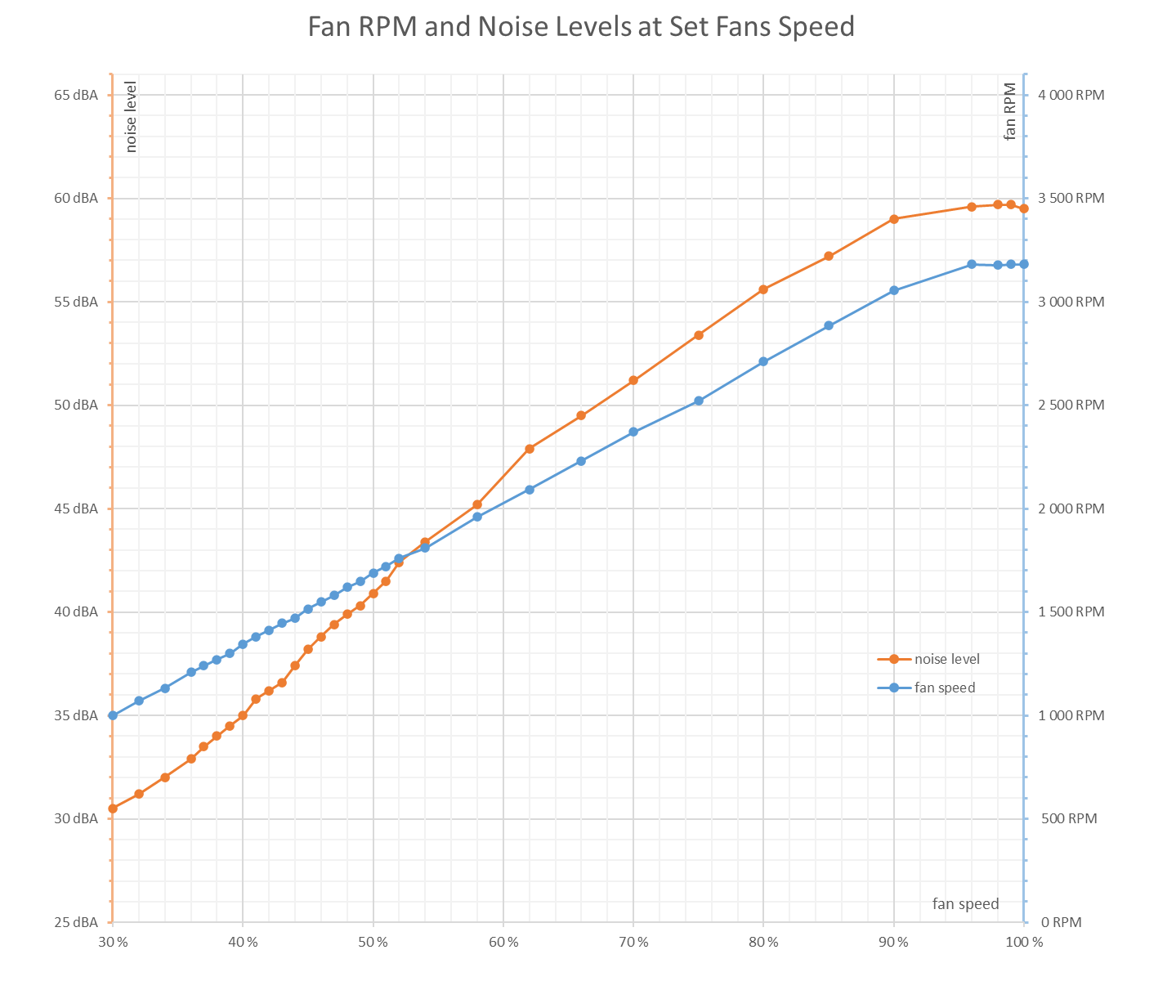
The fans are large and powerful, so they’re only quiet at low speeds. The minimum speed that can be set via fan control is 30%, at which point they spin at 1000 RPM, generating a measured noise level of 30.5 dBA. They become noticeably louder somewhere around 1400 RPM.
Under sustained load, once the card heats up, fan speeds in Silent mode hover around 1300–1400 RPM. This corresponds to a noise level of 35–36 dBA. So, the card isn’t completely silent, but the cooler is relatively quiet. If this still bothers you, the fact that the average temperatures of the GPU and memory stay below 70 °C means reducing the fan speed to around 1200 RPM shouldn’t be a problem, and at that point, the noise drops to around 33 dBA.
With the Gaming BIOS, fan speeds reach 1640 RPM, and noise hits 40 dBA – more of an average level. However, the performance gain is practically unmeasurable and temperatures only improve by a few degrees. Not really worth the increased noise.
Coil whine is average, comparable to other cards with similar power consumption and performance. In Silent mode, the coils can occasionally be heard over the fans; in Gaming mode, they blend in with the fan noise.
VThe fans can spin up to 3000 RPM, leaving plenty of headroom for cooling experiments – though no one would want to run the card long-term at 3000 RPM with noise levels reaching 59.3 dBA.
Cyberpunk 2077, RT Medium, 3840 × 2160 (BIOS Gaming)
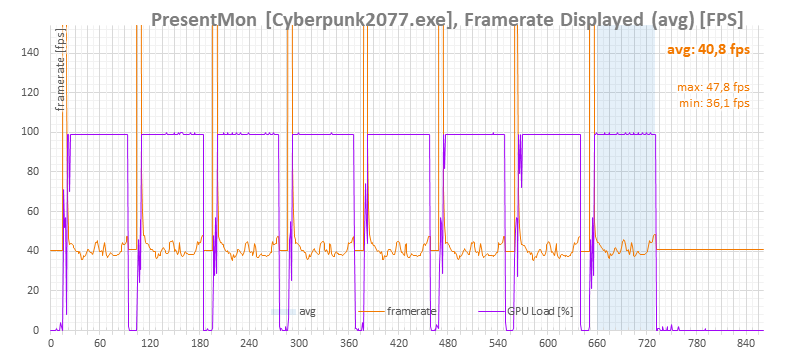
The first test set comes from the Cyberpunk 2077 benchmark, with RT Medium settings at a resolution of 3840 × 2160. Under these settings, the GPU is fully loaded. The results are based on eight consecutive benchmark loops.
The graph always displays the final loop, from which the average values of the warmed-up card are calculated.
GPU clock speeds ranged from 2805 to 2820 MHz, averaging 2811 MHz.

Based on power consumption, clock stability, and limits, it’s evident that the card wasn’t constrained by power in the test – similar to earlier-tested RTX 5080 models. It appears that voltage is the primary limiting factor.
Tmavou barvou v grafu pak zanesený příkon celého PC měřený multimetrem UT71E. Je na něm vidět, že se příkon celé sestavy dostává bezmála k 800 W, příkon samotné karty se pak drží na horním 600W limitu.

Average GPU temperatures in the test peaked at a luxurious 62 °C, and memory temperatures were just a few degrees higher.

You’ll pay for that with a higher noise level. In Cyberpunk, 1500 RPM isn’t too bad, but in longer workloads without pauses between tests, fan speeds go even higher.







What are the standout features of the MSI GeForce RTX 5080 Suprim SOC?
From my point of view, it’s the cooler with its top-notch efficiency. 🙂