
Long awaited laptops with Nvidia’s RTX Spark N1X processors are finally coming the market. One of their main propositions is a GPU derived from the GeForce RTX 5000 graphics architecture, although games will have to contend with the poorer compatibility of the Arm platform. Nvidia has therefore aligned various gaming news with the launch of the RTX Spark, including updates to DLSS technologies that also benefit regular GeForce cards.
Probably the most interesting news for owners of GeForce graphics cards (or, eventually, the RTX Spark N1X) is that Nvidia has announced a considerable speedup and reduction in performance requirements for DLSS 5, the AI image enhancement technology introduced last month. This tech had a pretty harsh performance impact (and along with it, it also increased power consumption).
Nvidia has now announced that DLSS 5 is receiving a new, significantly lighter and faster model. It is said to deliver up to 2× better performance. Or perhaps more accurately, 2× lower performance cost. That does not mean you will see a 2× higher frame rate in the game—performance of the GPU is also consumed by the rendering of the game itself before the DLSS 5 filter is applied, as well as by DLSS upscaling and by frame generation too, when it is used. According to Nvidia, the final frame rate could be “up to” 40% better (so often probably by less).
However, this speedup probably will not come entirely for free. Nvidia states that graphics memory consumption has also been reduced (reportedly by 20% at 4K resolution), which is a good thing on the one hand. But this is a consequence of shrinking the AI model that DLSS 5 uses—it has 24% fewer parameters (118 million, which with FP8 values is roughly 118 MB). However, the “size” of AI models is precisely what improves their capabilities, so shrinking the model is apparently a compromise in which performance increases, but at the cost of image quality of the resulting frames and the filter’s effect worsening.
The fact that the computational demands have been halved at the same time is probably a sign of similar trade-offs being applied to the code of the filter as well. Shrinking the model alone would not have such a drastic impact, so alongside “lossless” optimizations, Nvidia probably also reduced the amount of compute operation that the AI model inferencing and other parts of the the entire filter execute.
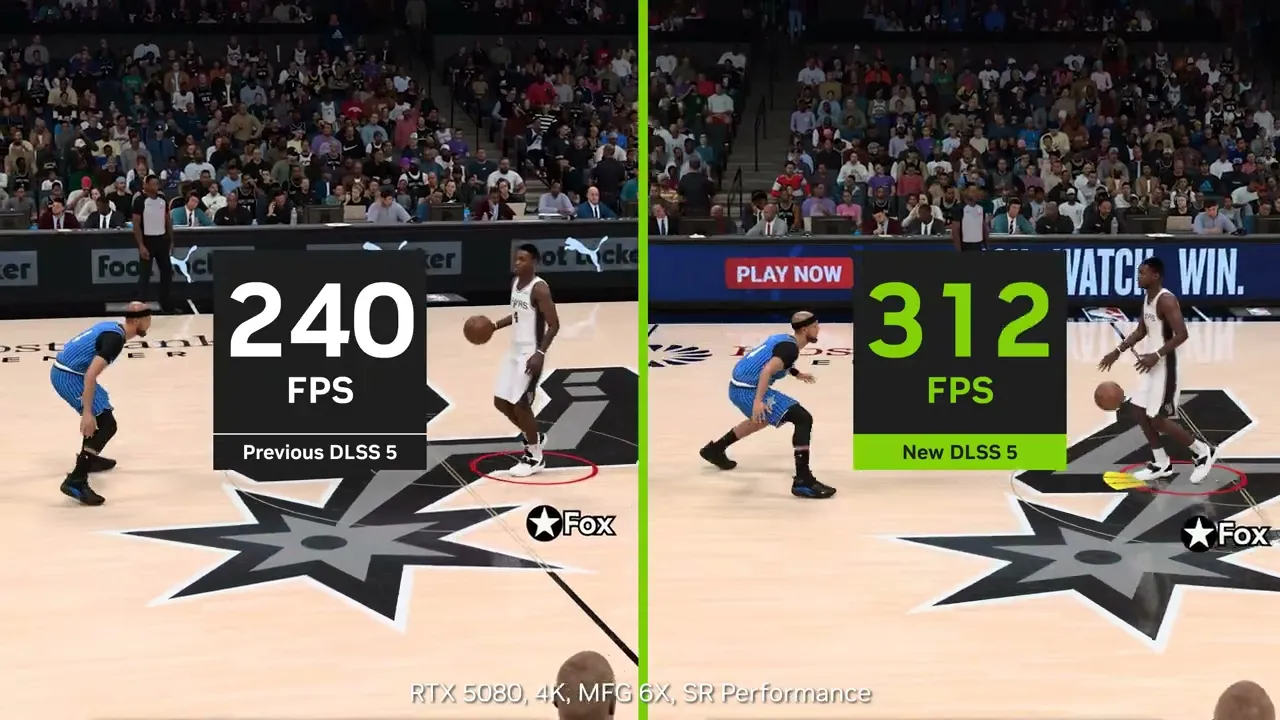
Both of these factors will therefore probably lead to the new model delivering different output compared to what the DLSS 5 filter produced at launch, even though Nvidia claims that “quality is comparable”. Note that the company has a history of always using given such claims with regards to DLSS, for example, claiming this about the relationship between the image quality achieved by DLSS upscaling and the quality of a frames rendered at native resolution for pretty much every single DLSS version Nvidia produces. The initial reviews made after launch of DLSS 5 comparing the original game image and the DLSS 5 output may therefore no longer apply to this new version, and such comparisons and evaluations should probably be redone now. We should not assume that the the only thing the model replacement causes is the performance improvement and that the output is the same as it was with the more demanding model initially used in games (or rather in the one launch game, NBA 27K2).
This new sped-up and reduced model was to be available on 16 October, the launch day of the RTX Spark laptops. The game NBA 2K27, which was the first title with DLSS 5 technology, has received it through an update.
Second and Third Games with DLSS 5
This new model should also bring official DLSS 5 support to two more games besides NBA 2K27—the Chinese title Where Winds Meet and the well-known game Hogwarts Legacy set in the eponymous wizarding school from Harry Potter novel series.
The second of these games was one of the titles in which Nvidia presented the DLSS 5 AI filter effect during its first reveal earlier this year, and was notable because the impact was quite ugly in a number of scenes. This new implementation is supposed to be different, and the game’s developers reportedly had the opportunity to tailor the effect in the game. Nvidia showed demonstration images (you can find them here on its website), in which the effect seems to have been toned down significantly. It seems that DLSS 5 mainly changes colors and tries to simulate shadows, but it can also artificially sharpen the scene considerably (arguably it may be oversharpening the image a lot). However, these are only images selected by Nvidia. It is hard to say how representative images from the hands of the vendor’s marketing team are.
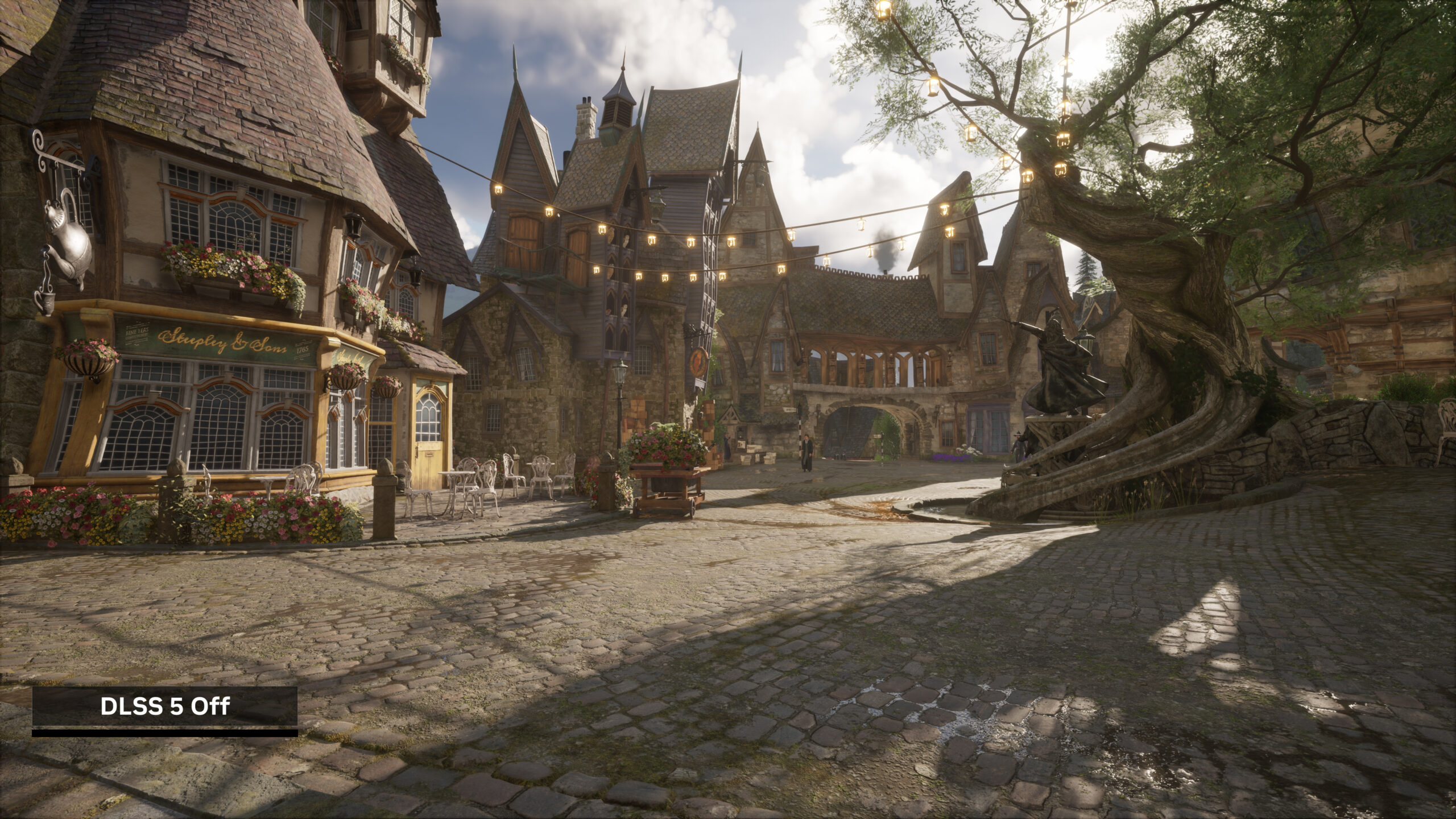
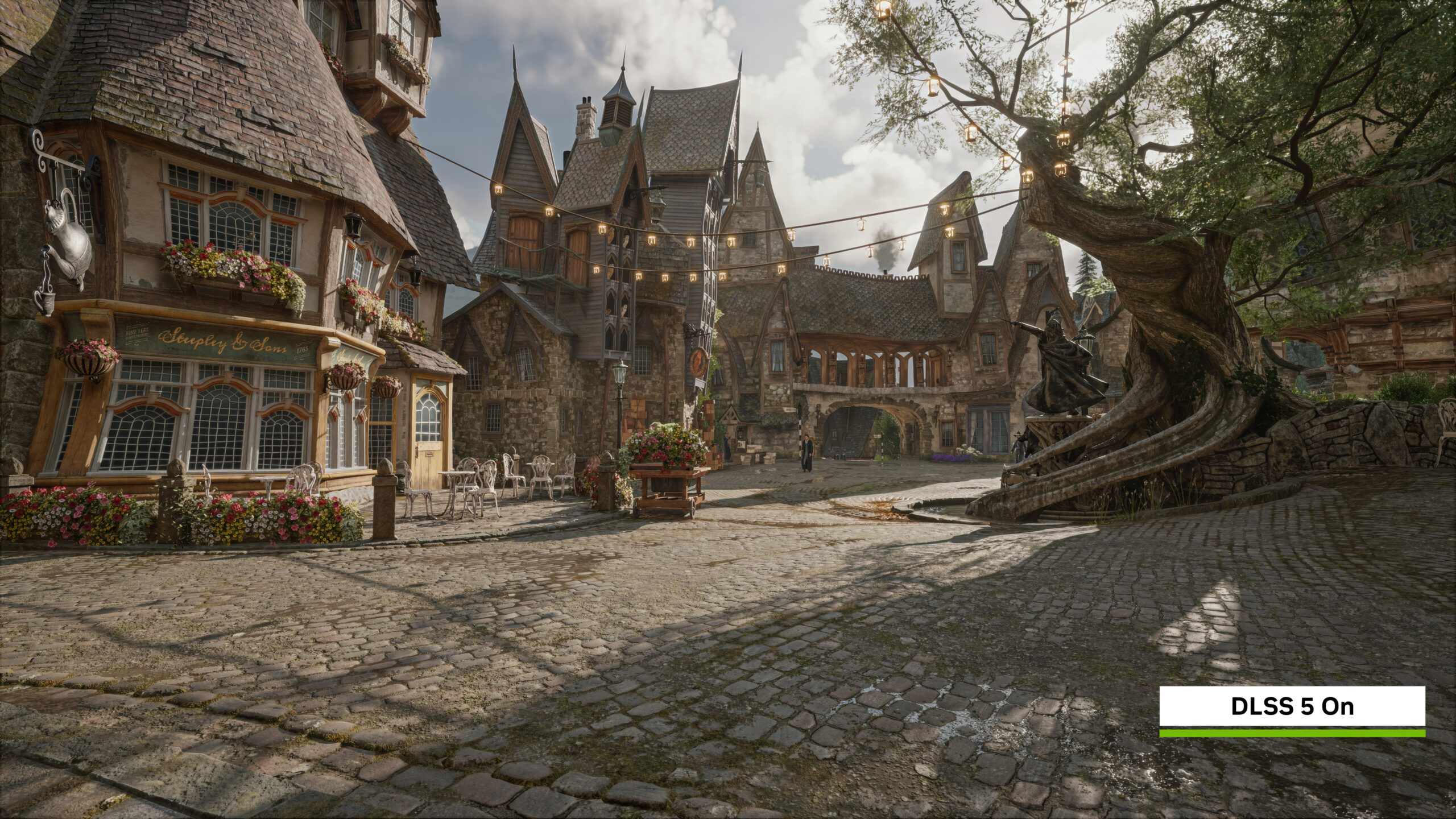
DLSS 5 should be added to these games through updates during November.
Faster (Worse?) DLSS Frame Generation Model
A higher-performance, but probably also simpler model that potentially sacrifices some image quality is also coming to DLSS frame generation. The Nvidia App update currently available now makes it possible to enable Performance Mode for frame generation, which is available for GeForce RTX 5000 and RTX 4000 graphics cards. In the Nvidia App, this model can be set as “Preset C.”
Preset C, or Performance Mode, should use the same AI model as standard frame generation for the part of the process that handles motion vectors and analyzes the movement of objects in pixels. However, the AI model used for the second part of the process, which is the application of the optical flow technique for interpolating image data (including, for example, pixels for which motion vectors do not provide satisfactory data), has been replaced with a simpler and lighter substitute that costs less performance.
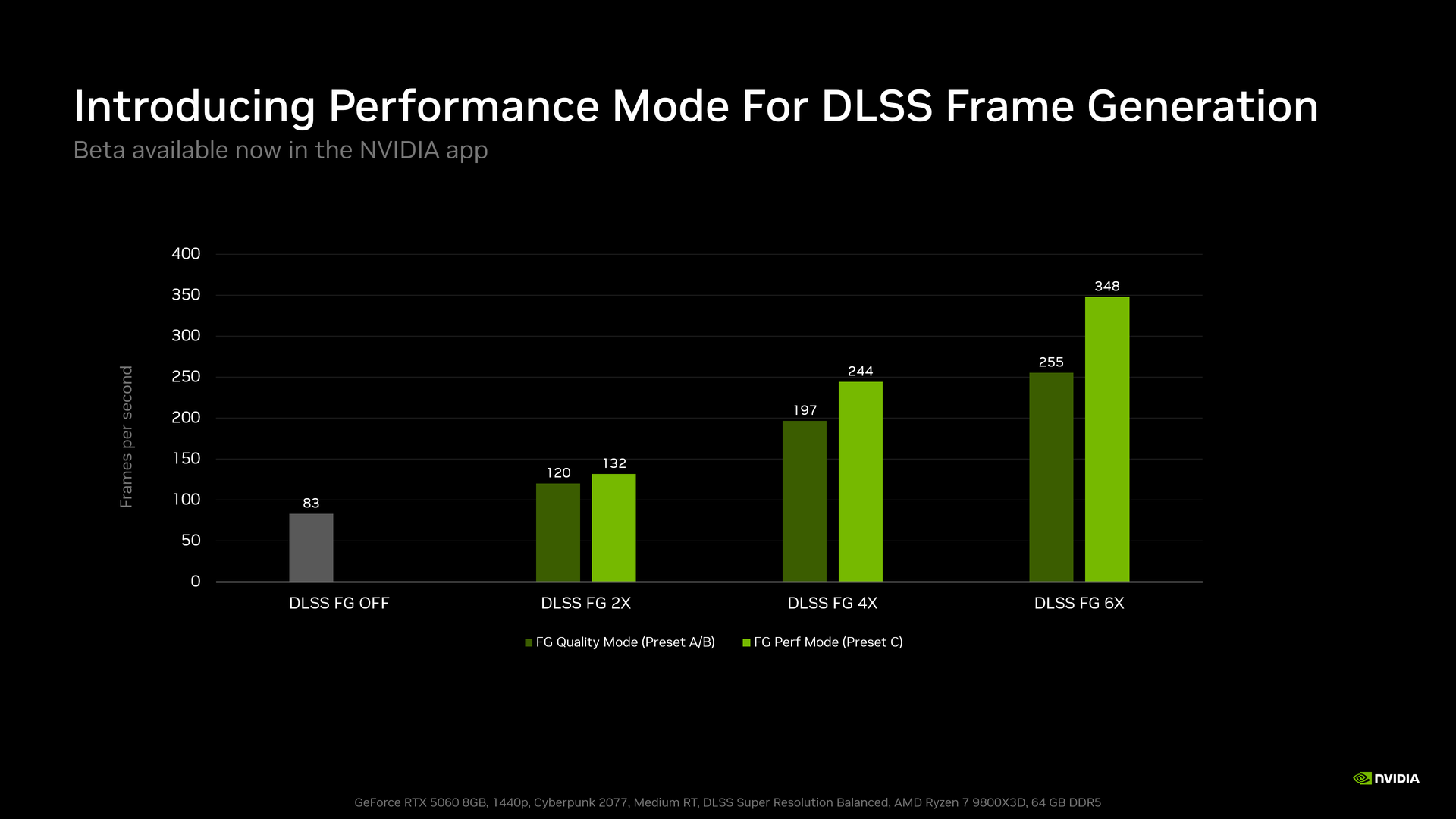
In this case, Nvidia itself admits that this model increases performance in exchange for “minor compromises in image quality.” According to Nvidia, frame generation with it is up to 35% faster (on a GeForce RTX 5060 at 1440p).
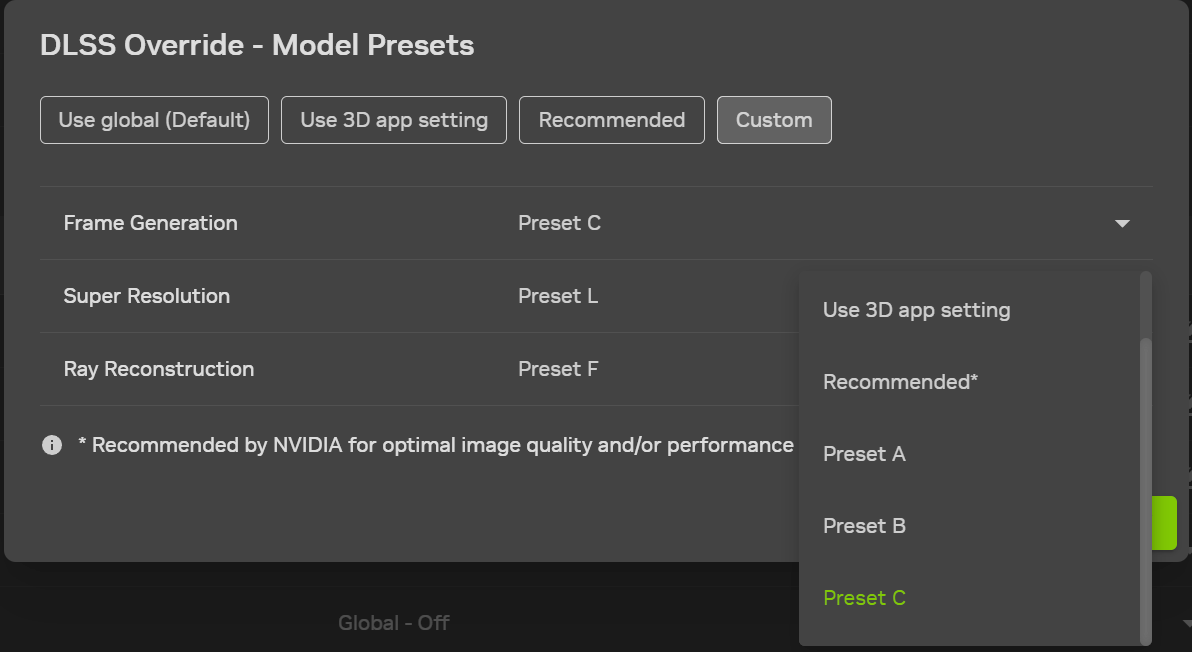
This Performance mode will apparently not be enabled by default for now, so it is an optional feature that you can enable for individual games or even globally through the DLSS Override option. It also has not yet been released as finalized production feature yet; Nvidia states that it is currently in beta testing phase.
Source: Nvidia
English translation and edit by Jozef Dudáš