
Ever since the first 3D V‑Cache processors in 2022, the possibility of a desktop CPU with 16 cores and 3D V‑Cache mounted on both CPU chiplets has been on the table. AMD never made it reality despite many asking for it, until now. Hints such a CPU was coming started pouring in last year though. It didn’t arrive with the gaming 9850X3D model in January, but this week, AMD is finally making this long-awaited CPU real.
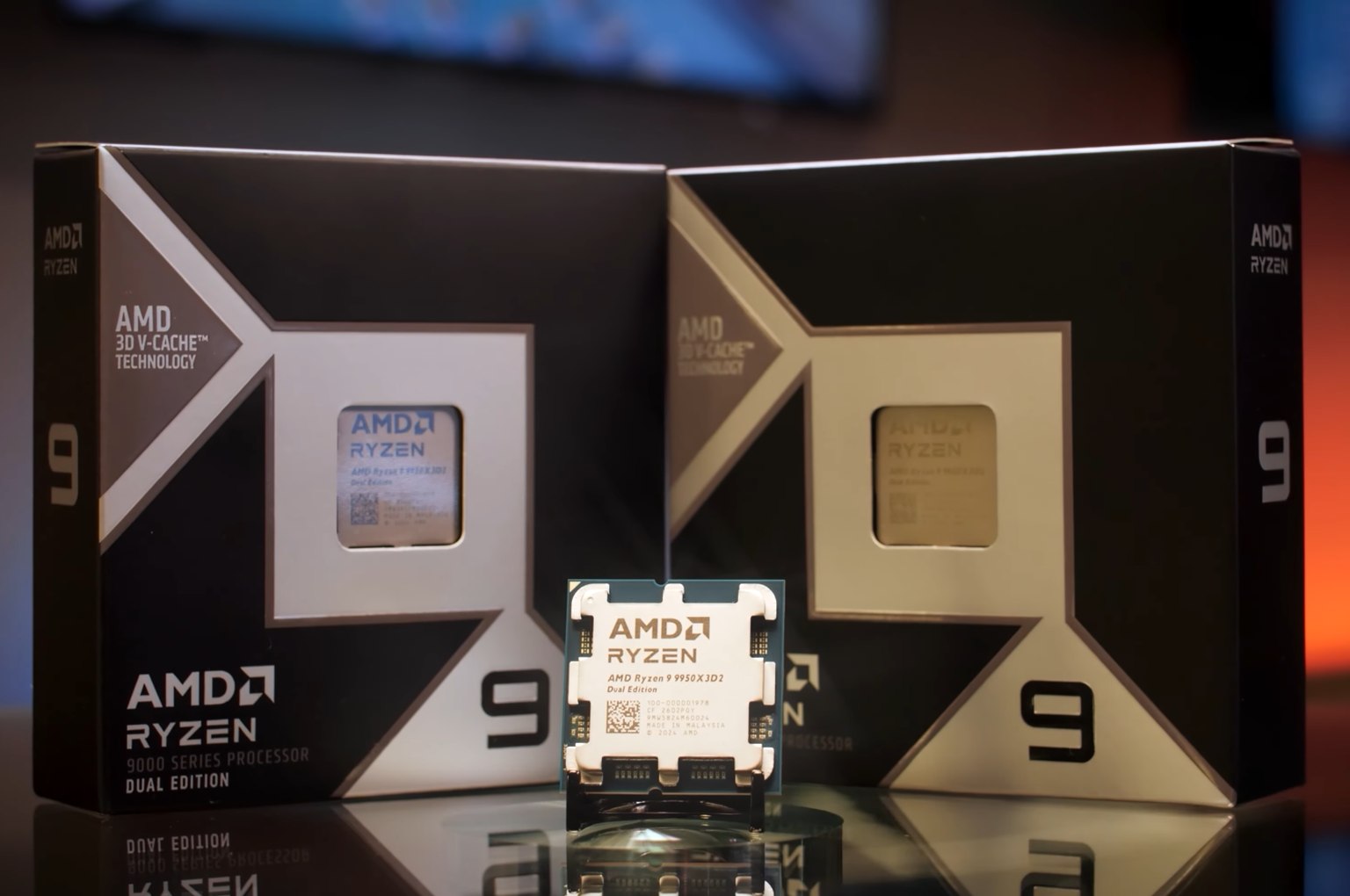
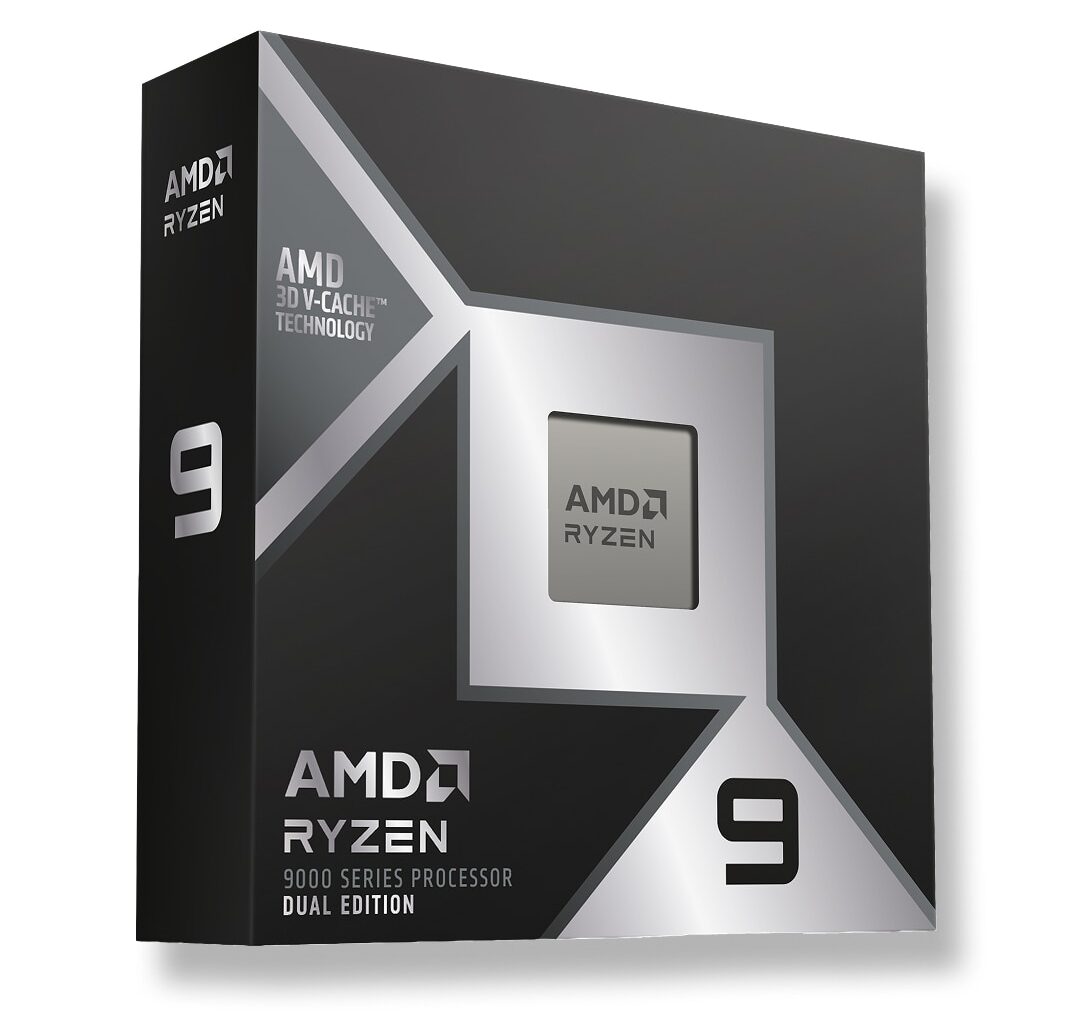
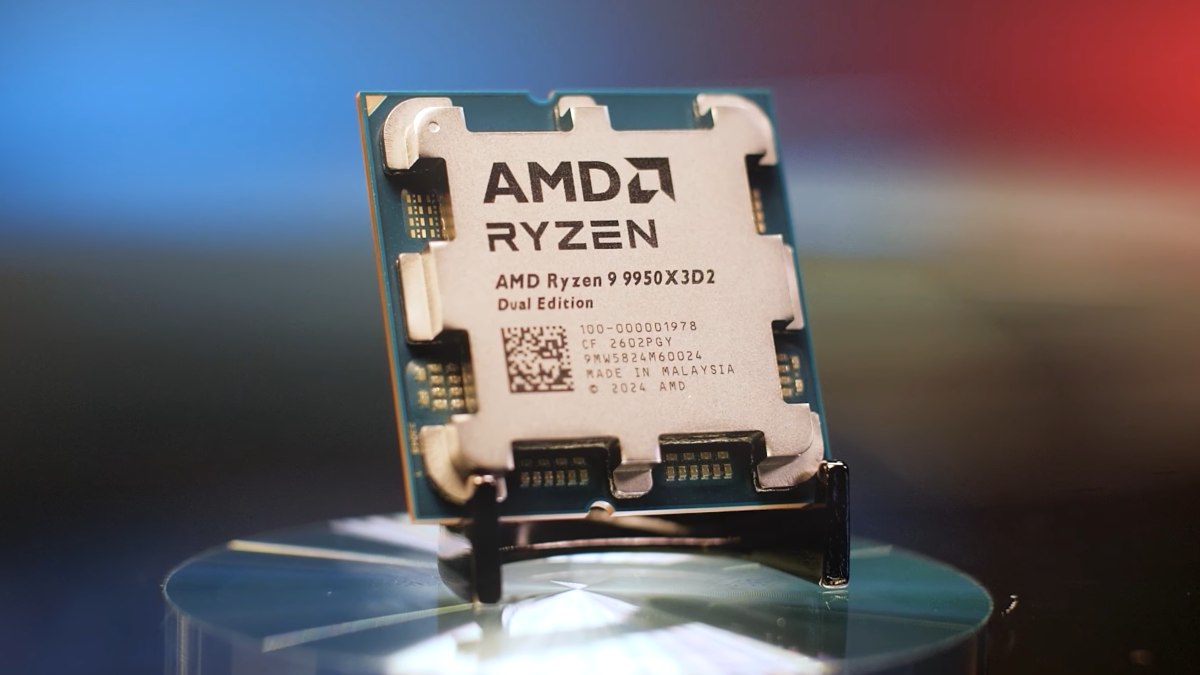
The company ultimately named the new processor Ryzen 9 9950X3D2 Dual Edition. Earlier leaks mentioned only the 9950X3D2 designation, which would not work very well (it’s easy to misread this designation as the standard 16‑core version that has 3D V‑Cache on just one chiplet). The Dual Edition label signals more clearly that this is meant to be a relatively special product.
The company officially announced the new model yesterday, following its indirect confirmation back in January. This is not a hard launch yet—the processor will actually go on sale on April 22, in just under four weeks. What we still don’t know is the price. It should be expected to come in higher than the current 16‑core Ryzen 9 9950X3D (since the Dual Edition model does actually have higher manufacturing costs).
The processor is still based on the Zen 5 architecture introduced in 2024, in its desktop implementation for the AM5 socket with two CPU chiplets. Until now, all desktop X3D processors—with the exception of an unreleased Zen 3 prototype on which the technology was first demonstrated in 2021—mounted 3D V‑Cache only on (or underside, since the current generation) one CPU chiplet. The 9950X3D2 Dual Edition finally exploits the option of enhancing both the compute dies.
The processor therefore has 16 cores, 32 threads, and a total of 192 MB of L3 Cache (AMD lists 208 MB in its materials, which is the sum of L3 and L2 cache across all 16 cores). The cache is, of course, composed of two 96 MB blocks, each shared by eight cores. This means that benefits—especially in gaming—won’t be as large as if each core could directly access a full 192 MB block.
AMD lists a base clock speed of 4.3 GHz, the same as the standard 9950X3D. Maximum boost is 5.6 GHz, matching the eight‑core Ryzen 7 9850X3D. Notably, this is boost on the chiplet with 3D V‑Cache—something that was pretty much unrealistic until recently. The previous 9950X3D could boast a 5.7 GHz boost, but only on the chiplet without 3D V‑Cache (the one with 3D V‑Cache maxes out around 5.2 GHz).
Higher power consumption
The processor also increases TDP and maximum power draw. Until now, the AM5 platform topped out at a 170 W TDP which corresponds to a real‑world maximum boost power (PPT) of 230 W. The Ryzen 9 9950X3D2 Dual Edition raises TDP to 200 W. AMD typically does not list PPT in official specifications, and we don’t know the value used by the 9950X3D2 yet, but it is usually about 35% higher than TDP. That would imply around 270 W—slightly above the default maximum turbo power of Intel’s top processors such as the Core Ultra 9 285K or the newly released Core Ultra 7 270K Plus (though Intel also offers an “extreme profile” with higher power draw that motherboards can optionally support).
If the motherboard’s power delivery is sufficient, the processor should still operate on all AM5 boards, with chipsets from A620 to X870E supported. High‑performance cooling may be required though (with liquid cooling likely being preferable). The processor will be sold without a cooler.
What hasn’t changed is connectivity: 24 PCI Express 5.0 lanes and support for DDR5‑5600 memory (with the usual option to use EXPO profiles for higher clock speeds). The processor again supports ECC memory, provided the motherboard does as well. The Ryzen 9 9950X3D2 Dual Edition also retains the simple integrated Radeon GPU with 128 RDNA 2 shaders at 2200 MHz, which can be used to connect displays if you don’t have a discrete GPU available.
The Dual Edition model is unlocked for overclocking according to the specifications (though keep mind that the chips require lower voltages— they can be damaged at the levels overclockers commonly use, so extreme caution and adherence to recommended guidelines for these processors is essential).
A performance jump—but not a huge one?
Ryzen 9 9950X3D2 Dual Edition will now represent the highest‑performance processor for mainstream AM5 platform (excluding Threadrippers and Epycs). It should be the best solution for both gaming and application software—and both at once in a single package. That is, if you’re not concerned about price. However, on average, performance gains over previous Ryzen 9000 models (the 9800X3D and 9850X3D for gaming, and the 9950X and 9950X3D for multithreaded workloads) may not be that dramatic.
For reference, AMD’s official benchmarks show application performance improvements of 5–13% over the 9950X3D. So while this is currently AMD’s fastest processor, it isn’t leading by an enormous difference. Exceptions may include specific compute workloads that truly require large cache capacity that serves all cores and not just eight of them.
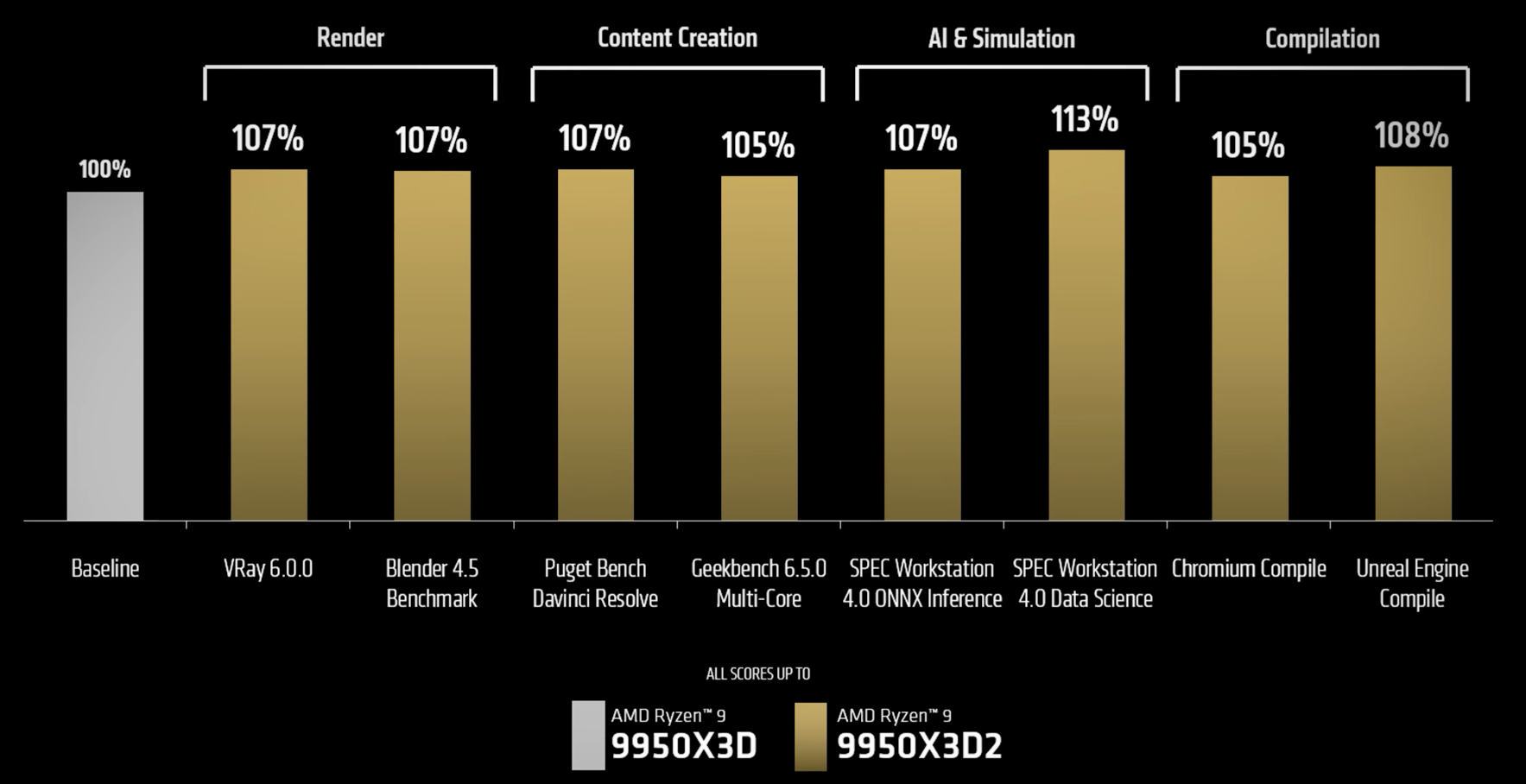
According to AMD, the dual‑cache model will shine in professional deployments that leverage CPU performance combined with the high bandwidth and low latency of the large L3 cache. Benefits are expected in compiling large software projects (Chromium and Unreal Engine are cited), working with AI models, or demanding content creation. The processor should also be useful for certain HPC workloads and simulations that benefit from 3D V‑Cache on large Epyc “X” server processors. If you need a similar solution in a smaller desktop‑class package, this CPU can be an effective solution.
English translation and edit by Jozef Dudáš
⠀