

The Pure AMD Radeon RX 9070 XT by Sapphire is a slightly higher-clocked variant of the base Pulse AMD Radeon RX 9070 XT. It features the same cooling system, differing only in the color scheme and the design of the shroud and backplate. In terms of performance and operating characteristics, both models are nearly identical. The most noticeable difference between the two is the Sapphire logo on the side of the card, backlit by ARGB LEDs.
The Sapphire Pure AMD Radeon RX 9070 XT cooler differs from the previously tested Pulse AMD Radeon RX 9070 XT mainly in the shroud design, while it’s identical to the Pure AMD Radeon RX 9070. A heatsink with transverse fins is cooled by three large fans mounted in a white plastic shroud.


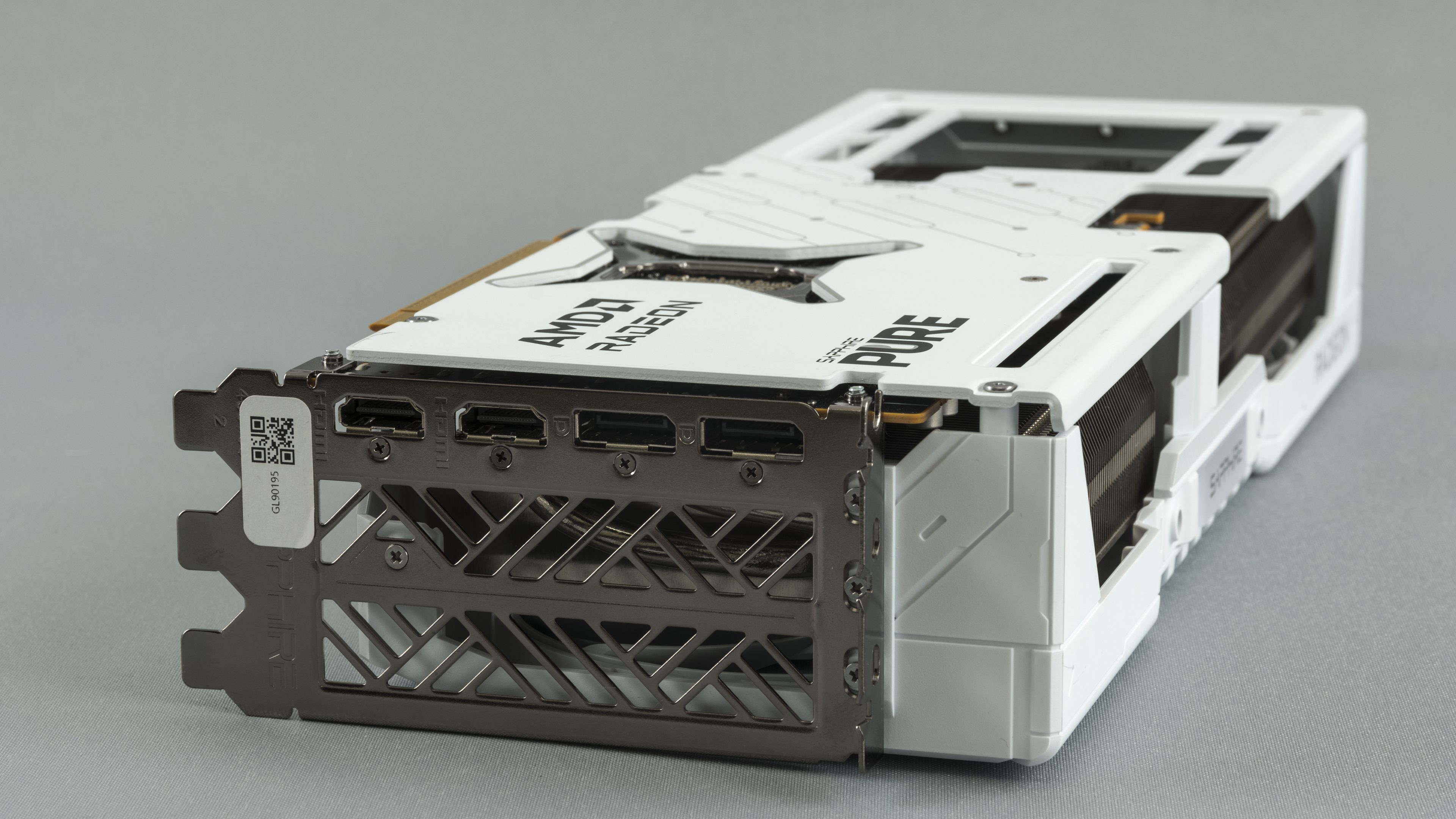
What differs from the Pulse RX 9070 XT is the design of the metal backplate on the rear side of the PCB. The perforation near the bracket is less pronounced, while the rear section is slightly more open. Near the PCB, there’s also a cutout for a connector where you can connect an ARGB LED strip.


The external dimensions of the card are the same, with a length of 32 cm. It extends about 3 cm beyond the bracket in width and occupies three full slots in height, so plan for a fourth free slot for air intake. The power connectors are recessed, making the card compatible with narrower cases.


The weight differs from the Pulse model by just a few grams, likely because of the ARGB LED connector and the different illuminated logo on the side of the card.
The bracket features a less common combination of outputs—one of the three usual DisplayPort 2.1b ports has been replaced by a second HDMI 2.1b connector. While in the previous generation, Radeons had an edge over GeForce thanks to support for the newer DisplayPort standard, in this generation, they offer DisplayPort with lower bandwidth (UHBR13.5) compared to GeForce’s UHBR20.
For cards in the upper mid-range performance category, you won’t have to worry about them only handling 54 Gbps. They’re not designed for high resolutions at extreme refresh rates.
For additional power, it uses a pair of classic 8-pin connectors, which, due to the aversion to the new 12V-2×6 connectors, is seen as a plus by most people today.

⠀