


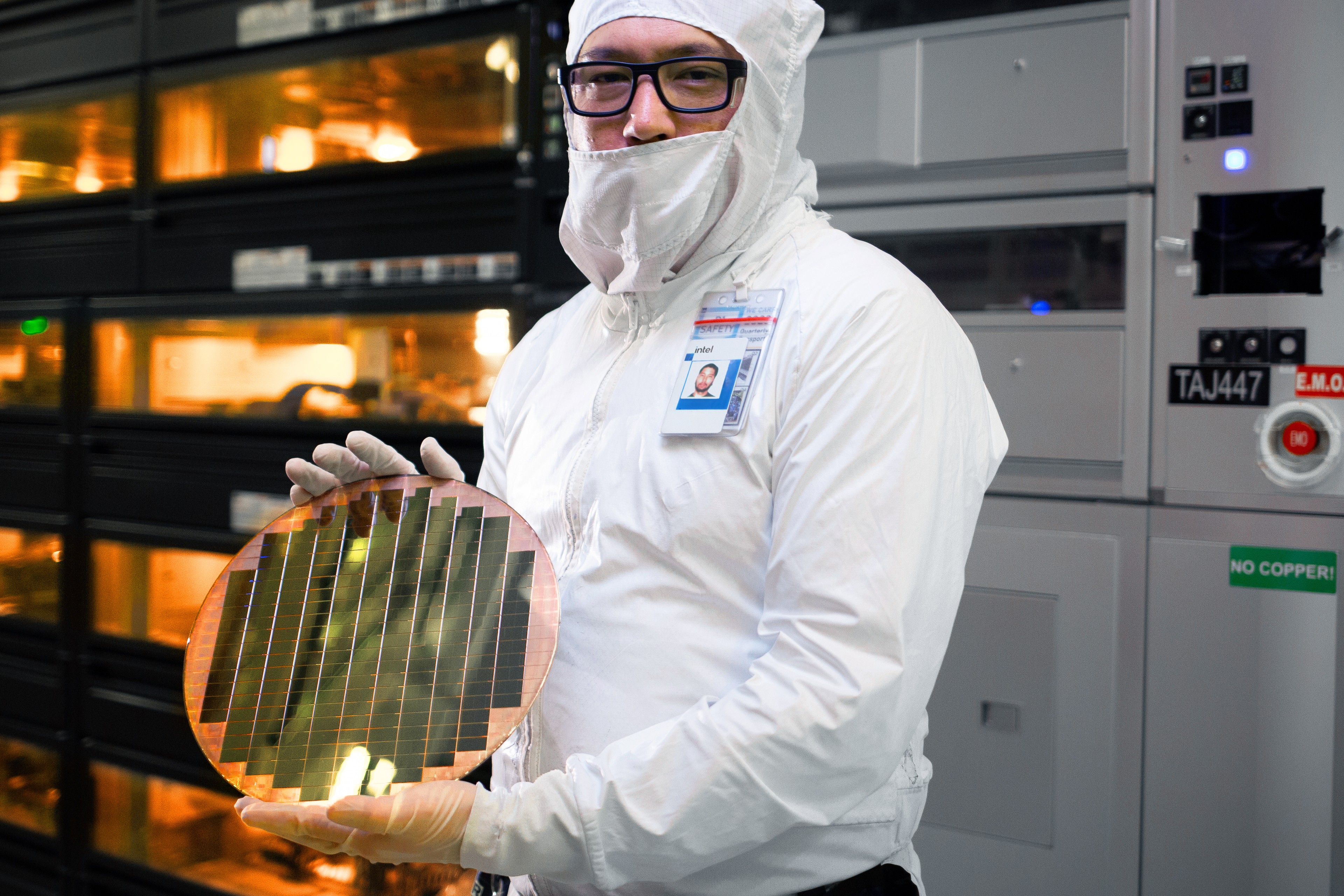
Under Patrick Gelsinger, Intel planned to build its first semiconductor fab in continental Europe, in Magdeburg, Germany to expand the company’s manufacturing capacity and turn Intel into a foundry rivalling TSMC. The project was also intended to help develop semiconductor manufacturing within the EU. Intel’s financial difficulties and cutting costs was the end of the project, but it seems Europe investments are back on the table now.
This week, Intel announced that it will expand its manufacturing capacity in Europe. However, this will not involve reviving the Magdeburg project or building a new fab there. Instead, Intel will expand Fab 34, a facility it already operates within the EU—although not in continental Europe, which is perhaps why it tends to be somewhat overlooked. The company has long operated a manufacturing complex in Leixlip, Ireland, where it employs approximately 4,900 people.
It is this facility that Intel will now modernise for manufacturing using its Intel 3 process node, officially classified as a 3nm technology and the company’s second most advanced process after Intel 18A (1.8nm—although it should be noted that these node names are largely arbitrary, and Intel’s 18A process is generally considered to be more comparable to TSMC’s 3nm technology than to 2nm and lower nodes). It has to be noted that Fab 34 in Leixlip has already supported Intel 4, the 4nm process from which Intel 3 is derived. Perhaps the most important aspect of this announcement is that, alongside the process upgrade, the fab’s manufacturing capacity is also expected to increase.
The investment is expected to total approximately 5 billion EUR (5.7 billion USD), and the decision has reportedly already been finalized. Despite the substantial amount, this is not as historic an investment as the planned German fab would have been, because Intel already operates a large manufacturing complex in Leixlip and has invested considerably more there over the years—more than 30 EUR billion to date. Expanding this existing site is therefore something that Intel likely was expected to do no matter what (provided the finances were there) and not some big change of course. Nevertheless, it will strengthen Europe’s semiconductor manufacturing base, which could also serve local foundry customers in the future, in theory.
Intel specifically intends to manufacture Xeon server processors at the facility, mentioning the current Xeon 6 generation (namely the Granite Rapids and Sierra Forest processors with E-Core architecture). The fab is also expected to manufacture Xeons of a yet unnamed next-generation lineup, which will likely still be based on the Intel 3 process. These could, for example, include Diamond Rapids processors, whose CPU tiles are expected to be manufactured on Intel’s more advanced 1.8 nm process, but the SoC or I/O tiles could use the Intel 3 node.

Xeon processors manufactured in Europe could become attractive for strategically important or security-sensitive applications, in theory. However, they would still be designed overseas by a foreign company, meaning they would not be as strategically independent as a hypothetical processor manufactured but also designed entirely within Europe.
- Read more: European CPU SiPearl Rhea1 now in tape-out. Launch expected next year
- Read more: SiPearl introduces Athena1, Europe’s Arm processor aimed at military industry
Fab 34 in Leixlip has undergone a somewhat unusual ownership history. In 2024, Intel sold a 49% stake in a joint venture the facility was placed into to private equity firm Apollo Global Management for 11 USD billion. This year, however, Intel bought the stake back for 14.2 billion USD to become a sole owner again.
It remains to be seen whether Intel proceeds to eventually expand the site’s capabilities to include 1.8 nm and newer process nodes as well, perhaps with government or EU support. Intel 18A is expected to be the first process on which the company is supposed to manufacture for external foundry customers more extensively, potentially making it an attractive option for semiconductor products developed and manufactured within the EU.
Source: Intel
English translation and edit by Jozef Dudáš
⠀

