


The Silent Wings (Pro) 4 represent the pinnacle of computer fan range. The non-Pro variants stand out especially in system positions and are not well suited for radiators. This is by design and in line with the sort of “micro-segmentation” of BeQuiet. In a white design, like the one tested, it will be quite difficult to find other 140 mm fans that are quieter at comparable airflow.
Mounting and vibration measurement
Naturally, each tested fan must first be properly mounted. With all that we want to measure, and with the kind of precision that is required for relevant measurements, even the smallest details matter. The whole mounting system is quite complex and we are happy to have fine-tuned it to maximum satisfaction. Even if it meant hundreds of hours of tinkering. What’s so complicated about it? There’s more.
The fans are installed to the multi-purpose bracket. The substrate is a 2 mm thick metal plate to which the fan is attached, or the fan is attached together with an obstacle (e.g. a filter, hexagonal grille or liquid cooler radiator).
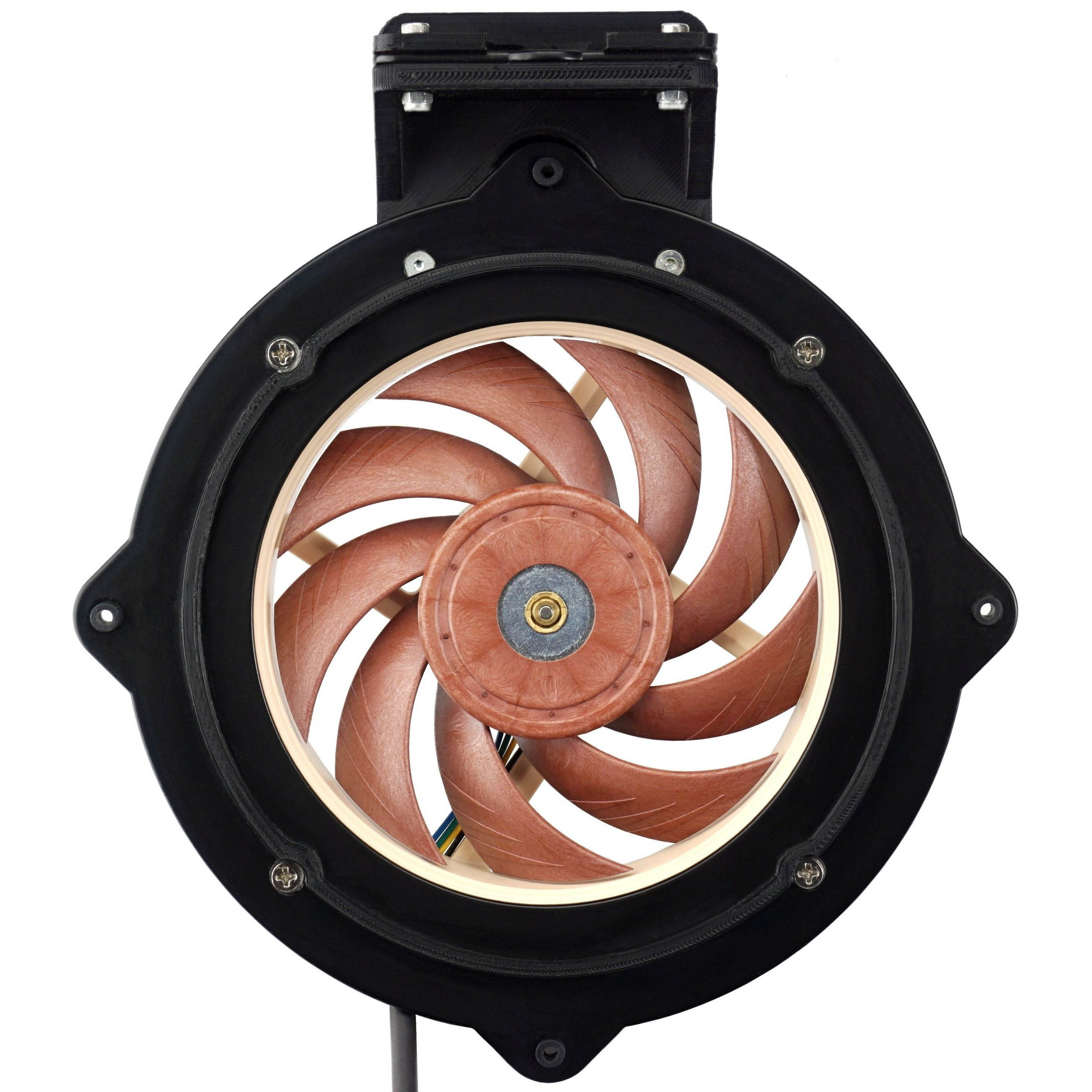
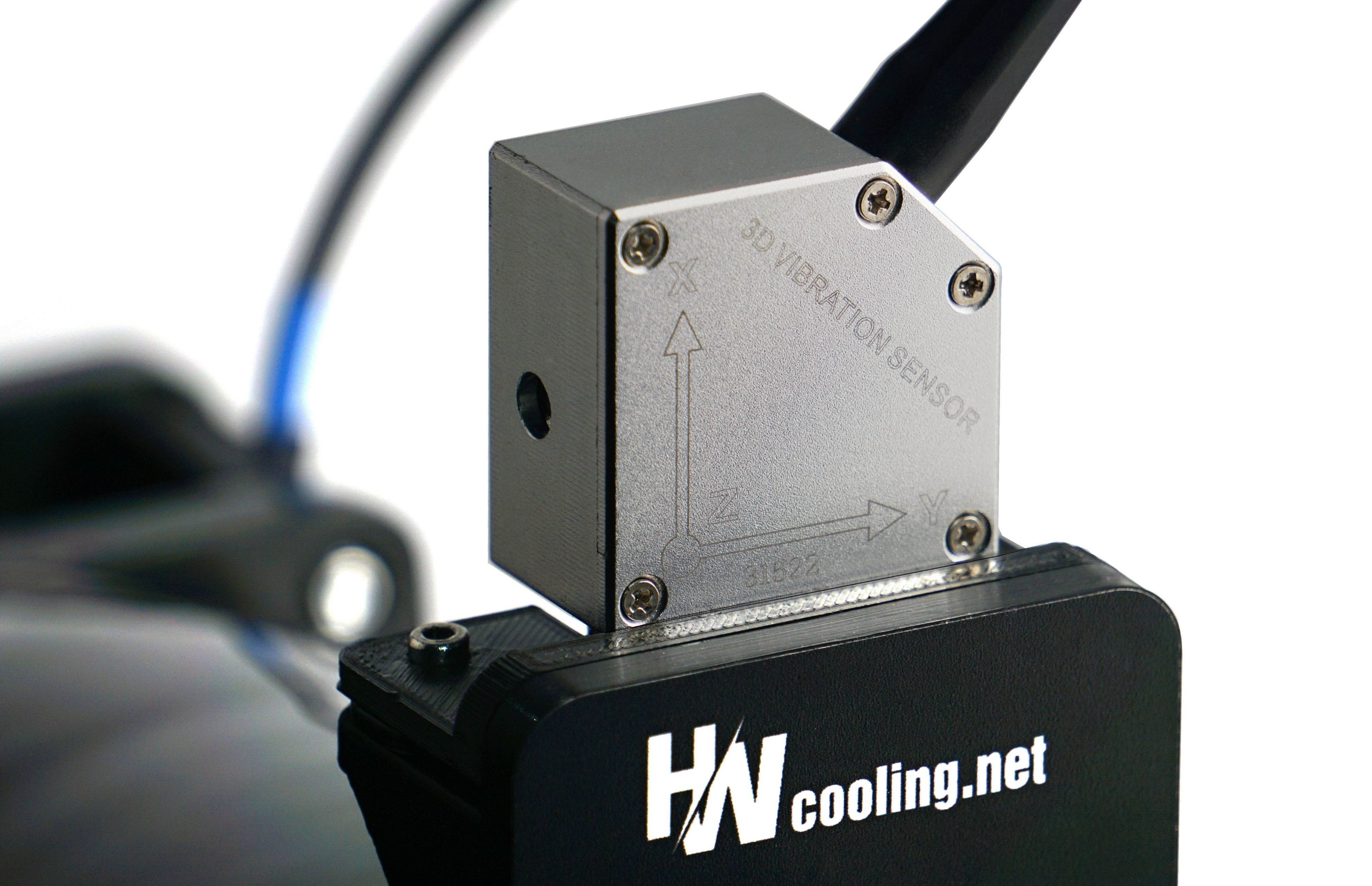
For correct and always equal pressure, the fans are always tightened with the same force with a torque screwdriver. If this were not the case, joints and clearances in the assembly could arise, in short, uneven conditions with undesirable distortion. For example, also for vibration measurement. On top of the fan mount there is also a bracket for the three-axis vibrometer sensor. The latter is magnetically attached via a steel insert, on which the sensor exerts a force of one kilogram and, thanks to the stop, is also always in the same place and in the same contact with the rest of the structure. These are the basics in terms of repeatability of measurements.
In order to capture the intensity at the highest possible resolution, the tray of the holder cannot be too heavy and at the same time it must be strong enough not to twist. This would again cause various distortions. Therefore, we used a hard (H19) aluminium (AL99.5) plate for the construction of the holder, whose weight is just enough so that free movement is not significantly restricted.
To achieve the finest possible resolution for vibration measurement, soft rubber inserts are provided in the mounting holes through which the bracket is installed to the tunnel. And just behind these inserts are silent blocks with a very low hardness of 30 Shore. These are also used so that the vibrations of the fans don’t spread to the tunnel skeleton. If this were to happen, then for fans with more intense vibrations, this secondary noise component, which is not related to the aerodynamic sound of the fan, would also be reflected in the noise measurement results.

This is where it is good to have ideal conditions, even though they are unattainable in practice, because fan vibrations will always be transmitted to the case skeleton to some degree. But each cabinet will react differently to them, or rather the final noise level will depend on a number of factors, starting with the materials used. Therefore, it is a good idea to filter out this extra noise component in tests and in practice take into account the measured vibration intensities. The higher these vibrations are, the higher the noise addition has to be taken into account.
The silent blocks are naturally formatted to offset the bracket a bit from the rest of the tunnel, otherwise they wouldn’t make sense. This creates a gap that is sealed across the entire surface with a soft foam seal with closed cell structure (i.e., it’s airtight).
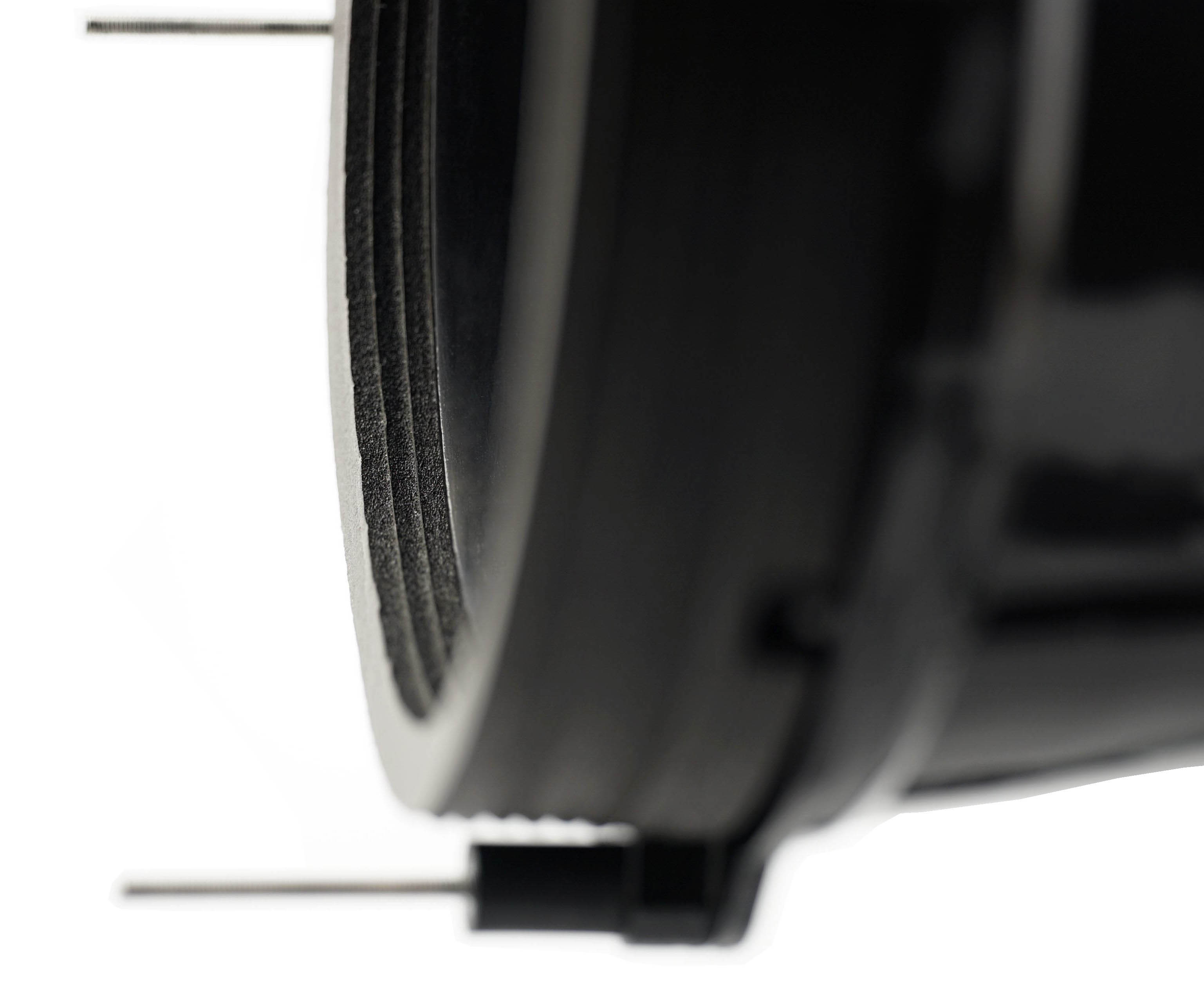
To properly center the fan impeller in relation to the other elements, the bracket includes a protruding frame that follows the inner contour of the seal. And to make matters even more complicated, the frame with the tested fan is pressed against this seal by a small force of compression springs, which in turn is set with the highest possible resolution for vibration measurement in mind and at the same time so that sufficient pressure is generated to maintain a flawless seal.
Vibration is measured with a Landtek VM-6380 vibration meter. It records the vibration speed (in mm) per second in all axes (X, Y, Z). For quick orientation, we calculate a 3D vector from the measured values and graph the “total” vibration intensity. But you can also find your results if you are only interested in a specific axis.
The most complicated part of the tunnel is behind us, and we’ll move on in the next chapter. But we will still stay at the beginning of the tunnel, we will just turn to the peripheries on the sides.




Is the very low speed characteristics similar to that observed in CPS RZ120?
This fan would have been much more competitive if it were to have closed corners by default. The corner swapping gimmick doesn’t seem to offer any actual benefit to me, as the vibrations are already low and similar results in dampening could already be achieved by using rubber mounts. They definitely could have saved some cost and/or priced the fan even more competitively by using integrated, closed corners instead of this gimmicky design.
That said, for users willing to DIY, this should still be a great radiator fan. All you need is some tape to seal up the corners, saving you quite a bit of money.
I mean the F5 R120. Confused with the cooler names.
Yes, if you encounter a lower airflow at the same noise level, a similar characteristic (as with the Silent Wings 4 BL117) is also found in the F5 R120. More fans have this. At such low speeds, the non-aerodynamic sounds must be extremely quiet to leave room to set the speed high enough for leading rankings.
Replacing the corners of the BL117 is really useful if only just to be able to install this fan on a radiator of a liquid cooler, where the SW4 doesn’t make much sense. Although the SW4 doesn’t need to be smeared too much in this scenario. Sure, due to the significant drop in placement compared to other fans, the urge is there, but at higher speeds it even outperforms the NF-A14. Sure, for a fan with modern geometry it’s more of a failure, but…
Using tape to seal the corners is a good DIY “trick”. 🙂
How would you compare it to the Pure Wings 3? This fan seems to constantly get outperformed by its cheaper sibling. The Pure Wings 3 does have a lower RPM limit, but there doesn’t seem to be other major disadvantages by going for the Pure Wings instead.
Now I’m really curious how the high speed, 9-blade version of the Pure Wings 3 performs.
The 140 mm Pure Wings 3 with 7 blades often seems to be a balanced (and a hair more more efficient) solution like the Silent Wings 4 (BL117). Although we have the SW4 in the white variant, which probably tends to be a bit noisier. These small differences (in tonal peaks) do not show up on radiators, where the tested PW3 variant has a significant advantage for obvious reasons (good sealing corners). We are also curious about the 9-blade Pure Wings 3 in 140 mm format. We will probably get to it after the announced Arctic P14 triple fan test (PWM PST, PWM PST CO and Max). 🙂
The Pure Wings 3 has a MTBF of 60 000 hours, which can be a disadvantage compared to Silent Wings 4 (with 300 000 hours). Lower robustness of critical parts in terms of durability (or change of properties over time) can also be indicated by the smaller impeller hub (of the PW3 BL108) and also at higher speeds relatively higher vibrations (again of the PW3 BL108), which could also indicate higher manufacturing tolerances. Of course, these vibrations could also be due to vibrations on the blades, but I assume they will be composed of several sources. And one of them will be related to the quality level of the impeller centering.
I guess the P14 trilogy will be consecutive releases then.
It’s a shame that we can’t have a Silent Wings 4 that comes with sealed corners, otherwise we’d have a reliable (and strong performing) 14 cm fan in the ~20$/£ price range that would compete very favourably vs. the Noctua A14 for example. I guess that’s done to prevent cannibalising their sales of their own flagship, but I’m not sure if it’s a smart move given the tough competition…
Yes, the next test will be the P14 PWM PST CO and I will conclude the trilogy (on Monday?) with the Max model.