


The Silent Wings (Pro) 4 represent the pinnacle of computer fan range. The non-Pro variants stand out especially in system positions and are not well suited for radiators. This is by design and in line with the sort of “micro-segmentation” of BeQuiet. In a white design, like the one tested, it will be quite difficult to find other 140 mm fans that are quieter at comparable airflow.
Base 6 equal noise levels…
There are several options by which to normalize the test modes for fans. In the previous chapter, we wrote that perhaps the least appropriate option is equal speed.
Settings according to the same static pressure or flow are for consideration, but we find it most sensible in the long term to normalize the measurement modes according to the same noise levels. Firstly because decibels are a logarithmic unit and all others scale linearly, but mainly because you can orientate fastest by the same noise levels. The easiest way to compare the efficiency of fans is just by how they perform at the same sound pressure level. Of all the options, this is the one that most people can best imagine and bounce off of when considering other variables.
The individual noise level modes are adjusted from low levels continuously to higher levels. All users will find their results in the tests, regardless of whether they prefer very quiet operation at the limit of audibility or whether high performance is paramount.
The quietest mode corresponds to 31 dBA, followed by 33 dBA, and for each additional mode we add 3 dBA, which always doubles the noise level (36, 39, 42 and 45 dBA). Finally, we measure the fans at maximum power. Here, each one already has a slightly different noise level, which we also report. If there are missing measurements between the results for any of the fans, this means that it was not possible to set the target noise level. Either because its minimum speed exceeds the quietest mode of 31 dBA or vice versa because the fan is quieter than 45 dBA at maximum power.
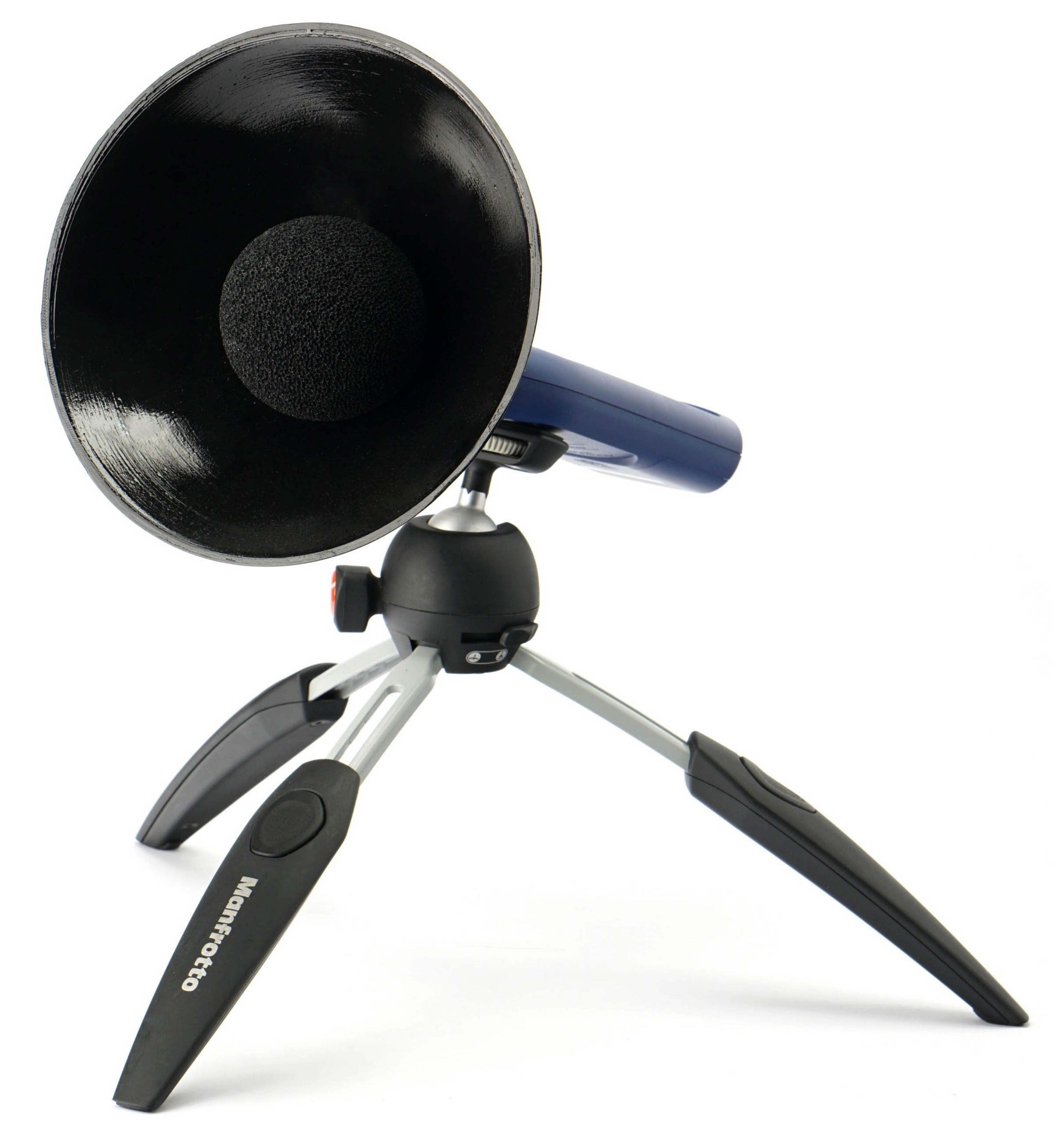
It is important to add that our noise level measurements are incomparable to the values quoted by the fan manufacturers in their specifications. One of the reasons is because we use a parabola-shaped collar around the sensor of the noise meter, which increases sensitivity. This is important in order to distinguish and set to the same noise level even modes at very low speeds, especially 31 dBA.
The noise meter next to the fan is quite close for sufficient resolution. The distance between the frame and the sensor is 15 centimeters. The sensor is positioned in such a way that there is no distortion or that the noise level measurements are not affected by airflow. Therefore, the noise meter is centered perpendicularly to the frame that defines the depth of the fan. Everything is always at the same angle and at the same distance. We use an inclinometer and markers to set the distances precisely and always the same.

We use a Reed R8080 noise meter to measure noise levels. This allows real-time averaging of samples, which is important for fine-tuning individual modes. We tune the fans until the specified noise level is reached to two decimal places, for example 31.0 dBA. The noise meter is the only instrument we calibrate inside our testlab. The other instruments have been calibrated by the relevant technical institutes. However, in the case of the noise meter, calibration is required before each test and we therefore have our own calibrator. This is already calibrated externally according to the standard.



Is the very low speed characteristics similar to that observed in CPS RZ120?
This fan would have been much more competitive if it were to have closed corners by default. The corner swapping gimmick doesn’t seem to offer any actual benefit to me, as the vibrations are already low and similar results in dampening could already be achieved by using rubber mounts. They definitely could have saved some cost and/or priced the fan even more competitively by using integrated, closed corners instead of this gimmicky design.
That said, for users willing to DIY, this should still be a great radiator fan. All you need is some tape to seal up the corners, saving you quite a bit of money.
I mean the F5 R120. Confused with the cooler names.
Yes, if you encounter a lower airflow at the same noise level, a similar characteristic (as with the Silent Wings 4 BL117) is also found in the F5 R120. More fans have this. At such low speeds, the non-aerodynamic sounds must be extremely quiet to leave room to set the speed high enough for leading rankings.
Replacing the corners of the BL117 is really useful if only just to be able to install this fan on a radiator of a liquid cooler, where the SW4 doesn’t make much sense. Although the SW4 doesn’t need to be smeared too much in this scenario. Sure, due to the significant drop in placement compared to other fans, the urge is there, but at higher speeds it even outperforms the NF-A14. Sure, for a fan with modern geometry it’s more of a failure, but…
Using tape to seal the corners is a good DIY “trick”. 🙂
How would you compare it to the Pure Wings 3? This fan seems to constantly get outperformed by its cheaper sibling. The Pure Wings 3 does have a lower RPM limit, but there doesn’t seem to be other major disadvantages by going for the Pure Wings instead.
Now I’m really curious how the high speed, 9-blade version of the Pure Wings 3 performs.
The 140 mm Pure Wings 3 with 7 blades often seems to be a balanced (and a hair more more efficient) solution like the Silent Wings 4 (BL117). Although we have the SW4 in the white variant, which probably tends to be a bit noisier. These small differences (in tonal peaks) do not show up on radiators, where the tested PW3 variant has a significant advantage for obvious reasons (good sealing corners). We are also curious about the 9-blade Pure Wings 3 in 140 mm format. We will probably get to it after the announced Arctic P14 triple fan test (PWM PST, PWM PST CO and Max). 🙂
The Pure Wings 3 has a MTBF of 60 000 hours, which can be a disadvantage compared to Silent Wings 4 (with 300 000 hours). Lower robustness of critical parts in terms of durability (or change of properties over time) can also be indicated by the smaller impeller hub (of the PW3 BL108) and also at higher speeds relatively higher vibrations (again of the PW3 BL108), which could also indicate higher manufacturing tolerances. Of course, these vibrations could also be due to vibrations on the blades, but I assume they will be composed of several sources. And one of them will be related to the quality level of the impeller centering.
I guess the P14 trilogy will be consecutive releases then.
It’s a shame that we can’t have a Silent Wings 4 that comes with sealed corners, otherwise we’d have a reliable (and strong performing) 14 cm fan in the ~20$/£ price range that would compete very favourably vs. the Noctua A14 for example. I guess that’s done to prevent cannibalising their sales of their own flagship, but I’m not sure if it’s a smart move given the tough competition…
Yes, the next test will be the P14 PWM PST CO and I will conclude the trilogy (on Monday?) with the Max model.