


In the past we mentioned how Intel doesn’t seem to be too confident in their 1.8nm tech. Although Nova Lake CPUs using Intel’s in-house 18A-P process made it all the way to engineering samples stage, production units will stick to TSMC’s 2nm technology. The latter apparently has better characteristics. Now another piece of negative news has been added, showing that Intel is still far from being able to compete with TSMC.
To save Intel chip fabs and keep them operating (and to have any chance of returning to the top league of chip manufacturers), the company needs external clients whose orders would significantly expand its economies of scale. Without that, its factories are loss-making, and as future technologies grow more demanding, their red numbers will get worse and worse. A year ago, alleged leaked information spread that suggested the company may have been seeing early success in winning these vitally important external orders: it was reported Intel had landed Microsoft as a client.
Microsoft was reportedly to manufacture the company’s in-house Maia 300 AI accelerators on the Intel 18A process, that is, the same 1.8nm technology that Intel was trying in Nova Lake CPUs. Like GPUs, AI accelerators are large chips that test the ability of a technology’s transistors to deliver high performance while remaining energy efficient. And because these are large chips and Microsoft it could be expected to want to deploy large numbers of them in the company’s data centers, this would be precisely the kind of big order that would help not only Intel’s reputation and customer references, but also balance sheet.
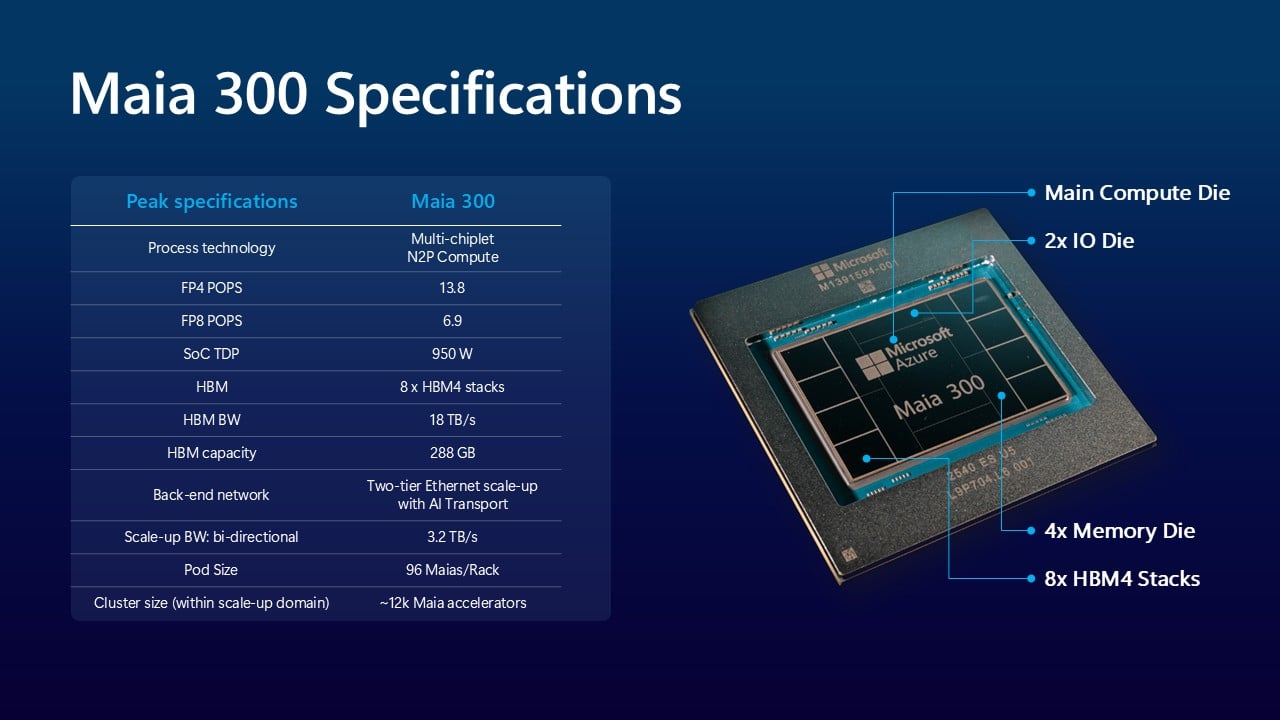
All of this hope has now evaporated, however. Microsoft has by now officially unveiled the Maia 300 accelerators, but at the same time stated that Intel did not become the manufacturing partner; TSMC did, once again. The manufacturing process is officially stated to be the N2P technology, that is, an enhanced version of the Taiwanese 2nm process.
Although Intel labels its process “1.8nm,” it is in reality considered a competitor to TSMC’s 3nm process instead. And Microsoft wass actually already manufacturing the previous generation of the accelerator, the Maia 200, on TSMC’s 3nm process (N3P). It therefore apparently decided that the Maia 300 on Intel’s 1.8nm technology would not deliver a substantial generational improvement in performance and efficiency, which can be achieved only with TSMC’s 2nm technology as it is in reality a generation further along. Microsoft’s reluctance to risk potential problems with Intel’s unproven technology may also have contributed. And that is despite the fact that 18A manufacturing was most likely offered at a considerable discount.
A potential “success story” has thus turned into more of an embarrassment for Intel, although it should be pointed out that this is not entirely a blunder of the company’s own making. Microsoft’s alleged contract was never officially disclosed and it was always just an unofficial report or rumor (it came from the website SemiAccurate). Intel never publicly promised this anywhere. We do not know whether SemiAccurate’s information was entirely wrong from the start, or whether chip production at Intel was actually in play sometime in 2025 and it was only later that Microsoft gave up on these efforts.
How serious this news is for Intel’s efforts is not entirely easy to assess. Microsoft’s decision to go with TSMC’s 2nm process was probably motivated most of all by the aim of achieving top performance with the freshest technology, for which Intel does not yet have an alternative. The rejection therefore does not necessarily mean that Microsoft found Intel’s technology outright unusable. Had only a 3nm process been available from the Taiwanese leader at that moment, Intel might have had a chance of succeeding. In other words, the US foundry’s problem may be that it lags behind TSMC in timing, yet it can still work as an alternative against TSMC’s older processes (for products where having the very latest process is not critical). That would be a significantly better situation for Intel compared to the alternative where the company’s technology suffered not only from delays, but also from fatal quality, performance, or yield issues.
English translation and edit by Jozef Dudáš

