

Last month, the JEDEC consortium developing memory standards unveiled a new generation of mobile RAM: LPDDR6. It introduces sweeping changes, particularly in channel width and ECC option, offering significant gains in both performance and reliability. By contrast, news about the next desktop RAM standard, DDR6, has been relatively scarce—until now. We’re starting to see new details emerge, including a projected release timeline.
The analyst firm TrendForce—often quoted for its memory and SSD price forecasts—has just published an article summarizing leaked information about DDR6 from Korean (The Guru) and Chinese (Commercial Times) sources. According to these reports, DDR6 is expected to hit the market in 2027.
DDR6 specs are finalized, but it’s still two years from launch
Although DDR6 development hasn’t attracted much attention publicly, the standard is reportedly close to completion—perhaps even ahead of LPDDR6. In fact, the DDR6 specification was said to be finalized as early as the end of 2024, while LPDDR6 only wrapped up its spec in Q2 of this year.
Chip and memory controller development is already underway. All three major DRAM manufacturers—SK Hynix, Samsung, and Micron—have working prototypes in the lab, with testing and validation currently ongoing.
CPU manufacturers, including Intel and AMD, are participating in early validation. However, processors capable of supporting DDR6 won’t begin integrated testing until 2026, as they’re still in development. For now, testing is likely taking place via FPGAs. Since there’s always a lag between validation and commercial rollout, DDR6 modules and compatible processors aren’t expected to ship until sometime in 2027.
Doubled clock speeds, but tripled bandwidth
DDR6 will launch at speeds ranging from DDR5-8800 up to DDR5-17600 (these are “effective clock speeds” of 8.8 to 17.6 GHz, though the real clock rate is much lower). That’s roughly double the speed range of current DDR5 memory. As usual, speeds of the actual shipping modules will start on the lower end initially, with higher speeds introduced gradually over time—and potentially even higher speed grades will be unlocked via overclocking.
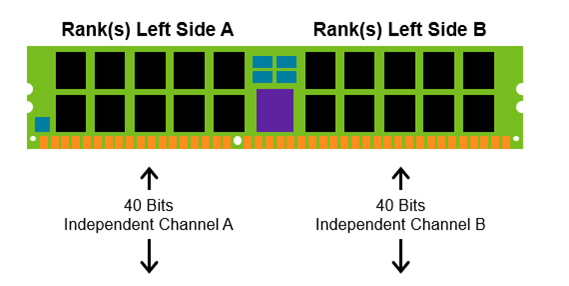
But a more notable and fundamental innovation lies beyond just frequency increases. DDR6 will employ the same trick as LPDDR6 by expanding the channel width (or more precisely, what has historically been referred to as a memory controller channel) by 50%. Whereas today a standard DDR5 module features a 64-bit width composed of two 32-bit (sub)channels, DDR6 will use 24-bit (sub)channels, but four of them per module.
This expands each module’s total bus width to 96 bits, meaning desktop and notebook platforms—traditionally running on 128-bit (dual-channel) memory—could now operate with 192-bit memory bandwidth. That change alone boosts throughput by 50%, and when paired with the higher effective clocks, overall bandwidth could triple compared to DDR5.
Because this kind of data bus width is unusual for PCs, it will likely adopt the same mechanism as LPDDR6, where each 24-bit subchannel is accessed in bursts whose length has also been increased by 50%—from 8 to 12 cycles. This means the granularity of read or write operations will now be 288 bits. Out of that, 256 bits are reserved for actual data, which results in a clean, round 32 bytes—a data granularity already standard for PC architecture. The remaining 32 bits could be used for various forms of metadata, including ECC protection. With any luck, this could finally pave the way for memory protection becoming a standard feature in DDR6-equipped systems.
The use of 24-bit sub-channels is a surprise. Previous reports didn’t indicate DDR6 would adopt this radical LPDDR-style structure. But this design choice means DDR6 will actually match LPDDR6 in bandwidth scaling, even if LPDDR6 is expected to continue to lead in the adoption time of particular clock speeds grades. The performance gap between mobile and desktop RAM won’t widen as much as once feared.

DDR6 will be in PCs—LPDDR6 won’t replace it
Interestingly, TrendForce indicates DDR6 won’t be exclusive to servers. Previous reports hinted that client platforms might drop DDR-type RAM altogether in favor of LPDDR-types. However, it now seems DDR6 will continue in desktops, even as LPDDR6 adoption grows. DDR6 is also expected to appear in high-end laptops, following the same path as DDR5’s current deployment in gaming and workstation notebooks.
…but with CAMM2 modules?
One major innovation in DDR6 may be its use of CAMM2 modules—compression-attached memory modules that mount flat to the board. JEDEC is currently working to standardize CAMM2 for DDR6, and it’s possible this will become the primary module format for this memory generation.
While there’s no official confirmation yet that CAMM2 will fully replace traditional DIMMs, that scenario is certainly plausible. CAMM2 offers lower signal impedance and enables higher speeds, likely making it the preferred choice. Should DIMMs still be supported, they might be limited to lower data rates.
In server hardware, CAMM2 likely won’t be used directly. Instead, an adapted form called SOCAMM (also based on compression mounting) is expected to take over—backed by players like Micron and Nvidia.
DDR6 could represent the biggest leap in system memory since the original DDR debuted—which was almost 25 years ago (and by the launch in 2027, that milestone will have officially passed). The move to 24-bit sub-channels is a defining moment, and if it comes hand-in-hand with CAMM2 adoption and mainstream ECC, the term “revolution” would hardly be an exaggeration.
Sources: TrendForce, The Guru, Commercial Times
English translation and edit by Jozef Dudáš
⠀