At last, we have the test results for the Fractal Design North XL case. The first article with construction details is now complemented by this second part, which brings a wealth of measurements that form the basis for a comprehensive evaluation. With this, the North XL case is now properly qualified for future comparisons with competing models. Fractal Design has certainly set the bar rather high.
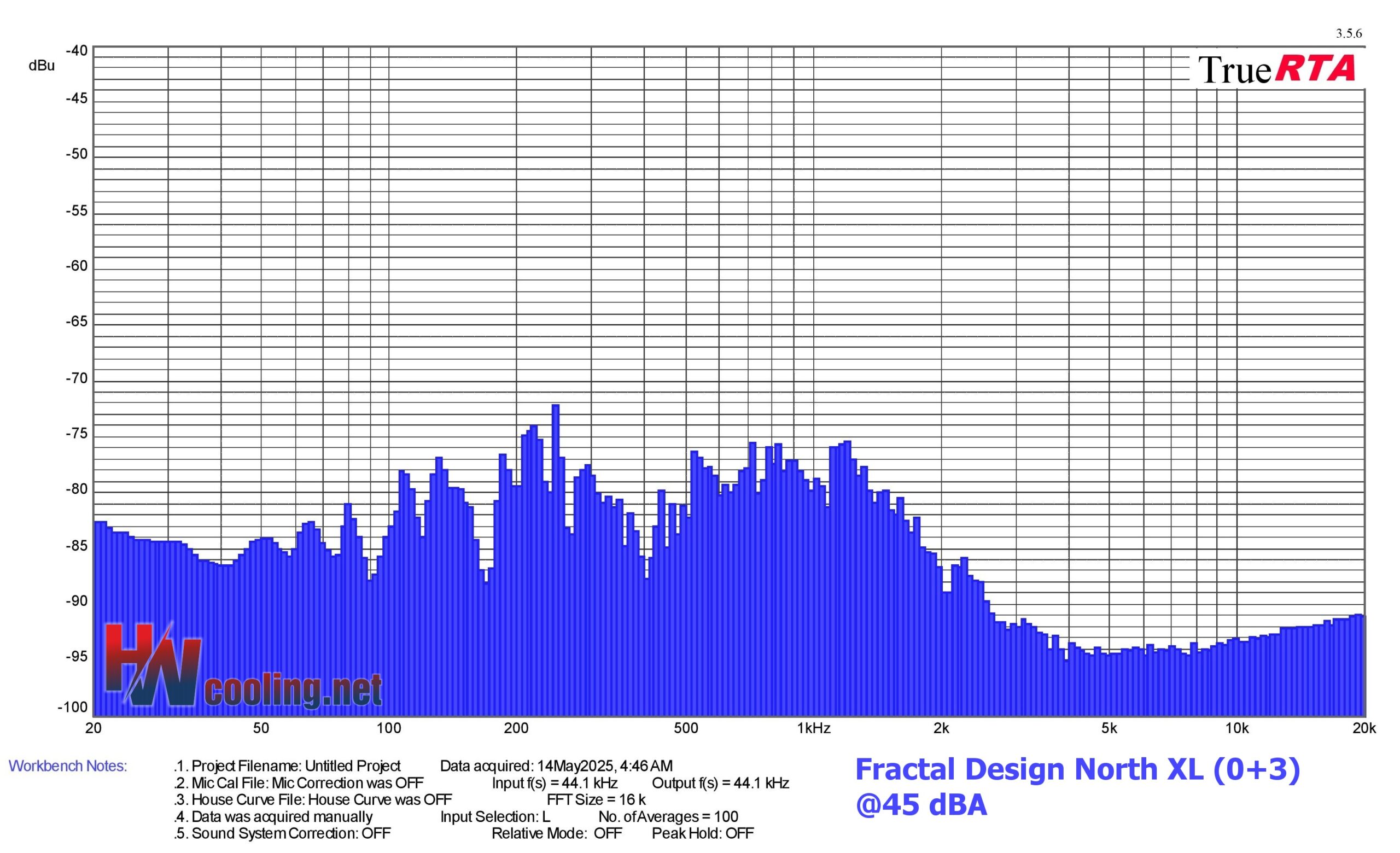
Results: Higher performance (45 dBA)
What about the system fans? We’re testing the Fractal Design North XL in two fan configurations. One is labeled “3+0” in the graphs, which is the default setup – all three included fans are in intake positions. No fan is placed in an exhaust slot (hence the “+0”). That’s the first of the two configurations. In the second, all fans are mounted as exhausts, thus labeled “0+3.” In this setup, there are no intake fans, but three exhaust fans pulling air out of the case – one in the rear and two in the top panel. That’s the limit with 140 mm fans; no more than two can fit in the top.
On vibration: With intake fans installed, we recorded relatively higher vibrations on the side panels near the wooden fins. However, the nature of these vibrations does not generate any secondary noise that might be bothersome. With the fans in exhaust positions, vibrations throughout the case structure remained consistently very low – negligible.
Why is there a missing value in the chart for a case? One possible reason is that the fans couldn’t be set to the required mode – either because the minimum RPM was too high or the maximum RPM was too low. Another reason could be that the available cooling performance was insufficient for one of the test components, which led to thermal throttling. Temperature values are always recorded (and compared) at comparable performance levels.
They’re built on an exceptionally efficient aerodynamic design, but come at a lower price point. Using more flexible blades reduces manufacturing costs, and the bearings in the Dynamic 3 fans are also “simpler” compared to the Momentum series. For the user, this doesn’t necessarily mean any major drawback—on the contrary, you can look forward to more pronounced lighting, enabled in part by a larger area of light‑conducting material. Read more “FD Dynamic 3: Efficient design (from Momentums) cheaper”»
Our database now includes one hundred fans—75 in the 120 mm format and 25 models with a physical size of 140 mm. In this article, we have compiled all data into unified charts. What was once separated for clarity is now brought together again, and the commentary will also include a… look ahead regarding fan testing. But we can already reveal that there is still a lot more to come. Read more “The end, or just the beginning? 100 fans in HWCooling tests”»
The HDD noise results, which were missing from the article immediately after publication, have now been added. For now, without comparisons, these measurements are hard to evaluate – but once more cases are added…
Would say HDD noise is good addition, but probably should be noted.
Whats drives are used and how much, because 5400 and 7200 is already different.
But if you pick 7200 8TB, and 7200 20TB, there is difference in sound. IDLIng may be similar, but startup or quick surface run will change sound profile for sure.
To provide the best experiences, we and our partners use technologies like cookies to store and/or access device information. Consenting to these technologies will allow us and our partners to process personal data such as browsing behavior or unique IDs on this site and show (non-) personalized ads. Not consenting or withdrawing consent, may adversely affect certain features and functions.
Click below to consent to the above or make granular choices. Your choices will be applied to this site only. You can change your settings at any time, including withdrawing your consent, by using the toggles on the Cookie Policy, or by clicking on the manage consent button at the bottom of the screen.
Funkčné
Always active
Technické uloženie alebo prístup sú nevyhnutne potrebné na legitímny účel umožnenia použitia konkrétnej služby, ktorú si účastník alebo používateľ výslovne vyžiadal, alebo na jediný účel vykonania prenosu komunikácie cez elektronickú komunikačnú sieť.
Predvoľby
Technické uloženie alebo prístup je potrebný na legitímny účel ukladania preferencií, ktoré si účastník alebo používateľ nepožaduje.
Štatistiky
Technické úložisko alebo prístup, ktorý sa používa výlučne na štatistické účely.Technické úložisko alebo prístup, ktorý sa používa výlučne na anonymné štatistické účely. Bez predvolania, dobrovoľného plnenia zo strany vášho poskytovateľa internetových služieb alebo dodatočných záznamov od tretej strany, informácie uložené alebo získané len na tento účel sa zvyčajne nedajú použiť na vašu identifikáciu.
Marketing
Technické úložisko alebo prístup sú potrebné na vytvorenie používateľských profilov na odosielanie reklamy alebo sledovanie používateľa na webovej stránke alebo na viacerých webových stránkach na podobné marketingové účely.




Thank you for the review(s) of this Fractal Design case: part one and part two.
May I suggest that more pictures are taken when grills and filters are removed to see what obstructions, if any, exists?
In the Meshify 3 article, you’ll hopefully already find at least some photo details similar to the ones you’re suggesting. 🙂
Thanks!
The HDD noise results, which were missing from the article immediately after publication, have now been added. For now, without comparisons, these measurements are hard to evaluate – but once more cases are added…
Would say HDD noise is good addition, but probably should be noted.
Whats drives are used and how much, because 5400 and 7200 is already different.
But if you pick 7200 8TB, and 7200 20TB, there is difference in sound. IDLIng may be similar, but startup or quick surface run will change sound profile for sure.
Thanks for the message. The HDD we used is a WD Gold HDD (WD4004FRYZ) – you can find this info in the second chapter of the article, Testing Methodology. We chose it based on experience from other tests where we monitored the impact of vibration on overall system noise. WD Gold drives are known to be very loud, but also high-performance. In our case tests, we measure noise levels during seek operations while performing random 512-bit read/write block access.