Thanks to the lower power consumption of the GeForce RTX 5060 Ti and the use of more compact printed circuit boards in the new GeForce RTX 50 series, Gigabyte offers cards with a unique design in the WindForce 2X and Eagle model lines. Their PCB extends only halfway along the PCIe slot. This allows the use of a compact dual-fan cooler with an unobstructed heatsink behind the rear fan, which delivers excellent cooling performance for its size.
A detailed description of the new technologies brought by Nvidia’s new graphics cards has been compiled by Jan Olšan in the article Blackwell: GeForce RTX 5000 architecture and innovations. It introduces the individual graphics chips Nvidia is using in the new cards, the new GDDR7 memory type, and also covers changes in cache memory, GPU compute units, updates to shaders and tensor cores, as well as improved compute units for ray tracing. The new generation of GeForce also brings support for new standards such as DisplayPort 2.1b and PCI Express 5.0.
With the new generation of cards, DLSS capabilities are evolving as well. It now supports Multi Frame Generation, which allows the generation of up to three intermediate frames, and introduces Nvidia Reflex 2, the second generation of its latency-reduction technology. This includes Frame Warp, which adjusts object and camera motion in rendered frames based on the player’s most recent input device movement data received just before the already rendered frame is displayed. A more detailed explanation can be found in the aforementioned article.
The specifications and suggested prices of the RTX 5060 Ti and RTX 5060 Ti have already been presented in the article GeForce RTX 5060 and 5060 Ti are here: Specs, pricing, availability. Here, we’ll just briefly summarize – the RTX 5060 Ti is equipped with the smallest chip so far based on the Blackwell architecture, designated GB206. It has a die size of 181 mm² and 21 billion transistors. The core contains 4608 stream processors, 144 texture mapping units, and 48 raster units, along with 36 RT cores and 144 tensor cores. The base clock speed of the GPU is 2407 MHz, with a boost of 2572 MHz, and the power limit is set at 180 W. It comes in variants with either 8 or 16 GB of GDDR7 memory, connected via a 128-bit bus. The memory speed is 28 Gb/s, and the total memory bandwidth is 448.0 GB/s.
The first to hit the market are the 16GB variants of the RTX 5060 Ti, while the trimmed-down 8GB version of the RTX 5060 Ti and the 8GB RTX 5060 are scheduled to go on sale a few days later. The reason Nvidia prefers reviews of the 16GB version is clear – in several memory-intensive games, 8GB cards suffer from performance drops at ultra settings due to insufficient memory. Precisely because these games can showcase the benefits of greater memory, they are overrepresented in benchmarks compared to their share of the gaming market and significantly influence the overall evaluation.
Memory also runs out on 8GB GeForce cards in some games when path tracing, DLSS, and frame generation are combined. However, frame generation combined with demanding ray tracing is exactly what Nvidia highlights as the main advantage over previous-generation GeForce cards – and if these features can’t be used, the generational leap isn’t as apparent.
Gigabyte GeForce RTX 5060 Ti Eagle OC 16GB: Half the size, not half-baked
The Eagle series models sit roughly in the middle of the lineup – below them are the Windforce cards, and above them are the triple-fan Gaming, Aero, and premium Aorus GeForce RTX 5060 Ti Elite models.

This particular card is factory overclocked. The stated typical boost clock has been increased from the reference 2570 MHz to 2617 MHz. Actual operating clocks are higher and vary depending on load type and GPU utilization. Clock behavior and specific values can be found in the chapters covering operating characteristics.
The card features a single BIOS. Compared to Gigabyte’s dual-BIOS models, its behavior is more akin to the performance mode, where fans run at higher speeds and temperatures are lower.

The power limit is set at the reference 180 W but can be adjusted in a narrower range of 150–206 W, i.e., from -17% to +14%. This upper limit places the card between entry-level and more robust models. This is likely due to its power delivery – the card uses a standard 8-pin connector, which allows for a max draw of 150+66 W on the 12 V rail, while some cards with stronger 12V-2×6 connectors can exceed 230 W.
The fans are connected via a single shared connector using a splitter, which means their speeds cannot be monitored or controlled individually.


HWiNFO can extract significantly more data from the card than GPU-Z, you can see the list of currently read sensors in the snapshot from the monitoring.

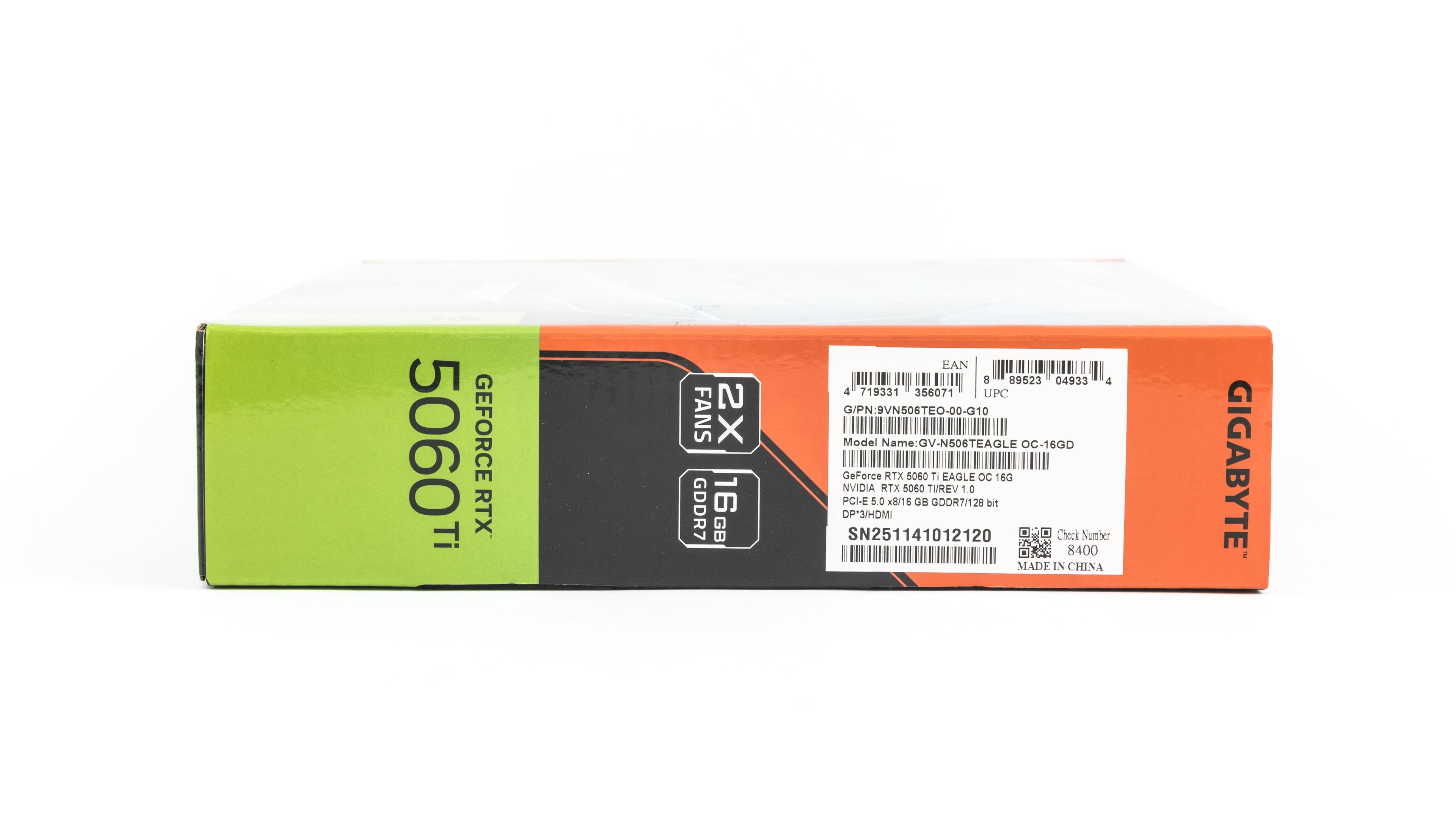
The back of the packaging highlights the features and technologies the card supports. As a more budget-friendly model, you shouldn’t expect anything too extraordinary. It details the Windforce cooling system, which includes two newly designed fans that offer higher efficiency and lower noise, as well as a large open vent behind the heatsink at the rear of the card. A more robust metal backplate, secured to the bracket, adds structural strength.


The accessories include only a brief installation guide.

⠀