

The Gigabyte GeForce RTX 5070 Ti AERO OC 16G targets gamers moving away from flashy RGB setups and pitch-black components, opting instead for an all-white aesthetic. Its elegant design and massive cooler take it clear that it’s built for demanding gamers who want more than just the best price-to-performance. Beyond its unconventional look, it also delivers slightly higher performance thanks to factory overclocking and excellent operational characteristics.
Fan behaviour, noise level
The fans have a large diameter and are powerful, so they are quiet only at low speed. The minimum speed you canin the control is 30%, at which they spin at 1000 rpm and the measured noise is just slightly above 30 dBA. They become noticeably audible somewhere between 1400 and 1500 rpm. In silent mode, they are mostly around 1200-1250rpm with a measured noise level of around 33-34 dBA, which is absolutely luxurious. Chances are you won’t be able to distinguish the card from other fans in the case, and at similar noise levels the power cascade coils are already more annoying than the fans.
In performance mode, the fans are already clearly noticeable by ear at speeds of around 1600rpm and 39 dBA, but they’re still noticeably quieter than most cheap models, whose noise levels are usually around 40-44 dBA
You can crank the fans up to 3000rpm, so purely in terms of performance temperatures the cooler still has a huge margin, so you have a lot of room to experiment with performance tuning. But a noise level of 58 dBA is hardly acceptable anymore.

Metro Exodus Benchmark, Performance
The first set of results are from the Metro Exodus Enhanced Edition benchmark with the RT Medium setting at 3840×2160 pixels. With this setting, the graphics chip is also fully loaded. These are six loops of the benchmark in quick succession.
The chart always shows the last run, which is used to calculate the average value for the warmed-up card.
The frame rate is around 48.3 frames per second.

The GPU clock speed is between 2707 and 2812 MHz with the average at 2749 MHz, about 40 MHz lower than MSI’s premium model.

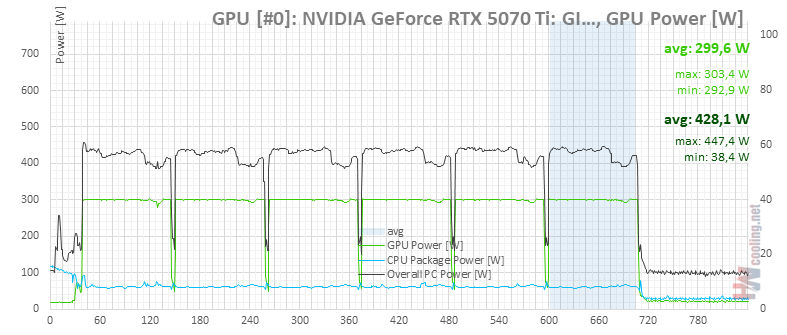
The power consumption of the card is just on par with GPU limit read from BIOS. The green is the power consumption of the card itself according to the monitoring and the blue is the power consumption of the CPU according to the monitoring (read via HWiNFO).
The dark colour is the power consumption of the whole PC measured by UT71E multimeter.
The average temperatures of the chip under load are around 63–64°C, and the memory is also well-cooled. However, maintaining such low values at the cost of increased cooler noise is probably not worth it.

In Gaming mode, the fans in the test spin up to around 1,600 RPM. The graph could show three separate values for each fan, but their curves mostly overlap, with deviations usually within a few RPM.

GPU Boost clock is limited by 300W power limit.

⠀