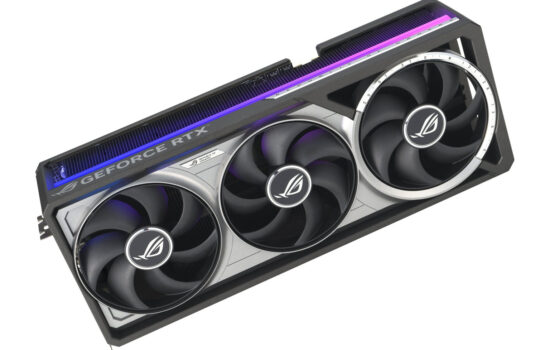


MSI’s Gaming series cards no longer sit at the top of the company’s lineup—they’ve now moved into the mid-range segment. Still, they offer an excellent mix of features and performance. A card like the GeForce RTX 5070 is likely to be popular among gamers, as it should handle sub-4K gaming comfortably for the next few years and remains relatively affordable. Let’s see how the RTX 5070 12G Gaming Trio OC compares to other models we’ve already tested.
Fan behavior, noise level
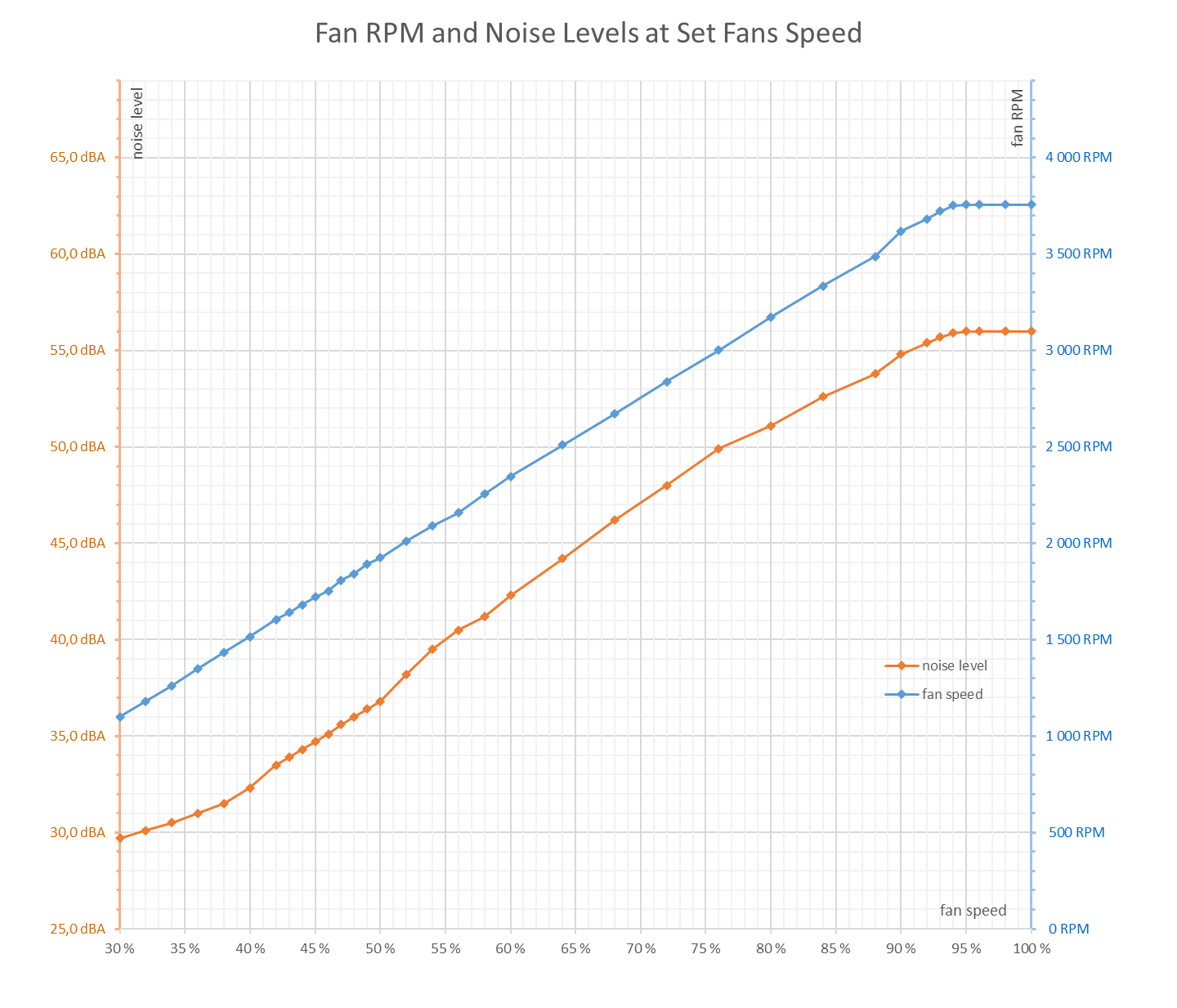
Fan speeds can be adjusted from 30–100%, which corresponds to fan RPMs in the range of 1100–3750 RPM (29.4–57.7 dBA). The graph shows the RPM of the rear fan connected to the Fan 1 header. The fan in the middle and the one next to the bracket are connected via a splitter to the Fan 2 header.
Fan speeds from the Fan 1 and Fan 2 headers were synchronized up to around 93% performance. Beyond that, the variance was minimal. Full speed was achieved at 95% – Fan 1 maxed out at 3756 RPM, while Fan 2 went slightly higher at 3800 RPM.
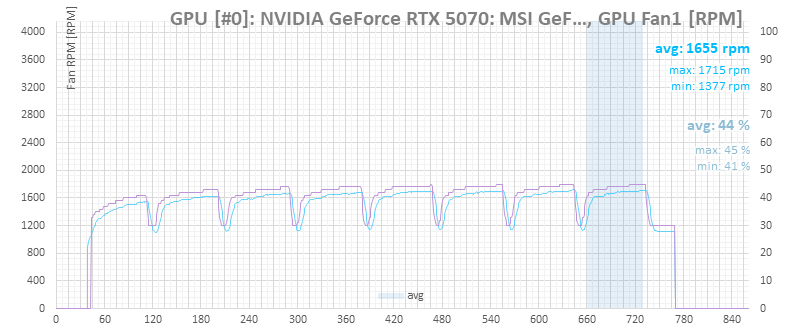
At minimum speed, the noise meter showed a noise level of 29.7 dBA, which is below its measurable range. At maximum speed, noise peaked at 56 dBA. During thermal performance tests, the fans on a warmed-up card ran in the range of 1715–1750 RPM, corresponding to noise levels of around 34.7–35 dBA. The card isn’t entirely silent, but ranks among the quieter options on the market.
The Gigabyte RTX 5070 Gaming OC performed only slightly better in Silent mode, with noise levels of 33.8–34.8 dBA. The Asus Prime RTX 5070 was about 1 dBA worse, though that was due to a buzzing fan. The Asus TUF RTX 5070 clearly outperformed others with its cooler, maintaining fan speeds of 900–990 RPM and a sound level of 29.6–30.3 dBA in Silent mode, at the lower end of the noise meter’s range (though the coils were slightly noisier, resulting in readings around 31 dBA).
Average GPU and memory temperatures stayed below 70°C, making the MSI RTX 5070 Gaming Trio’s performance more than satisfactory and leaving ample headroom to reduce fan speeds for quieter operation.
Cyberpunk 2077, RT Medium, 3840 × 2160
The first test data comes from Cyberpunk 2077 with RT Medium settings at 3840 × 2160 resolution. The test consists of eight consecutive benchmark loops. The graph shows the final loop, from which the average value of a warmed-up card is calculated.
During the test, the card hits the power limit, although frame rates indicate that native 4K with ray tracing is beyond the chip’s comfort zone.
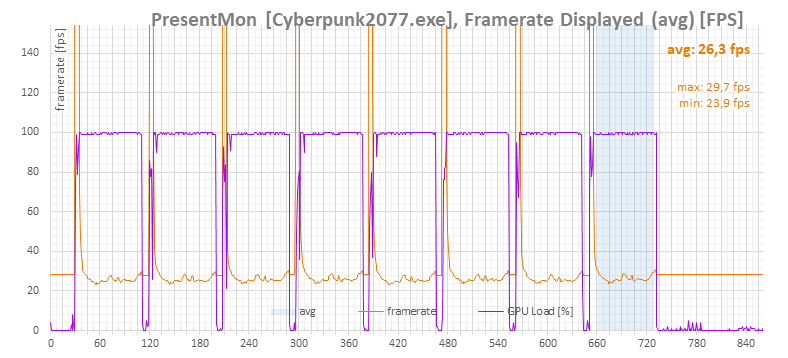
The warmed-up GPU clock speed fluctuated between 2730 and 2790 MHz, with an average of 2766 MHz.

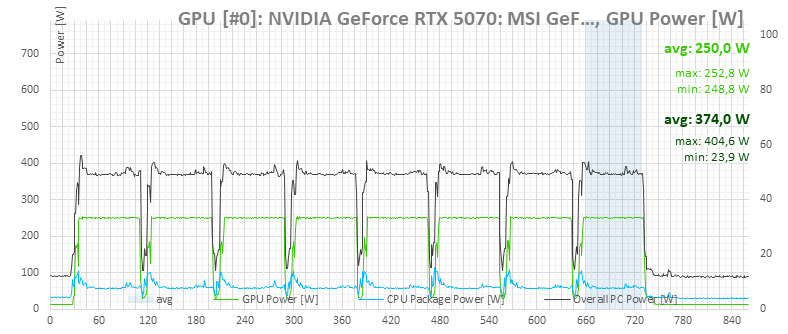
According to power monitoring (light green line), the card stayed at the defined 250 W power limit. However, the GPU Boost seems to be voltage-limited, which doesn’t really align with the light green line sitting at the power limit level.
The darker line on the graph represents total system power measured by a UT71E multimeter. Average power consumption under load was just 243 W, mainly due to low CPU usage and modest GPU workload.
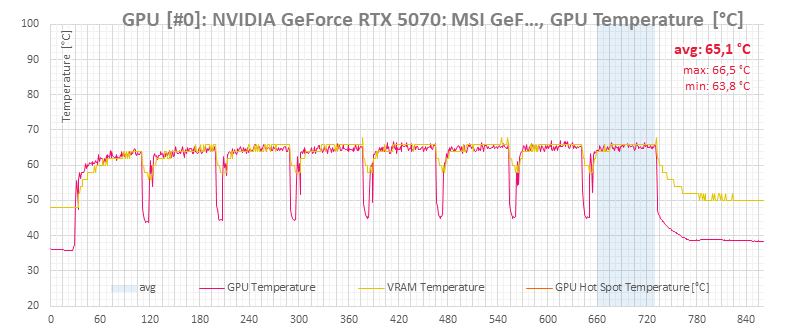
The GPU temperature peaked at 66.5 °C, and memory temperatures hit a maximum of 68 °C during the test period.
One could argue that the fans were spinning faster than necessary at these temperatures. A 200 RPM reduction would have made the card about 2.5 dBA quieter with no ill effects.

⠀