At the beginning of the year, Gerrard Williams III and other ex-Nuvia and ex-Apple processor architects had left Qualcomm, who had acquired their company five years earlier for the high performance Arm cores that power current Snapdragon X and X2 processors, as well as mobile chips. They immediately founded another new CPU-development startup, Nuvacore. The strategy they have revealed will be quite different from Nuvia’s, though.
Nuvacore was expected either to start developing another new proprietary line of Arm cores, essentially repeating the story of the Nuvia startup, most likely with the eventual goal of selling the company to one of the Arm chip manufacturers (MediaTek, Samsung, etc.). Or that perhaps, Gerrard Williams III and the company would try their luck with the RISC-V instruction set this time, which is a platform attracting interest in theory and simultaneously lacking truly high-performance processors which creates an opportunity to fill that gap in the market.
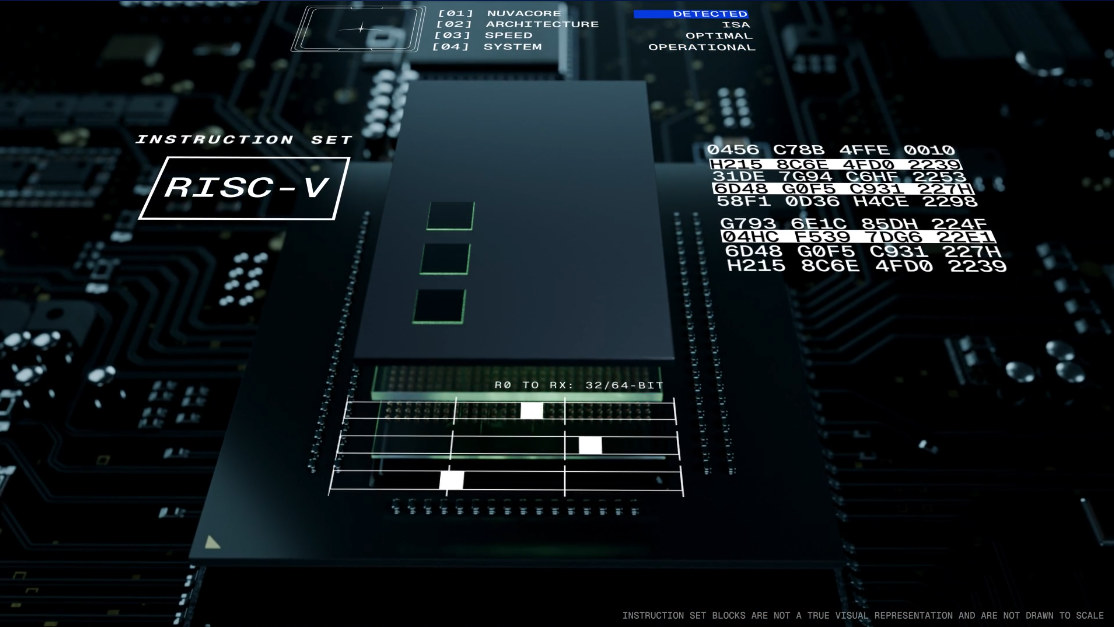
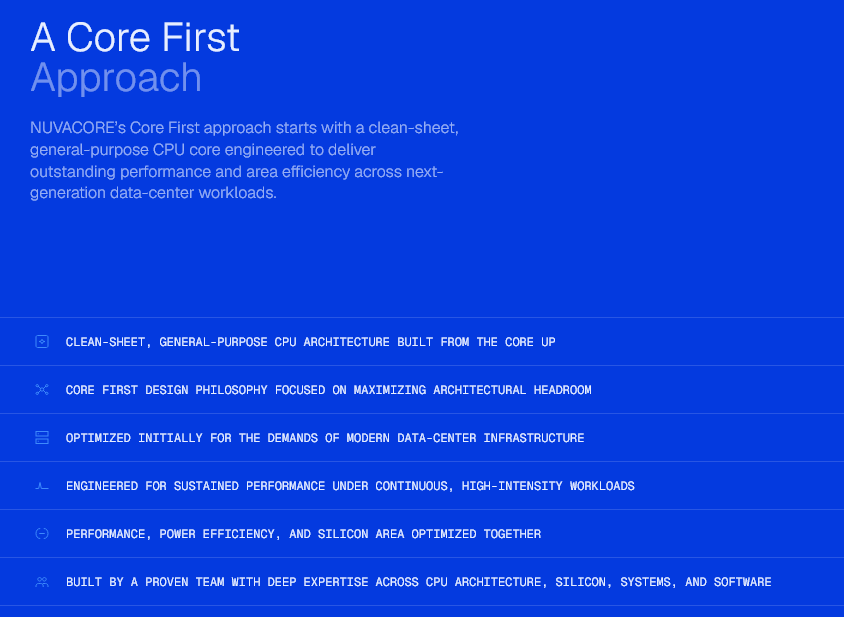
Nuvacore has now revealed some of its plans, however, and it turns out things will be somewhat different. The company has potentially signed up for the x86, Arm and RISC-V instruction sets simultaneously, while also committing to none of them. According to its presentation, the company is developing a high-performance CPU core (naturally world’s best and most powerful one—marketing can’t have it otherwise) called WarpCore. At its foundation is a new concept called “Core First”, which will be agnostic to the chosen instruction set and will allow it to be selected relatively flexibly, like choosing an outfit (to put it very simply).
This core is supposed to be designed from the ground up so that the “internal” infrastructure is built first. This infrastructure does not differ all that much between the Arm, RISC-V and x86 instruction sets (or perhaps it is influenced by their differences, but you can designed the logic with them in mind). According to Nuvacore, this part of the core can account for up to 95% of the entire design and can supposedly be developed without the company having to make a binding decision on the processor’s final instruction set.
Only the final 5% (instruction decoders, for example) then determine which instruction set the processor will implement and expose to the operating system and software running on it. Nuvacore presents this as a decision that can be made relatively late and, potentially, as a way for the processor to quickly adapt to several different architectures. This would allow one company to license WarpCore and turn it into a RISC-V processor, while another could turn it into an Arm processor. And if a customer with the right to manufacture x86 processors were found (or with ways to deal with Intel’s and AMD’s patents that normally prevent other companies from manufacturing such CPUs), Nuvacore could also turn the WarpCore core into an x86 processor.
AMD has once been pitching a somewhat similar strategy to its investors/shareholders. Alongside the first version of its Zen architecture, the company was also developing an Arm core called K12, which was supposed to share most of its technology with Zen 1 and differ mainly in the instruction decoders. Development of the K12 core was ultimately canceled before any actual chip could emerge from it.
Freedom in Design, or More Compromises?
The question is if this is really a technological oportunity and not more of a trade-off. Modern processors do indeed initially decode the regular instruction set into some other internal instruction format, which they then work with most of the time, so it may seem that the instruction set visible externally does not need to be all that important. Yet it still has a major influence on what the execution units inside the processor need to be capable of—which is also why people talk about x86 suffering from various forms of historical baggage that hamper performance. But the issue extends to other things as well.
If WarpCore or the Core First concept is supposed to provide a neutral common foundation that can easily be finalized into an x86, Arm or RISC-V processor, then it is probably not the case that the Core First approach gives Nuvacore a perfect design with all sorts of advantages and unlimited opportunities for optimization, as the company’s marketing suggests. Rather, the design may have to simultaneously accept constrains inflicted by the limitations of all three instruction sets instead of just having tu accommodate one.
Architectural preparation for supporting x86 and RISC-V could therefore slightly reduce the performance that the Arm version would otherwise be capable of. This does not necessarily have to be a bad trade-off, however. It is entirely possible that it will work out well for a range of applications and that the company will find solutions to some of these problems that circumvent or mitigate the various difficulties.
…or Boosting Acquisition Prospects?
It is also quite possible that this CPU development concept is not purely a technical matter, but that a somewhat more cynical factor is also at play. Nuvia ended up being acquired, with Qualcomm paying 1.4 billion USD for it. For startups, being acquired is one of the main goals and one of the main ways of recouping the investment put into them and “succeeding”. Sometimes this can even take pathological forms, where a company is not really betting on the actual prospects or feasibility of its product or technology at all, but is solely trying to find someone willing to buy it before the money provided by speculative investors runs out.
And the fact that this time Nuvacore is not tied to the Arm architecture like Nuvia was, but is also open to others, naturally expands the potential pool of large companies that could be persuaded to acquire it. Moreover, Nuvacore does not have to deal with licensing itself—the company’s apparent goal is to design an “agnostic” processor foundation, while the client is supposed to deal with the licensing issues (with Arm and x86).
This could be a reaction to the previous bad experience with licensing relationships, when, following Qualcomm’s acquisition of Nuvia, Arm sought to invalidate Nuvia’s license and claimed that Qualcomm had no right to use its core. It even asked the courts to have the development results destroyed irreversibly (for very self-serving reasons—Arm did not want Qualcomm to have its own core because this reduces the royalties Qualcomm pays to Arm).
- Read more: ARM to take over the license of the primary mobile chip manufacturer Qualcomm
- Read more: Qualcomm not required to destroy Nuvia’s core design, court rules in ARM’s lawsuit
Nuvacore is not even a year old, and it can be expected that turning its concept into an actual processor will once again take another three to four years. How successful these CPUs will ultimately be, and whether the “Core First” approach can actually succeed, will therefore probably not become clear for quite some time. What may find out sooner, however, is whether Nuvacore is once again going to be bought out by one of the silicon giants (or perhaps Microsoft, Google, Meta, etc.), or whether this time it will remain independent and make its living solely by licensing its cores like Arm.
English translation and edit by Jozef Dudáš