The Nitro+ Radeon RX 9070 XT sits at the top of Sapphire’s lineup. AMD’s current Radeon generation focuses solely on the upper mid-range segment with intense price competition. As a result, Sapphire’s flagship isn’t a pricey premium model with a massive cooler like the previous-gen Nitro+ RX 7900 XTX. Instead, the designers focus on attractive aesthetics and distinctive features, such as the hidden 12V-2×6 power connector.
Fan behavior and noise levels
Fan speed can be set between 30% and 100%, which yields roughly 1100–3000 rpm (29.1–46.8 dBA). At the minimum setting, the sound level meter read 32.1 dBA, which is audible at close range.
At higher speeds, large fans tend to show noticeable fluctuations in noise.

Fan behavior and noise levels
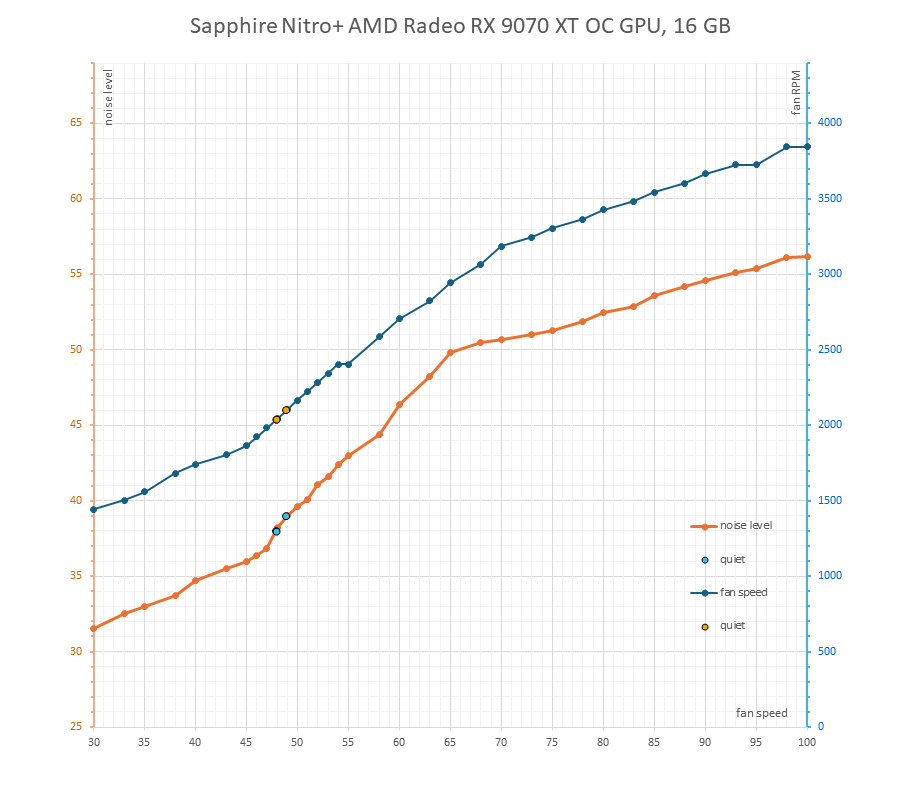
Fan speeds can be adjusted from 15% to 100%, corresponding to roughly 780–3850 rpm (29.4–56.2 dBA). At the minimum setting, the measured noise is below the sound level meter’s range.
Under load, the fans ran at 2000–2100 rpm, which equals 38.2–39 dBA. Surprisingly, that’s slightly worse than the cheaper RX 9070 XT Pure, where the fans spun 200–300 rpm slower under the same conditions and noise was about 35 dBA.
Even so, it’s still quieter than typical base models, which are usually around 41 dBA.
Cyberpunk 2077, RT Medium, 3840 × 2160 (P mode)
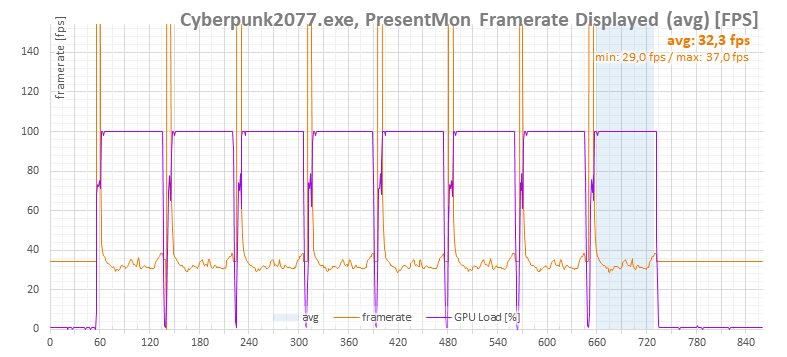
The first set of measurements comes from the Cyberpunk 2077 benchmark using the RT Medium preset at 3840×2160. It consists of eight loops. The final run is highlighted, and the average for the warmed-up card is calculated from that run.
The GPU is fully utilized in this test, and the card is pushed up against its power limit.
Once warmed up, the GPU core clock ranges from 2709 to 2879 MHz, averaging 2775 MHz.

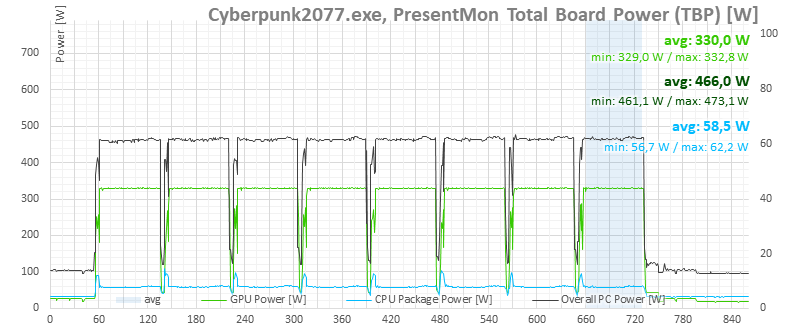
According to HWiNFO’s power monitoring, the card (light green line) sits at a 330 W power limit. Note that this is the power-control limit, not the card’s actual total power draw (total board power); the real draw is a few tens of watts higher.
The dark line in the chart shows the total system power measured with a UT71E multimeter. Under load, the system averaged 466.0 W.
Over the measured interval, the GPU’s average temperature reached 63.0 °C, with memory at 92 °C. The hotspot peaked at 88 °C.

At first, while the card was still cool, fan speeds were around 1700 rpm; after it warmed up, peaks reached about 2100 rpm.

⠀
⠀