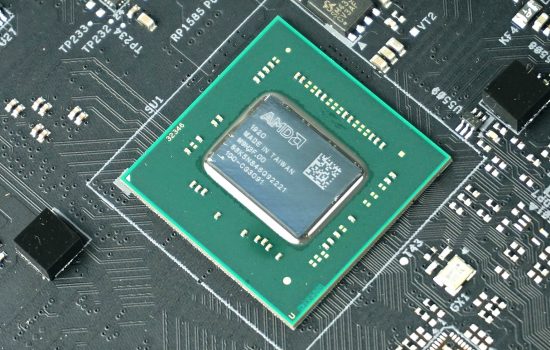
Last month, AMD unveiled its CDNA 5 architecture-based Instinct MI455X AI accelerators. This matters even outside AI and server workloads, because CDNA 5 is now related to the RDNA 5 architecture that will power the next generation of Radeon gaming GPUs. Let’s take a look at what the new Instincts reveal about RDNA 5 and what else has leaked about this architecture. This includes one change that is rather surprising.
Information had already surfaced that AMD planned to bring the CDNA and RDNA GPU architecture lines closer together or even unify them (possibly under the UDNA name). This now appears to be confirmed—AMD has “rebased” its compute GPUs on an architecture derived from gaming GPUs, and CDNA 5 evidently stems from the RDNA lineage. It should already reflect changes that will appear in gaming GPUs after the currently sold RDNA 4 architecture.
WGP instead of CU
The first change that might be immediately visible in specifications of the GPUs is that today’s basic building block—the compute unit (CU) with 64 shaders—may disappear. GPUs based on RDNA architectures have always grouped these CUs in pairs into larger units called WGPs (WorkGroup Processors).
It seems that with CDNA 5, and potentially RDNA 5, the CU will be fully merged into the WGP. Such a GPU would then have basic units with 128 shaders per WGP (which might perhaps be renamed back to CU—we’ll see).
This could complicate the interpretation of leaked GPU parameters. It will be important to distinguish whether the number of compute units in RDNA 5 chips refers to WGPs with 128 shaders or CUs with 64 shaders. Even after this change, a WGP is still composed of SIMD32 units like previous RDNA architectures, except that these SIMD32 units (SIMD units with 32 “lanes”) are now four per WGP instead of two per CU.
The fact that CDNA 5 is derived from the RDNA lineage of architectures is a major shift, as previous CDNA 1 through 4 designs evolved from GCN architecture and used SIMD16 units while processing wave64 wavefronts (this denotes the width of operations the GPU executes; each wavefront required four consecutive cycles to complete). Now the GPU uses SIMD32 units and processes wave32 wavefronts in a single cycle. For RDNA 5 compared to RDNA 4, this is not a change, since RDNA has had this characteristic from the beginning. Perhaps the only difference is that CDNA 5 does not support wave64 ops at all, whereas RDNA architectures have supported them so far (whether RDNA 5 will remove support or retain compatibility remains to be seen).

RIP Infinity Cache?
What may be quite surprising is that AMD appears to be abandoning Infinity Cache in its current form. This innovation significantly boosted the performance of Radeon RX 6000 GPUs, which managed to compete with Nvidia’s GeForce RTX 3000 cards despite using narrower memory buses. Infinity Cache is a high-capacity, high-bandwidth GPU L3 cache that covers a large portion of RAM accesses to most commonly used data, allowing the GPU to deliver the same level of performance with much lower VRAM bandwidth than it would otherwise require.
However, GPUs based on CDNA 5 do not use Infinity Cache at all and in fact contain no L3 cache at all. And it seems the same will be true for RDNA 5 GPUs. Instead, the GPUs will use only a global L2 cache (GL2), apparently in smaller capacities. According to earlier leaked specifications, for example, the AT2 GPU—likely the successor to Navi 48 die used in the Radeon 9070 XT—should have only 24 MB of L2 cache, whereas Navi 48 has 64 MB of Infinity Cache plus 8 MB of L2. And in the Radeon RX 6000 generation, the corresponding Navi 21 chip had the famous 128 MB Infinity Cache (and 4 MB of L2).
- Read more: RDNA 5 GPU specs leaked: RX 10000 Radeons back in high-end?
- Read more: Details on Cheaper RDNA 5 GPUs: Will Radeons Switch to LPDDR6?
It’s unlikely that this means AMD considers Infinity Cache a failure that was ineffective. The fact that gaming GPUs benefit from larger caches has been confirmed—and Nvidia has also increased L2 cache sizes since then, by the way. RDNA 5 will likely replace Infinity Cache functionality with its global L2 cache, which may be more silicon area-efficient solution. It appears that L2 cache in RDNA 5/CDNA 5 will prioritize higher performance over higher capacity (which is “expensive” in terms of die area). And although smaller capacity means worse hit rate, this may be compensated by improved cache policies that select which data to retain more efficiently, maximizing the benefit of the limited capacity.
According to some additional leaks, PlayStation 6 console may use a GPU with 52 CUs and just 10 MB of GL2 (and no Infinity Cache). Hopefully this means GL2 efficiency is high enough that it compensates for this relatively low capacity, rather than that Sony and AMD simply desiced up cutting the costs too aggressively.
RDNA 5 will launch next year
RDNA 5 will certainly bring many more changes compared to RDNA 4, and we naturally won’t learn about all of them in advance like this. And not all changes that are already known from CDNA 5 are guaranteed to have a major impact on gaming performance or even to appear in RDNA 5 at all.
CDNA 5 is likely based on architectural development that is somewhere halfway between RDNA 4 and RDNA 5, rather than being a direct derivative of RDNA 5, and the new generation of Radeon gaming GPUs based on RDNA 5 is probably still relatively far from release. Leaked information so far suggests they might begin shipping sometime around mid‑2027, possibly in the second half of the year—or even later.
Sources: Chips and Cheese, Moore’s Law is Dead
English translation and edit by Jozef Dudáš
⠀⠀