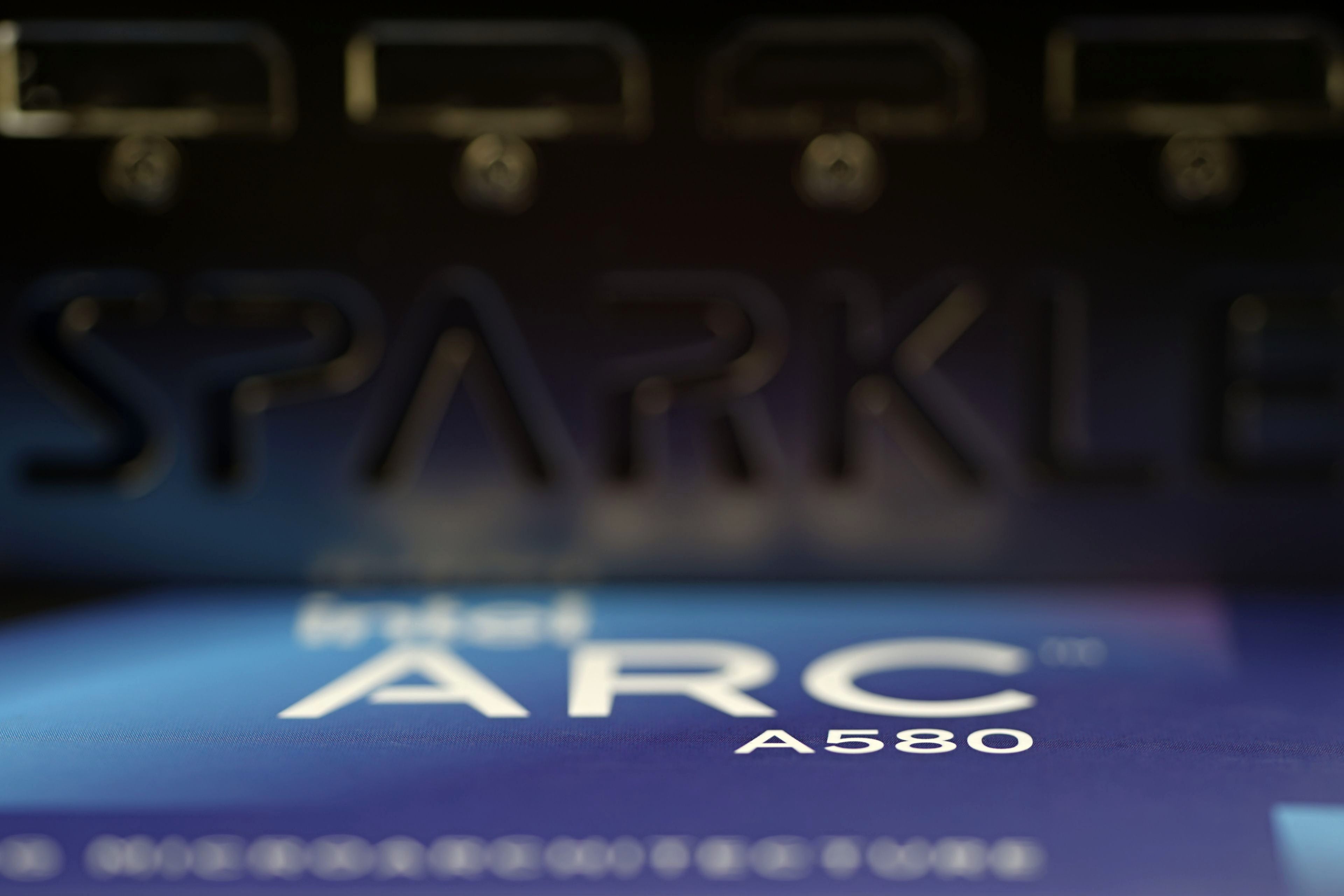
AMD and Nvidia let the cheap graphics card segment “deteriorate” so much that Intel took advantage of it quite elegantly. The latest Arc A580 in the Sparkle (Orc) design has a lot of imperfections that you might not get over, but at the same time it has settled into the top spot when it comes to price/performance ratio in gaming. With this primacy, it profiles itself as one of the leading adepts into low-budget builds.
Conclusion
Probably the most attractive thing – the Sparke A580 Orc tops the price/performance charts. This relatively inexpensive and powerful card can be extremely attractive to users who want a powerful gaming PC for as little money as possible.
Of course, we’re talking about the lower-end and 1080p resolution that the Arc A580 is aiming for, and compared to the more expensive RTX 3050, it’s 10% faster on average. The Intel GPU even has the upper hand with raytracing graphics, we saw an increase (compared to the RTX 3050) in Battlefield V, in Metro Exodus (and there really significantly). In Cyberpunk 2077 with RT graphics, the A580 is already a little weaker, and that’s also the case in Shadow of the Tomb Raider.
Anyway, it’s worth pointing out that with ray tracing, the A580 sometimes beats even the higher class Radeon RX 7600, which has about a 25% edge on average with pure rasterization. In FHD (1080p) resolution, that is. In UHD (2160p) it is only 12%. This is of little relevance to the A580, as at such high resolutions this graphics card can’t keep up anymore. However, this illustrates well the positive impact of the higher memory bandwidth that is achieved due to the wide 256-bit bus.
It’s one thing when the Intel GPU works great and another when it’s, shall we say, worse. For example, hardware acceleration in Blender@Cycles via OpenCL (i.e. the only option) is very slow, almost to the point of using the word “none”. There is some activity here though, but in any case at only ~51 W, which doesn’t even correspond to a quarter of the maximum power draw (the situation with oneAPI supported in newer versions of Blender than we use, for historical consistency of results, is already different, with more performance).In Affinity Photo, you have to disable OpenCL for the application to run at all.
Under OpenGL, for a change, even higher performance than the RTX 3050 is achieved, for example in CATIA, Maya or Medical. More interesting than this is the acceleration of Adobe Photoshop filters (Field Blur, Iris Blur, Adaptive Wide-Angle), where the A580 beats not only the RTX 3050, but also the RX 7600. It doesn’t always succeed, but we can definitely say that as a cheap option for DTP builds with Photoshop, the A580 Orc is a bargain in terms of speed.

If you are interested in the performance, the top-notch price/performance ratio and are not discouraged by possible complications with software compatibility, there are also the relatively unattractive operating characteristics. The Intel Arc A580 also has significantly worse efficiency compared to equivalent Radeon RDNA 2s. Even compared to the RX 6650 XT it’s about 30%, compared to the lower-power RX 6600, which we haven’t measured yet, it’s going to be an even bigger gap. Also notable is the comparison with the RTX 4060, which can be 40% lower-power while at the same time 23% faster. But that’s already in a different price range, typically with fewer shortcomings.
We praised the Sparkle A580 Orc for its smaller footprint (and thus better compatibility with surrounding components) when discussing design details, but it comes at the expense of higher noise. The latter is at the level of the Gigabyte RTX 4090 Gaming OC 24G, which is a graphics card with twice the power draw. And you may encounter higher noise levels than you’d like, even at lower loads. There, you’re likely to be on the borderline between passive and active mode, where the fan switches on and off in regular cycles. This period is well illustrated by the noise curve in Blender tests, it can happen even under video decoding loads and in builds with weaker system cooling even when idle, where it (GPU temperature) doesn’t get below 50 °C easily. Na to by ste museli grafickú kartu prevádzkovať v prostredí s nižšou teplotou okolia, než je prirodzených približne 21 °C.
The higher idle GPU temperature is also due to overall higher power draw. At 44.5W, it’s the highest we’ve measured in a graphics card to date (Even the RTX 4080 Suprim X has 12 W less). Idle consumption should be possible to reduce, Intel also has a guide on what to do to do this. What kind of reduction can be achieved will be the subject of a separate test which we will publish at a later date. However, this does not change the fact that naturally, without special user intervention, running the A580 Orc in a lower load is inefficient. The power draw is higher than would be appropriate, even when playing video or in a web environment.
Why the price of the Sparkle A580 Orc is set as (low as) it is, you know. The only question is whether you’re willing to tolerate more negatives for a truly unbeatable price/performance ratio than you’ll find in slightly more expensive Radeons or GeForces.
English translation and edit by Jozef Dudáš
| Sparkle Arc A580 Orc |
| + Usually sufficient performance up to 1080p even for the highest graphics details |
| + Faster ray tracing even than on more expensive Radeon RDNA 2/3 cards |
| + Top-notch price/performance ratio... |
| + ... better than competing GeForce or Radeon graphics cards |
| + Class-leading memory bandwidth... |
| + ... and because of it, a smaller performance drop in higher resolutions and an eventual gain in compute tasks as well |
| + AV1 encoding support |
| + Smaller footprint, better all-around compatibility |
| - Poor power efficiency |
| - Abnormally high power draw at lower loads (including "idle") |
| - Increased risk of software incompatibility |
| - Noisier cooler |
| - Lower performance on older platforms without Resizable BAR support |
| Suggested retail price: 205 EUR |
For cooperation in providing the tested hardware, we would like to give special thanks to the Datacomp e-shop