The Radeon RX 6800 is the cheapest graphics card equipped with a Navi 21 graphics chip. That is naturally slower in this card than in the RX 6800 XT and RX 6900 XT, but the RX 6800 clearly offers the most attractive price/performance ratio of the three. And the power draw is also not bad, the efficiency is remarkably very decent here, despite the large, partially deactivated core. However, some flaws can be found on the AMD reference card. Read more “AMD Radeon RX 6800 test: More affordable “Big Navi””
Category: Graphics
Radeon AI upscaling alternative to DLSS coming this spring?
Radeon graphics cards currently have one disadvantage: they do not support Nvidia’s DLSS AI upscaling technology, which significantly increases FPS in exchange for some (hopefully slight) quality loss. AMD announced development of its own alternative when RX 6000 cards lanched, but it was not clear how long it would take. It may come relatively soon, as a big driver update is coming in the spring and “AMDLSS” could be part of it. Read more “Radeon AI upscaling alternative to DLSS coming this spring?”
RX 6800 XT vs. RTX 3080. Part 2/2: Non-gaming tests
Without application/computational tests, graphics card tests would be incomplete. Therefore, we will focus on this area outside of gaming that most hardware magazines neglect. We understand the reasons, there are several of them, but even so, it is possible with a little effort to make at least a few measurements. So hopefully they will also help multimedia creators in choosing the right graphics card. Read more “RX 6800 XT vs. RTX 3080. Part 2/2: Non-gaming tests”
AMD SAM on RX 6800 XT: up to +44% performance (and lower noise)
We still have the Smart Access Memory turned off in the standard graphics card methodology (until there is support for GeForce as well). However, for AMD owners, SAM can be very beneficial, but on average you get a plus 5%. But also lower noise, which decreases remarkably. But in some areas AMD’s exclusive technology is also damaging. So be vigilant and broaden your horizons in a test in which we gave Radeon a hard time. Read more “AMD SAM on RX 6800 XT: up to +44% performance (and lower noise)”
Duel: Radeon RX 6800 XT vs. GeForce RTX 3080 (part 1/2)
Eighteen selection games in various resolutions and settings, performance tests in computing applications, detailed analysis of power draw and generated sound, in which we go up to the level of frequency responses. This captures the new robust methodology for graphics card testing. And right at the beginning, popular high-end models from both camps are going to undergo the tests. Read more “Duel: Radeon RX 6800 XT vs. GeForce RTX 3080 (part 1/2)”
A look at Nvidia DXR, Broadcast App and DLSS visual quality
We are introducing a new testing methodology for graphics cards. One of the reviewed cards will be the GeForce RTX 3070 and we have an interesting one: Aorus GeForce RTX 3070 Master 8G with six video outputs. Before the review comes out, we’ve use it for a visual comparison to see the impact of ray tracing and how the different DLSS settings in the latest Cyberpunk 2077 patch will affect the quality of the game graphics. Read more “A look at Nvidia DXR, Broadcast App and DLSS visual quality”
Nvidia intros PCIe Resizable BAR: Smart Access Memory for GeForce
With Radeon RX 6000 GPUs and Ryzen 5000 CPUs, AMD unveiled the Smart Access Memory feature, which improves GPU performance by giving the CPU access to whole graphic memory. It was touted as an exclusive feature for these products, but it won’t be in the end. Nvidia has now announced PCIe Resizable BAR, essentialy the same feature, and it’s soon going to be supported by GeForce RTX 3060. Older cards will need a BIOS updat, though. Read more “Nvidia intros PCIe Resizable BAR: Smart Access Memory for GeForce”
Radeon RX 6700 & RX 6700 XT launch expected at end of March
Last autumn, the long-awaited new generation of graphics cards arrived, but at the start Nvidia and AMD have only released the more expensive SKUs. Now, in the winter and spring months of 2021, cheaper cards are finally supposed to arrive too. It seems that new cards belonging to the Radeon RX 6000 hierarchy should appear in about two and a half months, and both will build on the Navi 22 chip. Read more “Radeon RX 6700 & RX 6700 XT launch expected at end of March”
Mobile GeForce RTX 3000 to arrive on Jan 12. Specs revealed
So far, Nvidia has only released the GeForce RTX 3000 graphics cards for desktop. But this year, it should soon come to laptops, which will bring the performance of the new generation of 8nm Ampere chips into mobile. According to leaks, GeForce RTX 3060, RTX 3070 and RTX 3080 mobile GPUs should be released soon, and we already have their specifications including the number of shaders and clocks. Read more “Mobile GeForce RTX 3000 to arrive on Jan 12. Specs revealed”
Next-gen Nvidia GeForce GPU is Lovelace on 5 nm. Up to 144 SMs?
A year ago, even before Nvidia’s announcement of Ampere, it was leaked that the followup to the current generation is likely called Hopper. But it looks like there may have been a change of plan. According to current leaks, Nvidia is readjusting GPU roadmaps and instead of Hopper chips, the next generation could be called Lovelace. These GPUs are said to already be 5nm and the increase in performance could be very large. Read more “Next-gen Nvidia GeForce GPU is Lovelace on 5 nm. Up to 144 SMs?”
Nvidia cooking new Ampere card with 7424 shaders, 10 GB GDDR6X
This week, attention is focused on the unveiling of AMD Radeon RX 6000 graphics, which took place this Wednesday. But Nvidia is already preparing an answer to that. The company reportedly plans to offer another GeForce RTX 3000 model, which will be based on the most powerful Ampere chip, the GA102 GPU. The resulting card should have performance (and price) between the RTX 3080 and RTX 3070 while retaining 10GB of GDDR6X memory. Read more “Nvidia cooking new Ampere card with 7424 shaders, 10 GB GDDR6X”
Ampere deep dive: what’s new in GeForce RTX 3000 architecture
In terms of hardware, September was a green month with the release of the new generation of Nvidia GPUs, GeForce RTX 3000. They are based on the new Ampere architecture. In this article we are going to discuss what’s new compared to Turing: the new SM architecture doubling the number of shaders, the manufacturing process and the characteristics of the two chips that have been unveiled so far. Read more “Ampere deep dive: what’s new in GeForce RTX 3000 architecture”
Some RTX 3080 cards reported unstable. Driver fix lowers boost
It looks like the release of Nvidia GeForce RTX 3000 “Ampere” will not be amongst those GPU launches that were free of initial issues at the start. Last week, first owners of GeForce RTX 3080 cards began to report instability of the cards allegedly associated with the GPU Boost. The problems might be due to the capacitors used, but Nvidia also solves them by updating the drivers which could probably affect performance. Read more “Some RTX 3080 cards reported unstable. Driver fix lowers boost”
Tests of Nvidia DLSS 2.0, RTX and other features for gamers
Nvidia RTX 2000 graphics cards are slowly but surely approaching the end of their production cycle, and new models are expected in the near future. But that doesn’t mean they have nothing to offer anymore, quite the opposite. Their main strengths, such as RTX and DLSS, have undergone several revisions, so let’s look at how well these technologies are doing and how they affect performance, whether positively or negatively. Read more “Tests of Nvidia DLSS 2.0, RTX and other features for gamers”
Ampere GPU: new PAM4-based GDDR6X memory & more details
Next-gen Nvidia GeForce GPUs are almost here, with reveal on September 1th, but we have interesting new information on them like some specs for the RTX 3080 and RTX 3090. But more importantly, it turns out Ampere introduces a complely new memory. Micron has confirmed developping special GDDR6X chips for Nvidia that will increase clocks and bandwidth by 50% over GDDR6. So what do we know so far? Read more “Ampere GPU: new PAM4-based GDDR6X memory & more details”
What’s the best position for your M.2 SSD?
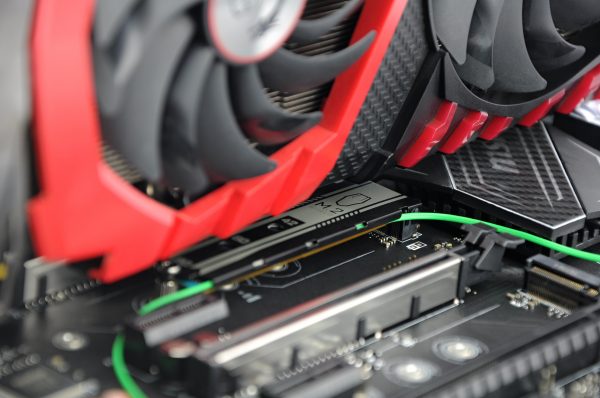
Graphics card can significantly contribute to cooling of SSD that are installed next to it. However, there’s a very thin line between helping and limiting. Let’s see when your graphics card can be a saviour for your SSD and when it’s an oppressor. As a bonus, we compared the cooling performance with and without the criticised MSI M.2 shield. Read more “What’s the best position for your M.2 SSD?”


Latest comments