


Our Computex 2026 coverage continues with a visit to another of the four major manufacturers of mobos, but also graphics cards, cases, PSUs, peripherals, and more these days: MSI, who is also celebrating an anniversary at this year’s show—the company was founded in 1986. Their display, however, wasn’t actually all that much about looking back. Instead, there were plenty of new and interesting products to see, including in cooling technology.
GeForce RTX 5090 32GB Lightning Z
MSI also had an extreme graphics card on display at Computex: the GeForce RTX 5090 32GB Lightning Z, a limited-edition version of Nvidia’s most powerful gaming model currently available. Only 1,300 of these cards were produced, and according to MSI, most have already been sold. The card is intended for extreme overclocking and has allegedly already been used to achieve around 15 world records.

It uses AIO liquid cooling with an external radiator, allowing it to join a major trend in today’s high-end hardware—which is slapping displays on everything. On the underside, where fans would normally draw air in, the card features an 8-inch display capable of showing whatever content the user desires. The effect will be applicable mainly to vertical mounting configurations using a riser cable, because in the standard PCIe ×16 slot orientation, the display will not be particularly visible.

The card includes additional features that go far beyond what is normally expected from a graphics card. Its display, lighting effects, and performance settings can all be controlled through a web interface, eliminating the need for a dedicated application. It can even be overclocked via a mobile app (although this likely requires some form of internet connectivity exposed by management software and drivers, which can be a double-edged sword due to potential security vulnerabilities).

The card also includes more traditional technical enhancements. Its PCB features an increased copper content and can supply up to 1000 W to the GPU (allowing the standard 575 W GeForce RTX 5090 to deliver even more performance through overclocking, though it has to be said it’s rather alarming how far GPU power consumption has escalated in recent years). It uses two 12+4-pin 12V-2×6 power connectors and also includes onboard measurement points for easily attaching voltage probes used by extreme overclockers.
GPU SafeGuard+ Against Melted Cables (and Graphics Cards)
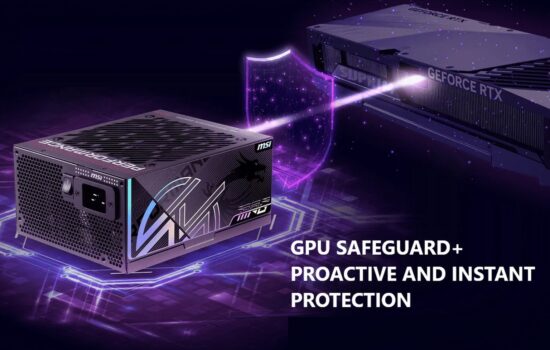
Those power levels inevitably brings to mind the ever-present issue of melting cables and power connectors. MSI directly addresses this problem with its proprietary GPU SafeGuard+ protection system, integrated into MSI power supplies—including the displayed MPG Ai1600TS PCIE5 and others.
This protection system continuously monitors current levels across all pins of the 12+4-pin connector in real time. It is therefore capable of detecting the primary cause of cable and connector melting in graphics cards—situations where uneven pin contact creates imbalances in resistance and current distribution among individual conductors within the small and not particularly robust 12V-2×6 connector. The PSU contains dedicated chip to monitor this current distribution. If an imbalance is detected, the PSU responds in several ways.
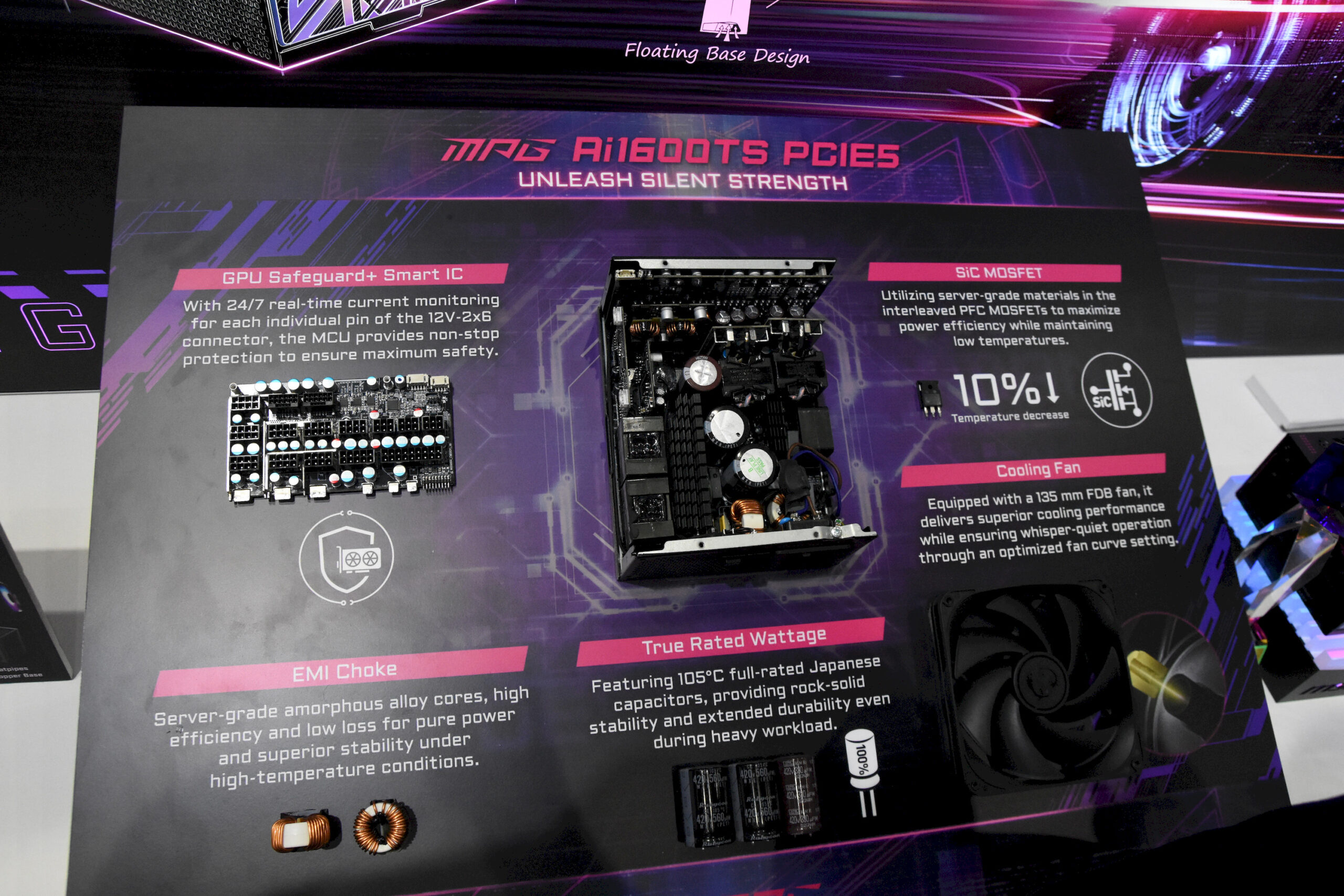
First, it sends a signal to the PC through the USB-C cable connecting the power supply to the motherboard. This signal—and telemetry data showing current values for individual connector pins—can be read by MSI Afterburner and by HWiNFO 8.41 Build 5915 Beta and newer versions. These applications then display a warning pop-up prompting the user to inspect the cable. Simultaneously, through cooperation with Afterburner, power consumption of supported graphics cards is reduced to 75% of the nominal level. For a 575 W RTX 5090, this means roughly 430 W.
Since one cannot rely on a particular application being installed and running—or even on the operating system remaining responsive—the PSU also includes an integrated buzzer that emits an acoustic alarm signal for three minutes after detecting an anomaly. After those three minutes, power delivery to the GPU is cut off. This gives the user time to save game progress or unsaved work and perform a safe OS shutdown before inspecting the cable.

In more affordable MAG-series power supplies (such as the displayed MAG A1000PLS PCIE5 W), MSI provides a simplified version called GPU SafeGuard. This variant only provides the acoustic alarm and forces GPU shutdown after three minutes, without the interoperability with monitoring software. But the critical failsafe functionality remains intact, making even this simplified version a fully capable solution. The only failure mode these systems cannot detect is connector overheating occurring under perfectly balanced load conditions, which is likely rare, though not impossible. Users must also avoid cables with bridged conductors, as these prevent the PSU from detecting imbalances occurring at the GPU-side connector.
New Graphics Card Cooling Uses Diamond Materials and Metal Fan Impellers
MSI also showcased a next-generation graphics card cooler currently under development. Its heatsink is set to feature improved heatpipes with spiral grooves along the inner walls (imagine something similar to rifling inside a artillery barrel), intended to enhance heat transfer.

The baseplate will incorporate another unusual feature. Instead of pure copper, it will use copper infused with diamond particles, which should improve heat transfer from the GPU die into the heatpipes and subsequently into the heatsink. The diamond particles will reportedly not be present on the surface (perhaps due to concerns regarding smoothness and abrasiveness), but only in an internal layer sandwiched between layers of pure copper.

MSI also displayed a thermal pad intended for use between the GPU die and the baseplate, replacing thermal paste. While Noctua is now pursuing a solution based on carbon nanotubes (Carbice), MSI uses a composite material containing diamond powder in this thermal pad.

The fans themselves will also be new. Thanks to the use of a stiffer material, they can employ thinner blades, improving airflow at a given rotational speed. Blade thickness is specified at just 0.8 mm. The key is the use of metal instead of plastic, reducing deformation and thereby lowering susceptibility to vibration and blade flutter.
Liquid and Air Coolers
MSI also showcased CPU coolers. The MAG CoreLiquid A13 360 Fabric is an unusually down-to-earth AIO cooler. While most premium models attempt to attract attention with extravagant displays on the CPU block these days, this cooler instead uses a fabric cover through which a display shines, showing a logo—or, in the case of the MAG CoreLiquid A23 360 W, temperature data. These displays appear to be simple segmented units, meaning they cannot show animations or other visual extravagances (which is arguably a good thing—this way you don’t need to pay for numerous extra components devoted to features that have no practical impact on cooling performance).


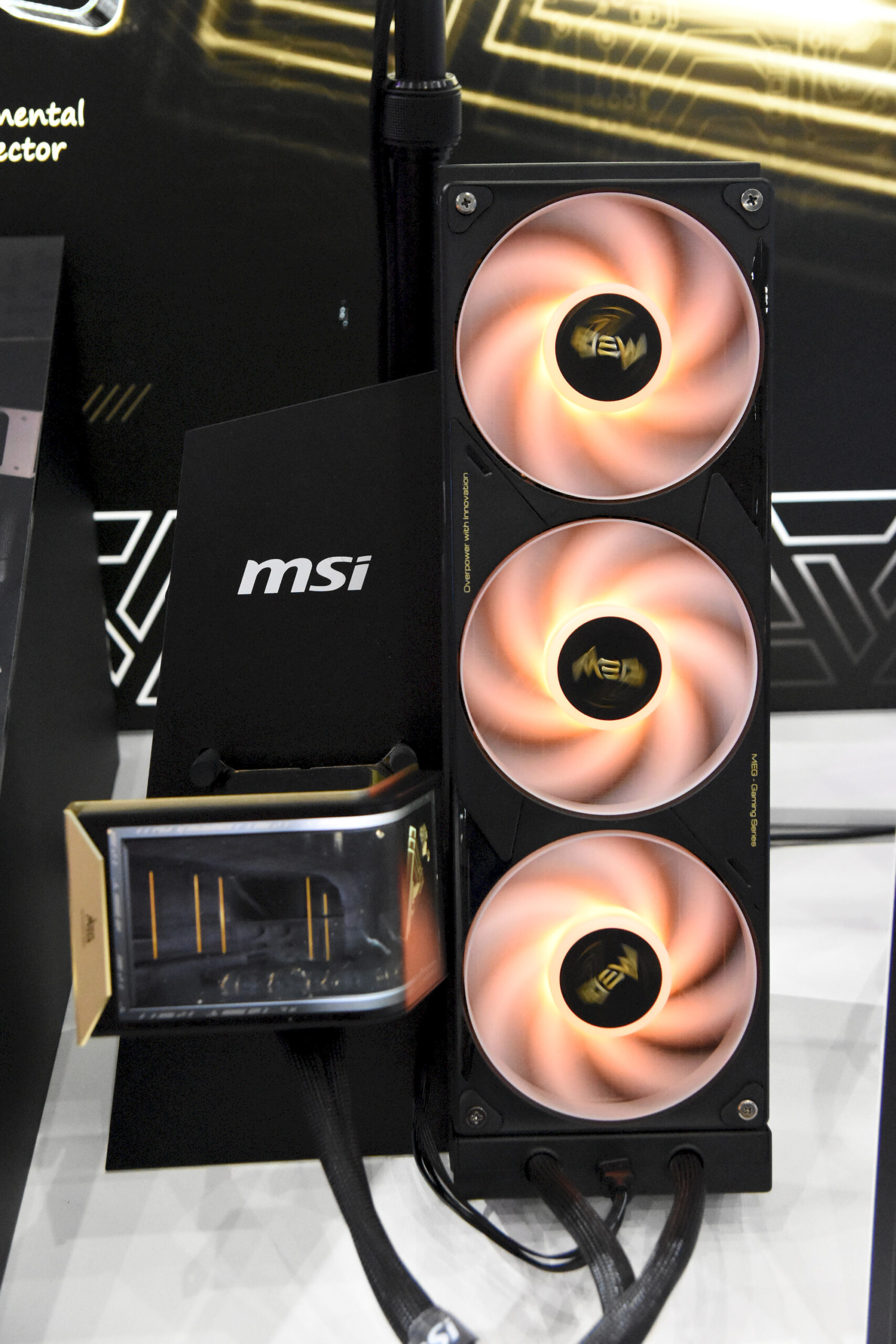
That said, MSI also offers their own AIO cooler with a curved AMOLED display in the form of the MEG CoreLiquid E15. The display is magnetically attached, so it should not complicate installation significantly. The screen measures 6.67 inches diagonally and features 2K resolution.


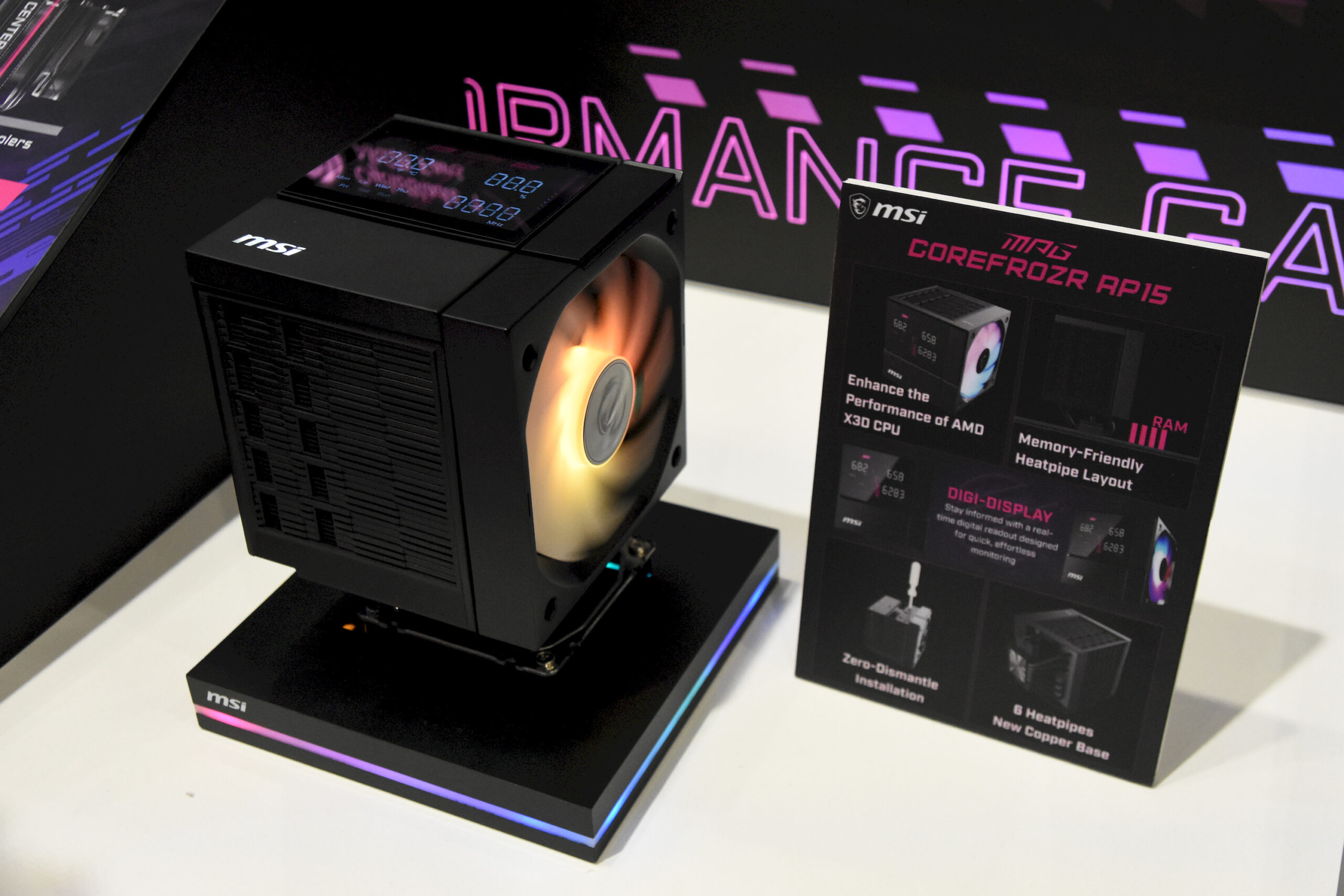
While it is fairly common these days for almost any company to sell liquid coolers (thanks to ODM manufacturers that can essentially provide turnkey products), MSI also offers air coolers in its portfolio. The displayed MAG CoreFROZR AP15 features a base with six direct-contact heatpipes and a shape designed to avoid interference with memory modules. Although not immediately obvious, it is a dual-finstack cooler equipped with two fans (120 mm, although this is not explicitly stated in the specifications). One fan is hidden beneath a segmented display connected via an internal USB header and requiring companion software. Besides temperature, it can display CPU utilization, power consumption, or clock speed. The display can be removed, providing access to the mounting screws—the cooler can reportedly be installed without removing the fans or further disassembly.
Motherboards
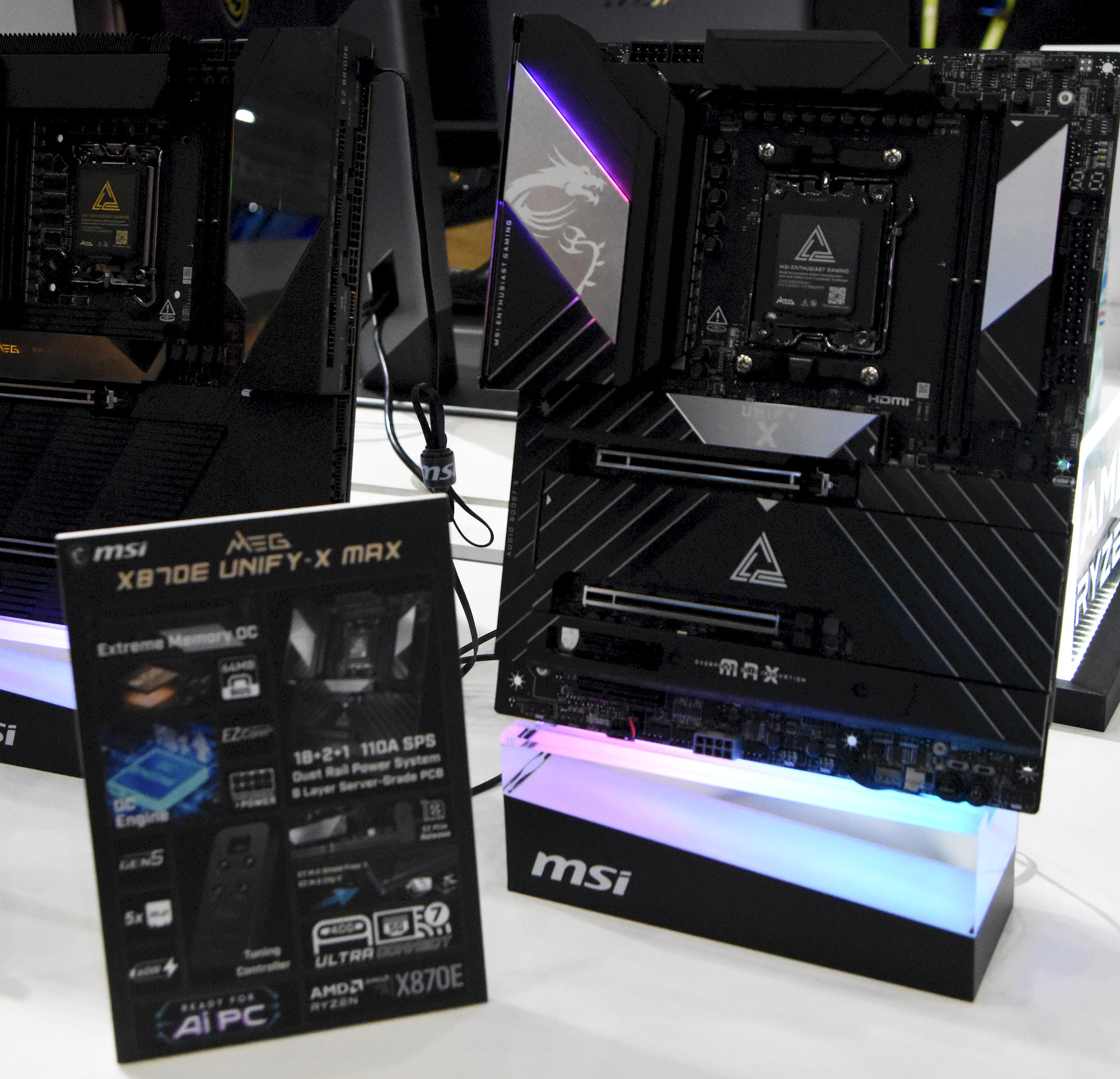
Naturally, MSI also had to showcase motherboards, the product category with which the company remains most strongly associated and where it originally built its reputation. We are currently in something of a transitional period while waiting for new generations of desktop CPUs and chipsets, but there were the MEG Z890 Godlike for Intel Arrow Lake processors and the MEG X870E Unify-X Max and MPG B850 Carbon Max WiFi for AMD Ryzen processors on the AM5 platform on display.




Cases: A Holographic Front, or an Empty Bottom
MSI is also active in the case market. The company showcased an unusual chassis forming part of the MEG Vision X2 AI desktop PC concept heavily infused with artificial intelligence, which is intended to control fan operation and other system functions. Mounted at the front of the case is a cylinder projecting a “holographic AI interface” represented by MSI’s dragon mascot, Lucky. Activated by voice commands, it accepts user instructions and appears to be connected to MSI’s “agentic” AI software likely based on OpenClaw, with MSI referring to the feature as LuckyClaw.
This is not a true hologram but rather a display-and-mirror arrangement inside a transparent cylinder that creates the illusion of depth when viewed from the correct angle—not directly from the front but roughly from where a user would normally sit beside the PC.
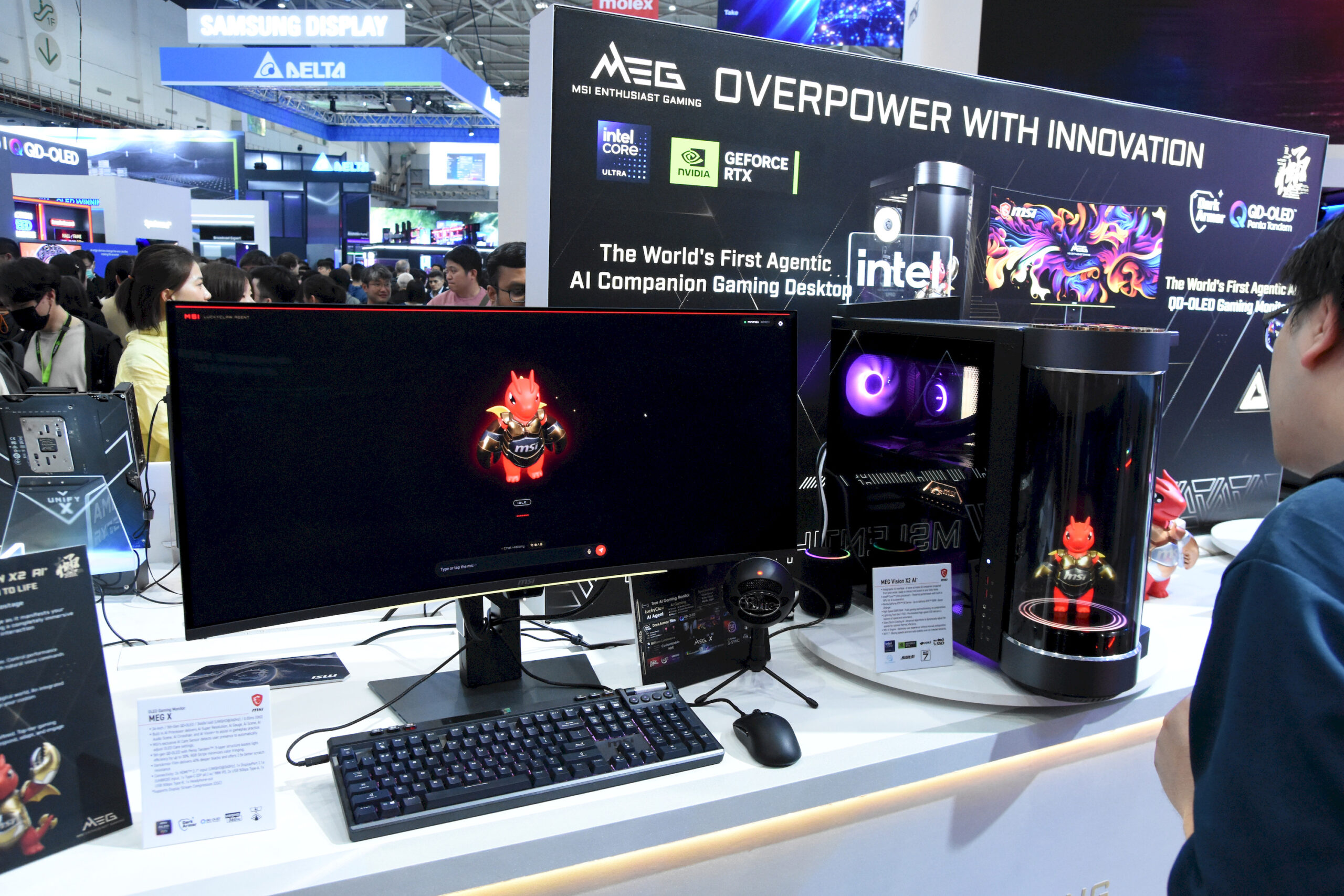
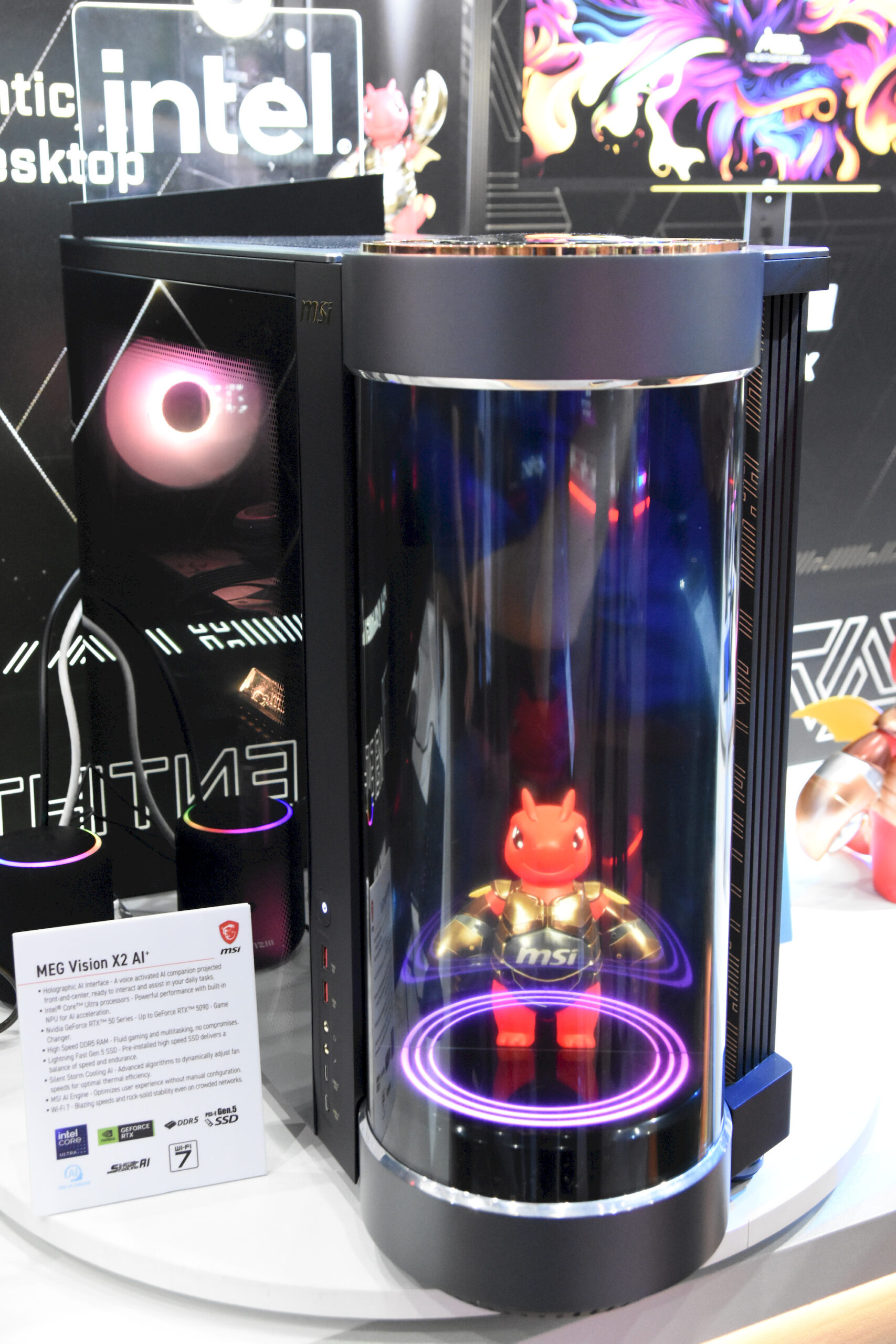
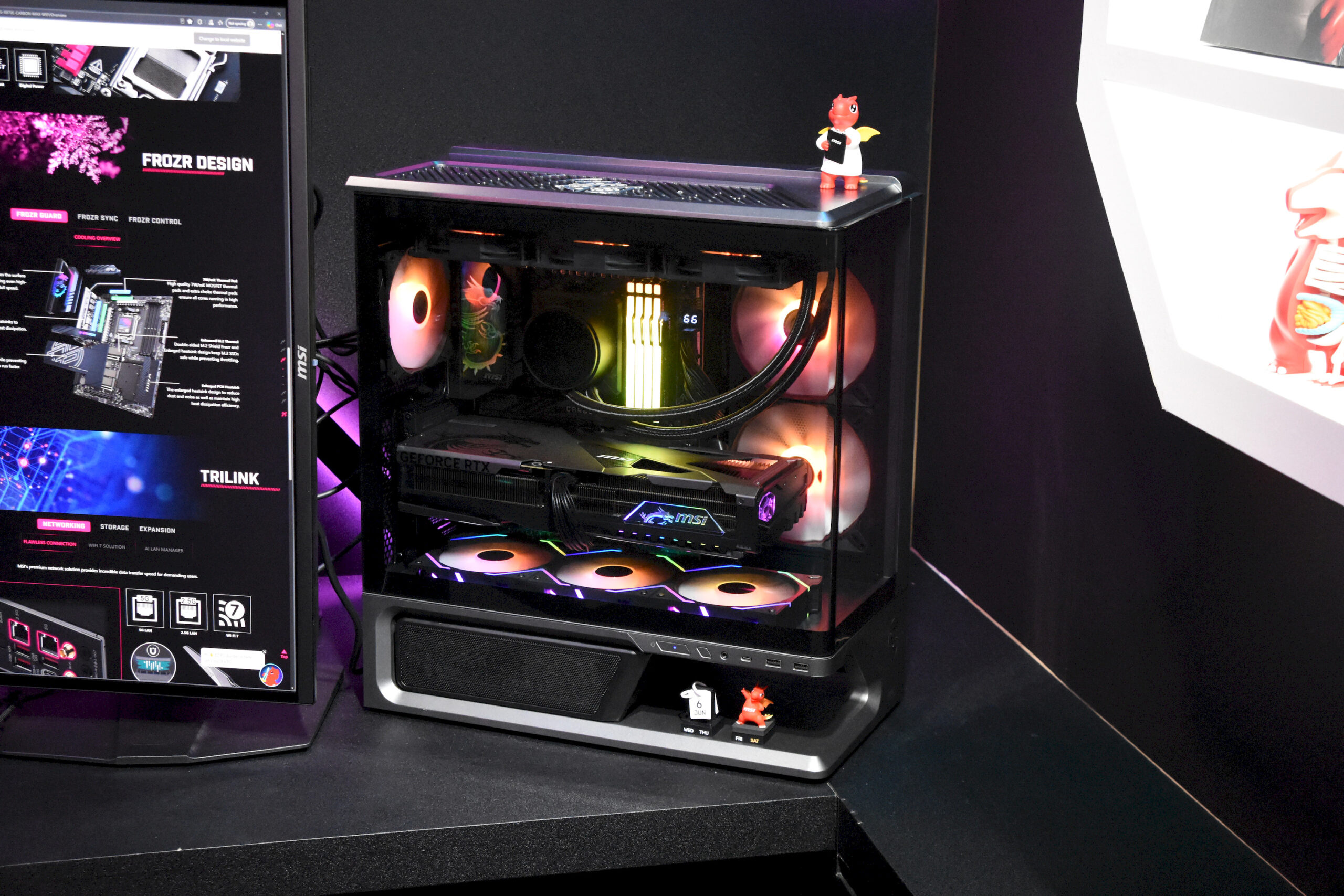
The second case, the MPG Vixta 300R, is less of flashy concept and more of a practical design. It features an unconventional lower section—notable by not actually having much thereof. The case follows the common modern layout with a PSU shroud at the bottom, but MSI’s designers reasoned that the power supply only occupies the rear portion while also requiring outside air intake. As a result, the front section of the shroud has been removed, creating a pocket or shelf-like compartment in the case floor that can be ventilated both toward the PSU and upward into the motherboard chamber.
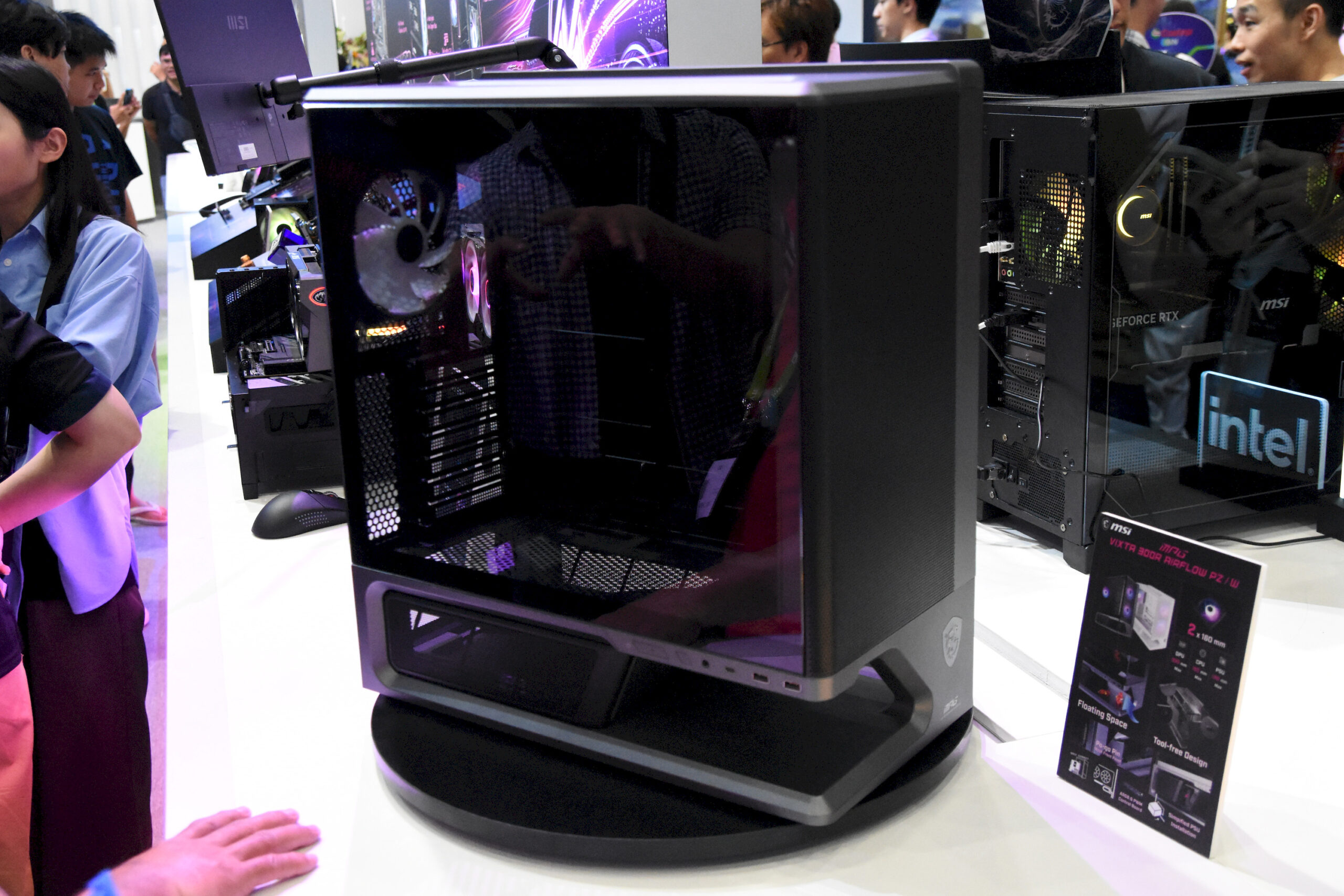
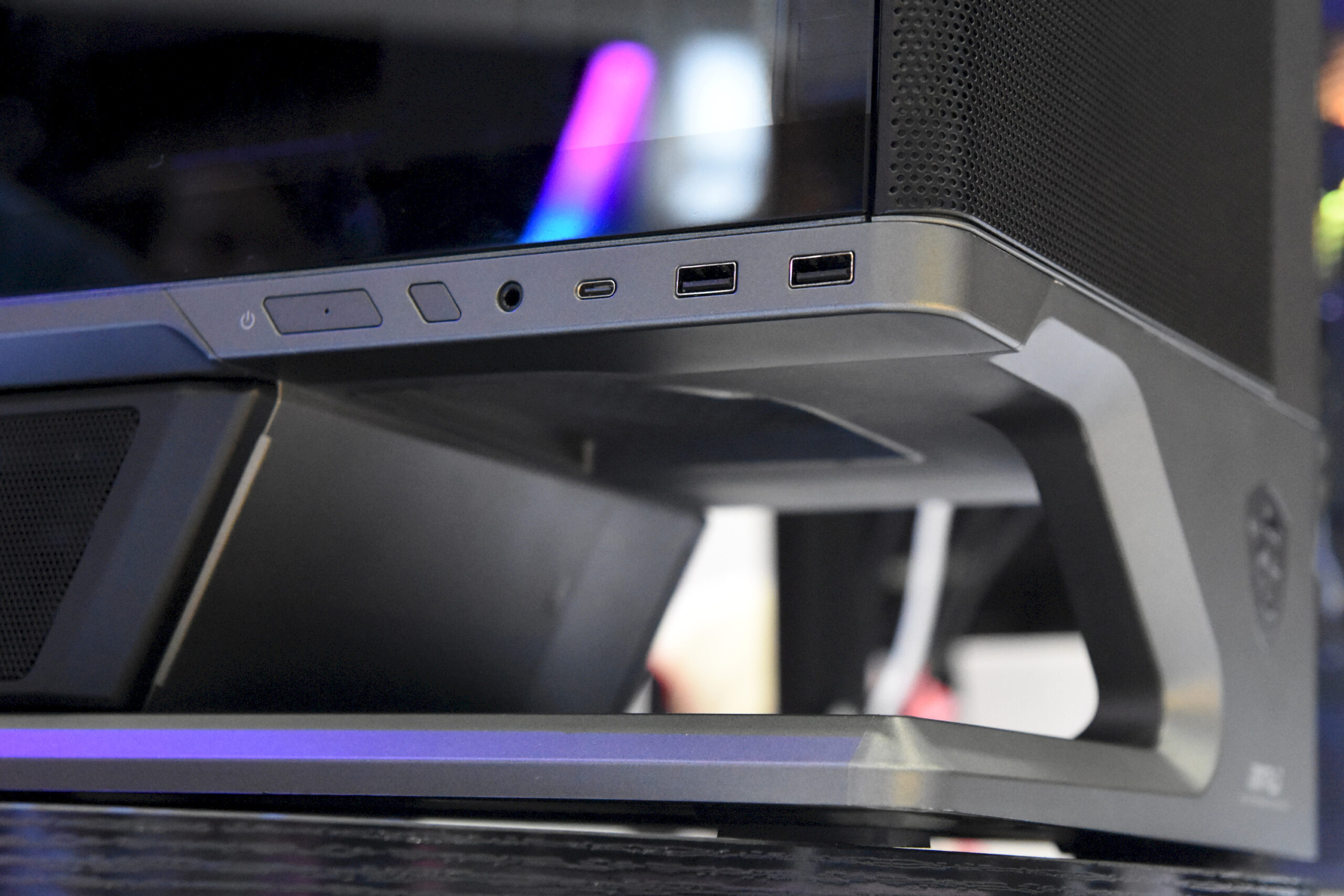
One potential advantage is that air intake does not occur directly at floor level, which could reduce dust accumulation. On a desk, the space might even function as a shelf or storage compartment (whether MSI intended it that way or not, that is probably how I would end up using it). The front panel can either be transparent for a panoramic “aquarium” appearance (MPG Vixta 300R W) or configured as a mesh panel equipped with a pair of 160 mm ARGB fans (MPG Vixta 300R Airflow PZ).
Dual-Mode? Now There Is a Triple-Mode Gaming Monitor
At Computex, MSI introduced the MPG OLED 322URDX36 gaming monitor, which it describes as a Triple-Mode display. The monitor uses a Penta Tandem QD-OLED panel with RGB Stripe pixels and carries DisplayHDR True Black 600 certification. Unfortunately, we do not have a photo of it.

The principle should be similar to existing 4K Dual-Mode displays. The native resolution of the 31.5-inch panel is 4K (3840 × 2160), which can operate at 360 Hz. In Full HD mode (1920 × 1080), it reaches 680 Hz (which is big with OLED). However, it also supports a third intermediate mode, “2K” at 520 Hz. Presumably this means 2560 × 1440 resolution. It is not clear how this mode is realised. Unlike Full HD mode, which can simply combine each 2 × 2 block of pixels into a single pixel, 1440p cannot be achieved through straightforward pixel mapping. Therefore, the monitor could either perform some form of interpolation or use only a portion of the panel area corresponding to that resolution.
The first “agentic” monittor
The LuckyClaw AI agent mentioned before is apparently intended to run directly on another MSI monitor, the MEG X, which features a 3440 × 1440 resolution, 360 Hz refresh rate, and another Penta Tandem QD-OLED panel, the AI reportedly powered by integrated hardware within the display itself. According to MSI, this will be the first “agentic gaming monitor.”
It will also provide various AI-powered functions, including an AI crosshair with dynamically changing contrast colors, AI Vision+, and AI Scene (likely various preset and image-adjustment modes for gaming), along with AI audio equalization and AI Super Resolution—an AI-based upscaling technology performed directly by the monitor. However, this is likely to deliver lower image quality than AI upscaling methods using game engine integration, as it cannot access game engine data and instead operates just on the pixel data of frames, much like the old and not very good DLSS 1.0.

Incidentally, both monitors support DisplayPort 2.1 UHBR20. MSI also highlights a new DarkArmor surface coating designed to improve scratch resistance (rated at 3H hardness) while simultaneously enhancing black-level reproduction.


MSI also constructed several gaming-room-style demonstration spaces at its booth, resembling interior design concepts commonly seen in specialized showrooms. In this case, however, the focus was on computer and gaming equipment rather than furniture and décor. These themed setups were each built around one of MSI’s product families—MAG, MPG, and MEG.
Sources: MSI, on-site reporting
On-site photography: Jozef Dudáš
English translation and edit by Jozef Dudáš
⠀





I’m mainly interested in when we’ll see those fancy new heat pipes on things like the CoreFrozr.
It’s about time we saw the first copper-diamond composite client designs too. We’ll be seeing a lot of those in the future, with the De Beers monopoly going down in the face of cheap synth. Won’t be seeing them too much in water mind, until 3rd printed structures hit the mainstream for the water interface… so not long at all tbh. Won’t be too nutty a price neither, considering diamond is already a component in mainstream power tool cutting disks.
Also, not so far off there’s gonna be something that’s basically PTM9750, but diamond bits instead of aluminum oxide.