


Vox Populi, Vox Dei. You wanted tests of the Fractal Design Momentum 14 fan—you shall have them. Naturally, we also recognized the importance of keeping a check. Especially after what we observed with the RGB variants (Momentum 14 RGB). The non-illuminated FD fans are even a hair better—often unmatched far and wide. Fractal Design’s generational improvements in their fans have turned out as well as they possibly could.
It wasn’t planned, but here we are. After the excellent results from the illuminated Momentum 14 RGB fans, we also tested the non-RGB Momentum 14 variants. We listened to your requests and agreed that, yes, it makes sense. It’s important to have a complete overview of the performance of such attractive fans—something the Fractal Design Momentum models certainly are as a series.
The Momentum 14 fans feature aggressively curved blades, seven in total. These blades are truly long—even slightly longer than those on the Momentum 14 RGB variants, which include a ring-shaped light guide. That element takes away some of the space that could otherwise be used for the impeller. Not so with the Momentum 14 fans. These make full use of the available space toward the frame (in this case without the light guide). Longer blades, with an otherwise identical impeller hub and aerodynamic design, naturally mean higher airflow per revolution. However, this does not necessarily translate to higher airflow per unit of noise. That’s because at the same speed, different tonal peaks are produced, and it can happen (and in fact does happen…) that at comparable noise levels, the Momentum 14 fan (compared to Momentum 14 RGB) actually delivers lower airflow. But it can also be higher. You already know the technical explanation of why it can go either way.

The Momentum 14 fan generally performs better at lower speeds, where vibrations at the blade tips are practically nonexistent. Those vibrations remain low even at higher speeds, thanks to the impeller being made from an exceptionally rigid material—LCP. Despite the longer blades, flex is suppressed at the material level. This is also one of the factors that enables Fractal Design’s Momentum fans to achieve such excellent results.
The specified static pressure is at least average for a 140 mm fan—perhaps slightly above average—suggesting the fans may also perform well in restrictive conditions, such as on a radiator. But their primary role is likely as system fans (with filters or grilles), which is exactly where Fractal Design aims them. The Momentum fans will appear in Fractal Design cases, and in the 140 mm format, the Momentum 14 is included in cases like the Meshify 3 (XL).
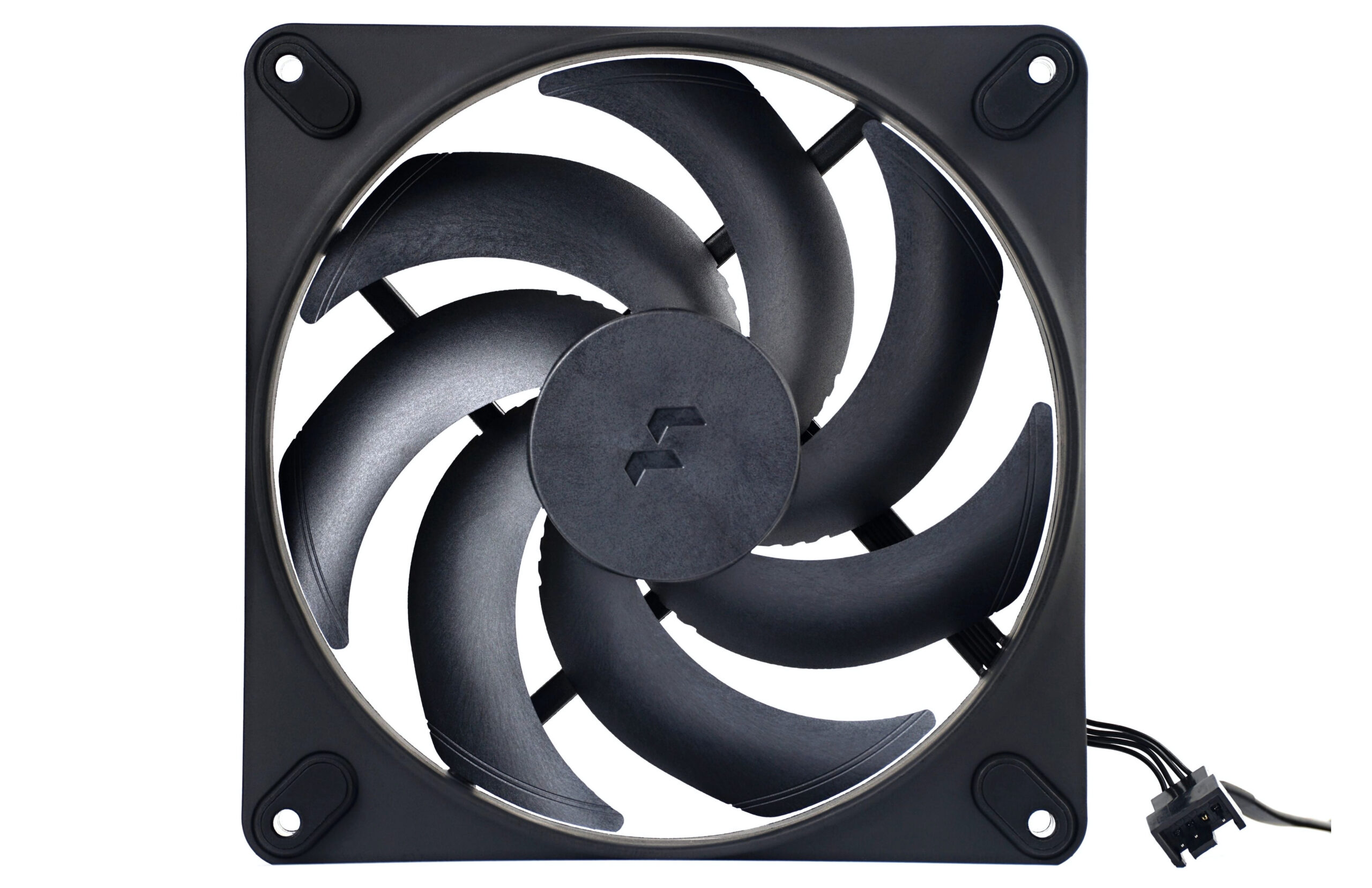

Near the root of the blades, close to the impeller hub, the fans have small notches. These are intended to eliminate unwanted turbulence that could otherwise produce unpleasant tonal peaks in restrictive scenarios. For additional flow laminarization, there are textures—grooves—on the opposite end, at the blade tips. These also contribute to increasing airflow at the outlet while keeping noise levels down (more laminar airflow is quieter than turbulent…). The tips themselves are slightly raised to increase pressure in key areas, and performance is further improved by the minimal gap between the blade tips and the inner wall of the stator frame—about one millimeter. This tight clearance improves static pressure especially, as there’s less room for airflow to escape in the opposite (undesired) direction under back pressure.

The speed range (350–1850 RPM) is the same as on the RGB variant, but the Momentum 14 is rated for a higher maximum airflow (which makes sense with larger blades) and also higher noise levels (which our testing confirms), even though static pressure is said to be slightly lower. That’s likely due to the larger gaps between the blades and what’s known as a larger dead space, through which more air escapes. Naturally, only a negligible amount, which, under low-resistance scenarios, won’t make a practical difference.
The fan connects via a traditional 4-pin PWM connector. There’s also a secondary 4-pin connector for easier daisy-chaining when using multiple fans in series or side by side. To extend the default, relatively short cable (approx. 15 cm), the accessories include a longer cable of about 50 cm. This applies to Momentum 14 fans with the product code FD-F-MO1-1401, which are sold in single-fan packs.

Please note: The article continues in the following chapters.




Thanks for another good testing.
So that means the non-RGB version is noticeable worse (as case fans, high airflow/low noise) than the RGB-fans, and is made basically obsolete by the RGB version.
Basically every case nowadays has two obstacles in front of the fans: the first nylon filter to hold of dust, and an additional plastic/metal front mesh (similar to the plastic filter) in front of the nylon filter.
At quiet levels of 31 & 33 dBA (724 & 864 RPM) the RGB-version delivers staggering 23 & 68 % higher airflow with the nylon filter.
At 36 & 39 dBA (1015 & 1132 RPM) it’s still 10 % higher.
As the nylon filter is always present, that should be deciding factor to look at, when it comes to air flow, as case fans.
So the way lower static pressure at low RPM is the reason for this, due to the small differnce in fan blade lenght?
Question: You haven’t tested the RPM range from 348 – 724, but based on your testing it can be safely considered the gap in airflow will be even higher compared to the RGB version? (31 dBA is 68 % difference, than 23 %, than 11 % etc.)
@Ľubomír Samák
Do you afraid to tell the harsh truth? Because I don’t see it. I understand free review samples, B2B-relations, sympathetic to manufacturers this and that, but when negative points are not criticized properly, than it automatically devaluates/disprizes other better products.
Despite this version being quite good some cases, it’s noticeable worse in performance and overall. Your conclusion is way too favourable and not displaying that.
I thus disagree with you giving it the top-notch award; that should be for the RGB version only.
This is what I mean with “devaluing” etc. pp. You now make it look like they are both top notch, but they are not.
I would be thankful you would be more honest.
“Get the RGB version, even if it costs 7 bucks more”, that’s what my conclusion is 🙂 🙂 🙂
Have a nice day!
Well, that was my first reaction (about top-notch).
https://www.hwcooling.net/fractal-design-momentum-14-takto-to-ma-vyzerat/#comment-11553
But our view is/was clouded by the amazing performance of the RGB variant. Try to think it over and compare the nonRGB with the Noctua NF-A14 G2 or Toughfan 14 Pro…and you will see that even the nonRGB variant deserves top-notch
Right, this often shifts toward comparing specific results to the RGB version—but that’s not the only thing we base awards on.
Yes, Momentum 14 RGB performs impressively in many ways—but so does the non-RGB version. It comes down to user preference. Performance on a grille might not look as “cool” as performance on a radiator, I guess. 🙂
–“…Performance on a grille might not look as “cool” as performance on a radiator, I guess…
Well on that matter
…in my opinion, the performance on the radiators is the least important for me 😉
…when you buy an Air/AIO Cooler, it already comes with fans.
(buying a cheap tower and then buying expensive fans is usually more expensive than buying straight a cooler with better fans) 😛
for me the most important are 1) nylon, 2) hex (I wish it was on the opposite side) 3) plastic filter and 4) w/o …I think you know it 😉
Thank you for the detailed comment.
First, I don’t agree that the Momentum 14 is significantly “worse” than the Momentum 14 RGB. But let’s break it down point by point:
„As the nylon filter is always present, that should be deciding factor to look at, when it comes to air flow, as case fans.
So the way lower static pressure at low RPM is the reason for this, due to the small difference in fan blade length?”
There may be several reasons, or more likely a combination of them. It’s important to remember that our tests are normalized by noise level (in dBA), not rotational speed. Differences in motor types, blade geometries, and other design aspects also play a role. There are numerous possible explanations why the Momentum 14 achieves lower static pressure at low speeds than the RGB version.
„Question: You haven’t tested the RPM range from 348 – 724, but based on your testing it can be safely considered the gap in airflow will be even higher compared to the RGB version? (31 dBA is 68 % difference, than 23 %, than 11 % etc.)“
It’s possible, yes. But as you noted, we haven’t tested that range, so we can’t say for sure…
Now regarding your more personal remarks:
„Do you afraid to tell the harsh truth? Because I don’t see it. I understand free review samples, B2B-relations, sympathetic to manufacturers this and that, but when negative points are not criticized properly, than it automatically devaluates/disprizes other better products.
Despite this version being quite good some cases, it’s noticeable worse in performance and overall. Your conclusion is way too favourable and not displaying that.“
The “harsh truth”? Honestly—Momentum 14 is a great fan. It’s true that the RGB version performs better in some areas, but the comparison must be broader—against all fans, not just its illuminated variant. Not awarding Momentum 14 a “Top-notch” rating would be unfair.
Take, for example, the NF-A14x25 G2 PWM’s results with a dust filter—those were also weak. Yet it received our top award, because it excelled in many other areas. Similarly, Momentum 14 achieves outstanding performance through a hexagonal grille and consistently strong performance across the board. Radiator performance isn’t its strength, true, but that doesn’t disqualify its overall value. No situation tested resulted in poor performance—it’s all excellent or at least very good.
As for any suggestion of favoritism or bias due to free samples or B2B ties—you’re mistaken. Please check our reviews of older Fractal fans (before the Momentum line). Or Arctic’s older BioniX F120. Those products didn’t receive praise because they didn’t deserve it—despite also being provided by the manufacturer. We truly don’t know how a fan will perform until we test it. Assumptions about preferential treatment simply aren’t correct.
„I thus disagree with you giving it the top-notch award; that should be for the RGB version only.“
Of course, you’re free to disagree, and we fully respect your opinion. But as explained above, we see things differently.
„Get the RGB version, even if it costs 7 bucks more”, that’s what my conclusion is…“
That’s certainly a valid perspective—but it’s not one we personally share. 🙂
May a bit offtopic but still quite interesting:
Regarding Fractal’s new case, specifically the Meshify 3 Ambience Pro RGB version.
https://www.hwcooling.net/en/arctic-p12-pro-key-to-noiselessness-is-in-7-blades-review/
I looked at the comments from ThermalLeft, Bufo and Pluten and what was linked regarding some issues/solutions regarding
1) air guides
https://www.reddit.com/r/Noctua/comments/1fafbt4/project_manifoldium_ducted_noctuafractal_build/
2) Impactul problem that nearly every case introdues: in order to attach fans to case, nearly every manufacturers uses mechanism which places obstacles right in front of the fans, making them way noisier
https://www.youtube.com/watch?v=WKs7_1gK4Zo
3) fan shrouds
https://www.reddit.com/r/FractalDesign/comments/1kositm/fractal_design_define_7_with_fan_inlets/
Looks like Fractal has adressed two of them and thus is the reason why this specific version Meshify 3 Ambience Pro RGB is the best (or top 3 at) airflow case on the market right now. The other one is thre pre-installed Momentum 14 RGB fans, and not the non-RGB Momentum 14 fans.
https://gamersnexus.net/cases/new-best-fractal-meshify-3-case-review-thermal-benchmarks-noise
1) They introduced the air guide in front of the PSU shroud, and gamersnexus proved it leads to noticeably higher airflow and lower noise at the same time. They taped a cardboard box extension onto the end of the PSU shroud and measured the difference: 4 degree Celsius lower GPU temeperature (full torture, 100 % fan speed) and 1.2 lower dBA with the air guide.
2) https://thinkcomputers.org/fractal-design-meshify3-review/2/
As can be seen in these images from the test, there are no obstacles in front of the fans anymore; they changed the way attaching the fans to the case completely. No metal bars, plastic thingies whatever. Completely unobsructed.
3) There are no fan shrouds present in the case, but since point 2) is eliminated, I wager to say they are not needed.
I now took some cardboard and a scissor and made a self-made air guide in front of the PSU bottom shroud 🙂
Thank you for the useful materials. Yes, ThermalLeft is doing an excellent job, and the mounts in the Meshify 3 Ambience Pro RGB indeed look solid—both structurally and acoustically. By the way, we’ve tested that case too:
https://www.hwcooling.net/en/the-fractal-design-meshify-3-xl-arrives-with-new-fans/
https://www.hwcooling.net/en/fractal-design-meshify-3-xl-case-in-thermal-tests-review/
And while the airflow design supports effective system cooling, that doesn’t always translate into significantly lower component temperatures. Even a relatively modest airflow can be enough to maintain sufficient air circulation inside the case. Beyond that point, higher airflow tends to just increase noise, not dramatically reduce temperatures.
–“…Even a relatively modest airflow can be enough to maintain sufficient air circulation inside the case. Beyond that point, higher airflow tends to just increase noise, not dramatically reduce temperatures…”
Yes 😛
…buuuut, if you play around with the settings and balance the intake/exhaust air volume…theeeeen 😀
…and yes, with increasing RPM, noise increases more than the positive contribution to cooling…that’s why lower sound levels are more important to me 😛
some of the test results are not showing, pls fix
Please let us know which specific charts are not displaying for you. I’ve just gone through the article section by section and everything appears fine on our end—there’s nothing I can currently identify that needs fixing.
That said, I’m not ruling anything out, but I can’t assist further unless you let us know which part isn’t rendering correctly.
P.S.: If data is missing from some charts, that’s usually because the results couldn’t be recorded. Possible reasons are always noted in the conclusion boxes of the relevant sections. In very specific cases, it may also be mentioned in the final verdict of the review.
One common reason is that a fan could not be set to a specific noise level—typically due to excessive tonal peaks making the noise output unstable. This tends to happen at relatively high RPM settings. But I assume this isn’t what you’re referring to? 🙂
Would you recommend the Toughfan 14 pro as the best 140mm fan for AIO radiators? I am waiting for the T30 140mm, but it has not been released yet, which is frustrating.
Among all the fans we’ve tested so far and published results for, the Toughfan 14 Pro stands out as the most aerodynamically efficient fan on radiators. That said, I wouldn’t go as far as calling it the overall “best” fan, because such a verdict needs to account for more than just cooling performance. As you’ve seen from our review, the build quality of Thermaltake’s units isn’t exactly flawless—some samples had clicking noises. We’re definitely looking forward to seeing the T30 in a 140 mm format as well. 🙂
P.S.: If you’re considering the Toughfan 14 Pro for a radiator setup, you might want to hold off just a little longer (a few days…) until we publish our results for the Arctic P14 Pro fans. 🙂
Well, …you could have fog it a little more. 😀
🙂
I have a question about the test methodology and its application to exhaust fans. Since the ‘Results: Airflow through a hexagonal grille’ section appears to measure performance with the grille positioned in front of the fan, but case exhaust fans typically have their grilles mounted behind the fan, would the ‘Results: Airflow w/o obstacles’ measurement be more representative of actual exhaust fan performance in typical PC cases?
yes, I have a similar opinion, of course some reduction in CFM is obvious 😉
see the last 2 charts here:
https://quasarzone.com/bbs/qc_qsz/views/1990602#p5c
…according to Qasarzone measurements it is about 90% of the unrestricted flow… of course there are some exceptions like the Corsair LL 120 ARGB (70%) 😉
…and Ľubo is right that this measurement would not yield that much information entropy. 😛 …and the ranking would be very similar to w/o
It depends on the type of grille at the output in terms of airflow restriction. With more closed structures (thicker walls), the impact will be greater, of course; with less closed ones, it could be even less. But 90% might be around the level that case manufacturers are aiming for. Their goal will also be to keep airflow as high as possible, even though it’s a compromise between this parameter and structural strength. Strength should still be good enough even with cases that have a mesh that is less dense, or rather has a higher degree of openness. After all, even if someone cuts out the grille, the case still holds together. The case’s structural strength will probably depend more on the frame, profiles, and such rather than on the grille itself. I don’t want to comment too much on this though, as it’s already bordering on mechanical engineering knowledge and so on. 🙂
that’s an interesting idea 😉
… cutting out the hex grille and replacing it with a fan grill (if too restrictive)
https://www.arctic.de/en/Fan-Grill/ACFAN00088A
They claim: “Fan grills barely affect performance — less than 1 % influence on airflow.
… but I’d rather not do that 😛
It wasn’t only Arctic that tested this, but us too. And yes, the difference in airflow with a circular grille versus without a grille is minimal. We’ve only based this on the results of one fan (Noctua NF-A12x25 PWM), but… there’s not much reason to believe it would be drastically different with other aerodynamic fan designs.
Of course, without a grille, there’s definitely a safety risk that should be prevented (by using the grille, obviously…). 🙂
Yes, the grille is in front of the fan. Having data from different positions (in front of the impeller and behind it) would, of course, be useful. But due to time constraints we had to decide on one option, and that’s the one we test (with the grille in front of the fan). This is because in that position the tonal peaks differ quite a lot between fans, whereas with the grille behind the impeller the acoustic profile doesn’t change much compared to without an obstacle. Of course, depending on the specific aerodynamic design, this may differ, but the differences are definitely more pronounced with the grille in front of the impeller in terms of acoustic profile. As for airflow—it strongly depends on how open (or closed :)) the obstacle is. Whether the grille is in front of or behind the fan, the airflow at comparable RPMs will be similar. 🙂