

We have recently covered a leak of driver files that revealed the incoming launch of AMD’s improved AI upscaling, FSR 4.1. Because the library itself was leaked, FSR 4.1 had already been tested in practice. Now this technology is officially arriving for all users (or at least those with sufficiently new GPUs) with version 2026.3.1 drivers, which the company released alongside the launch of the Crimson Desert game.
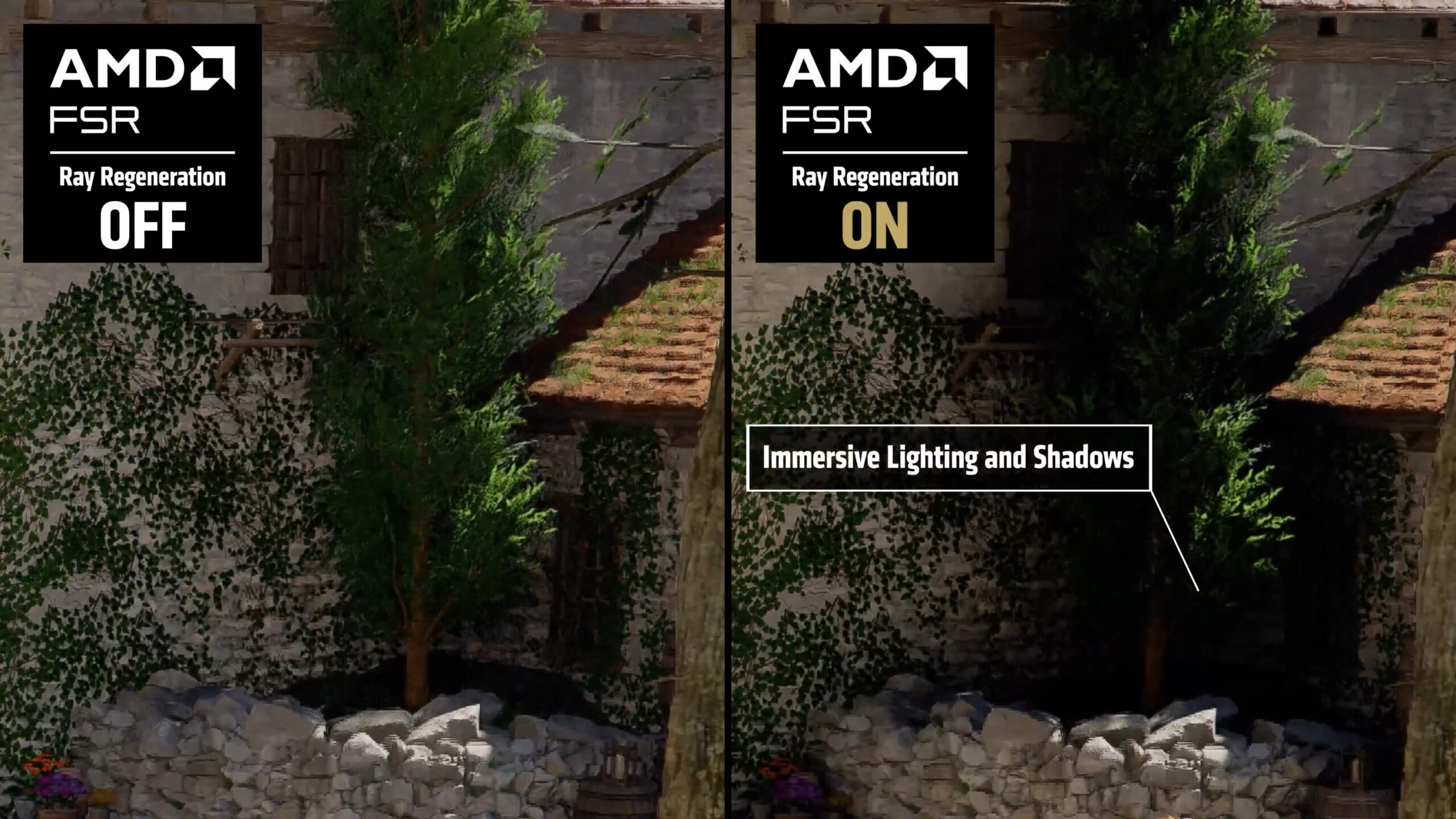
AMD is heavily promoting Crimson Desert, as the game uses its FSR Redstone technologies and can now also be obtained for free with Radeon graphics cards in a currently active bundle offer. The game is among the first titles to use Ray Regeneration and Radiance Caching technologies. The Adrenalin 26.3.1 drivers, in addition to supporting Crimson Desert, also bring support for Death Stranding 2 and various bug fixes.
FSR 4.1 improves image quality and Ultra Performance mode speed
The main novelty, however, is FSR 4.1, a new improved version of AI upscaling. FSR 4.1 is primarily intended to deliver improved image quality in motion. The image should be sharper and preserve more detail. Camera movement in scenes should also be rendered with better fluidity.
These improvements should manifest in games that are already using FSR 4, as the drivers should be able to automatically upgrade the version of libraries used in games (this capability was introduced in FSR 3.1, so games supporting this version should be upgraded to FSR 4.1 with the new drivers, too).

In addition to image quality, which should apply to “Performance” quality setting amongst others, AMD also advertises performance improvements realised in the fastest Ultra Performance mode, where the company has apparently focused specifically on speed—this performance increase is not quantified, but the difference is reportedly noticeable or measurable. Higher-quality settings than Ultra Performance will most likely not get faster (at least that’s what testing of the leaked preliminary version suggested).
Still Radeon RX 9000 only
In the meantime, internet commenter takes speculated that FSR 4.1 might extend support to older graphics cards, as a follow-up to the 2025 leaks of development version of FSR4 that was using a more compatible model with the INT8 integer data type (although it should be noted that this version has worse visual quality).
However, these speculations were not based on actual evidence, and it has now been confirmed that they were incorrect: FSR 4.1 remains available only for graphics cards of the RDNA 4 architecture, which provides hardware acceleration of AI operations that use the FP8 data type which FSR4 requires. The fact that FSR 4.1 is only available with Radeon RX 9000 GPUs is explicitly stated in the release notes.
Is FSR 4.2 next?
Discussing FSR 4.1, AMD’s Jack Huynh further stated that we can look forward to further results that will “push next-gen graphics forward” from company’s Project Amethyst. This could mean that after FSR 4.1, further updates or improvements to this technology are planned. The Project Amethyst designation refers to joint work between AMD and Sony focused on the development of AI upscaling and likely other gaming technologies.
Sony’s Mark Cerny noted that FSR 4.1 is based on the same foundation and possibly even the same neural network as the new version of PSSR upscaling (informally referred to as PSSR 2.0), which the company also released a few days ago, this time for PlayStation 5 Pro consoles. Interestingly, PSSR 2.0 likely uses INT8 AI cceleration instead of the FP8 that FSR 4 and FSR 4.1 rely on (this does not necessarily mean they can’t be based on the same neural network—the difference could lie merely in the quantization).
Given that this technology, albeit possibly with lower quality output, can apparenttly be made to work on INT8 hardware that is used in the PS5 Pro, it would be nice if one of the outcomes of the joint development with Sony ultimately were the release of something like INT8-based “FSR4 Lite,” that would also work on Radeon RX 6000 or at least on Radeon RX 7000 (which have more powerful support for INT8 compute, albeit not as powerful as Radeon RX 9000).
Sources: AMD (1, 2), Mark Cerny
English translation and edit by Jozef Dudáš
⠀