AMD FSR Redstone pushes the FidelityFX Super Resolution package for upscaling and frame generation into the machine learning era. Enhanced upscaling, frame generation, Ray Regeneration, and Radiance Caching all utilize ML on Radeon RX 9000 cards with the RDNA 4 architecture. We’ll look at what FSR Redstone adds compared to previous FSR 1–3 generations, how it works, what its limitations are, and how PC game support will shape up.
AMD FSR “Redstone” is the next major evolution of AMD’s FidelityFX Super Resolution technology. It originated in 2021 as a response to Nvidia’s DLSS. The first generation started as higher-quality upscaling of a single frame from a lower resolution to the monitor’s native resolution, with image quality gradually improving over time. AMD is now introducing enhancements with the fourth generation of FSR. Let’s quickly recap what each generation offered:
FSR 1—higher-quality single-frame upscaling
The first generation of FSR functions as an upscaler operating strictly on a single frame. The game first renders the frame at a lower resolution, and FSR then reconstructs a higher-resolution image using its own algorithm (EASU, Edge-Adaptive Spatial Upsampling). It attempts to preserve edges and fine detail while suppressing aliasing. After that, it applies sharpening (RCAS). FSR1 does not yet work with data from previous frames—it’s a “classic” upscaler that runs as a post-processing shader and doesn’t require any special hardware.
FSR 2—adding a temporal component
FSR 2 no longer works with just a single frame, but also uses data from previous ones, a technique known as temporal upscaling. The game renders the scene at a lower resolution, but FSR 2 processes not only the current frame—it also works with its history, which includes, for example, previous frames, motion vectors, and the depth map. From their combination it reconstructs a higher-resolution image and simultaneously replaces anti-aliasing (TAA). Thanks to this, it can reconstruct finer detail than the first-generation FSR and reduces flickering of elements between frames (such as wires, fences, or textures). However, it suffers from artifacts in areas where it lacks enough samples from previous frames. This most often occurs in parts of the image that were occluded in previous frames, for example around the edges of moving objects, where grain or the typical “ghosting” and smearing appear.
FSR 3—higher quality and frame generation, still shader-only
With the third generation of FSR, AMD further improved temporal upscaling and added support for frame generation, where the GPU interpolates additional, artificially created frames between the rendered ones. FSR 3 also introduced support for Native AA. In this mode the game runs at native resolution with full detail, and FSR’s temporal algorithm is used to achieve higher detail quality and anti-aliasing.
It is still a software solution that runs via the compute shaders of the GPU and is not tied to specialized hardware. However, FSR 3 is less prone to flickering of fine details, small structures are better preserved, and the occurrence of artifacts during fast motion is reduced. Improvements also relate to working with motion vectors and the scene’s depth map.
The aim of frame generation is primarily to improve fluidity on high-refresh-rate monitors in situations where the base framerate is already sufficient for comfortable gameplay. Frame generation cannot turn unplayably low framerates into playable ones.
If the base framerate is low, there’s nothing you can do about the long input latency—inserted frames actually make it slightly worse, because displaying an interpolated frame requires delaying the most recently rendered one. At low base framerates the differences between rendered frames are also larger, which significantly reduces the quality of inserted frames and makes artifacts more noticeable.
FSR 4
With the launch of the new Radeon RX 9000 generation, AMD introduced FSR 4, which uses artificial intelligence to address shortcomings of previous FSR generations, especially artifacts caused by insufficient sampling during rendering. It uses the same API functions as FSR 3.1, meaning FSR4 upscaling can be forced via drivers, enabling improved upscaling even in games without native FSR 4 support. A continuously updated list of titles supporting FSR 4 can be found on AMD’s website.
The trade-off for using machine-learning models is that FSR 4 is limited to the new Radeon RX 9000 generation, which leverages enhanced AI acceleration on RDNA 4–based cards, whereas FSR 3 essentially ran on a wide range of GPUs using only shaders.

FSR Redstone
Under the name FSR “Redstone,” AMD bundles several technologies that use machine learning to improve both performance and image quality in games. Machine-learning-based FSR 4 upscaling is complemented by additional AI-driven technologies—FSR Frame Generation, FSR Ray Regeneration, and FSR Radiance Caching.

The goal of the entire suite is to achieve higher framerates and better ray-traced image quality simultaneously. As a result, games will be able to use higher graphics-settings presets and deliver overall higher visual fidelity at framerates that would not be achievable without FSR.
Exclusive to Radeon RX 9000
In September there was speculation that FSR Redstone would bring FSR 4 support to older generations of Radeon cards (and potentially even competing GPUs). AMD accidentally released code suggesting support might be extended to additional cards, and there are even hacks that can inject it into games and make it work to a limited degree.
However, in the materials we have available, even within the FSR Redstone package, all AI-based technologies still reference only the latest Radeon RX 9000 architecture, with no mention of FSR 4 support on RX 7000. AMD’s own table says the same:
| AMD FSR feature | AMD RDNA 1, 2, 3 and 3.5 | AMD RDNA 4 |
|---|---|---|
| AMD FSR Upscaling (ML) | ✓ | |
| AMD FSR Upscaling (analytical, non-ML) | ✓ | ✓ |
| AMD FSR Frame Generation (ML) | ✓ | |
| AMD FSR Frame Generation (analytical, non-ML) | ✓ | ✓ |
| AMD FSR Ray Regeneration (ML) | ✓ | |
| AMD FSR Radiance Caching (ML) | ✓ |
First, a brief overview of each technology; we’ll break it down in more detail later:
AMD FSR Upscaling
FSR Upscaling uses a neural network to reconstruct a higher-resolution image from a relatively low internal rendering resolution. The game therefore runs internally at a lower resolution (for performance reasons), but the output displayed on the monitor appears sharper and more detailed than the source resolution would suggest. The fourth generation adds higher-quality image reconstruction through machine learning.
From AMD’s materials it isn’t clear whether FSR Upscaling itself received any improvements within the Redstone bundle—AMD compares image quality against FSR 3.1.


AMD FSR Frame Generation
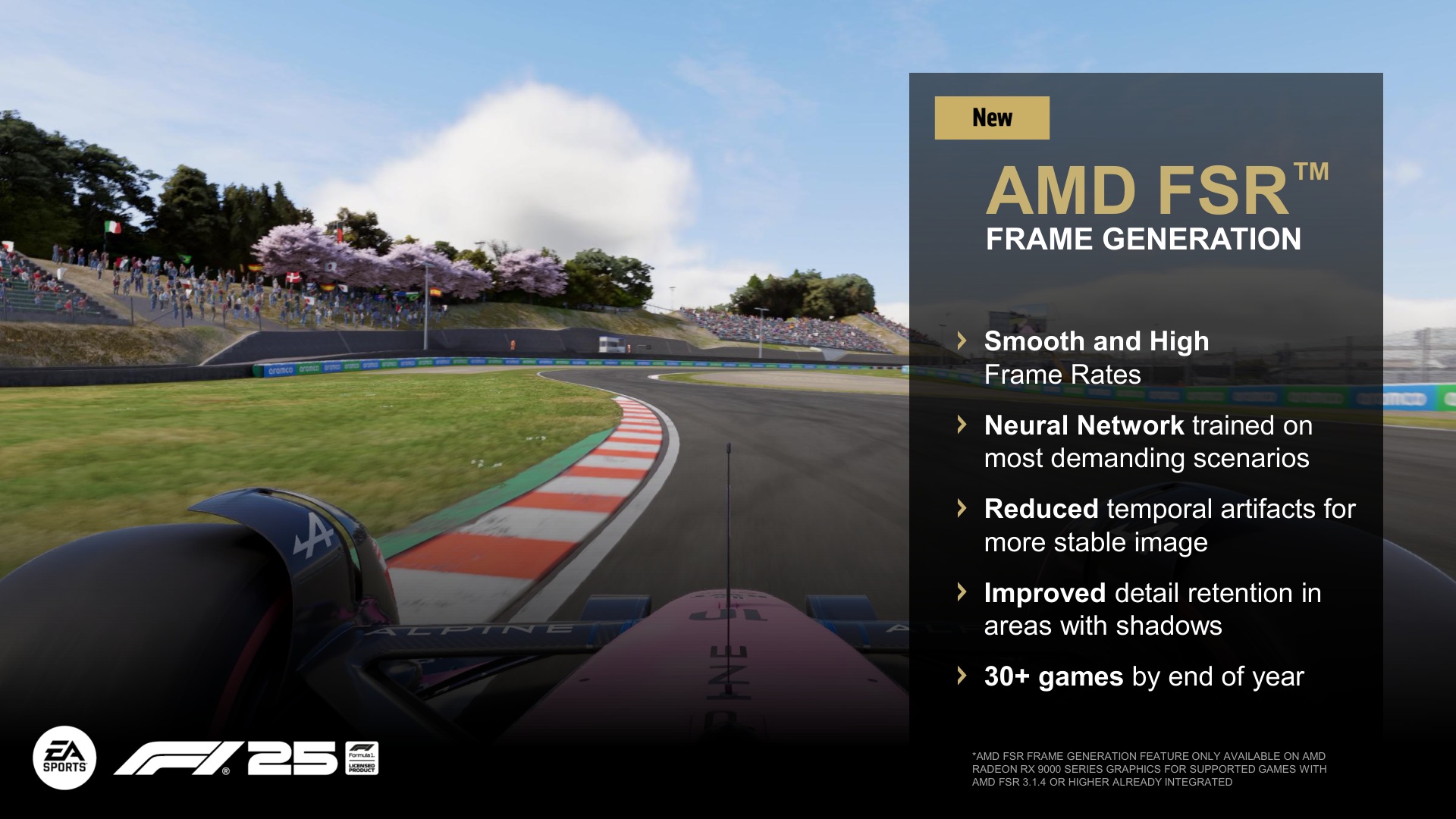
FSR Frame Generation inserts additional frames between those the game actually renders. On Radeon 9000 GPUs, a neural network trained on demanding scenes from modern games creates an intermediate frame based on two consecutive frames and supplementary data (such as motion vectors). In practice this results in a higher effective framerate and smoother motion without requiring the game to render every displayed frame. FSR Redstone improves reconstruction quality using machine learning.


AMD FSR Ray Regeneration
FSR Ray Regeneration targets ray tracing. It functions as a neural denoising layer for ray and path tracing: it takes an image rendered with a low number of samples per pixel (that is, with the typical “noise” of ray tracing) and removes the noise so the resulting frame appears cleaner. This processed image is then suitable for further steps such as upscaling or frame interpolation.


FSR Ray Regeneration is implemented in Call of Duty: Black Ops 7, and we have already examined its impact on ray-tracing quality and performance in a dedicated article.
AMD FSR Radiance Caching
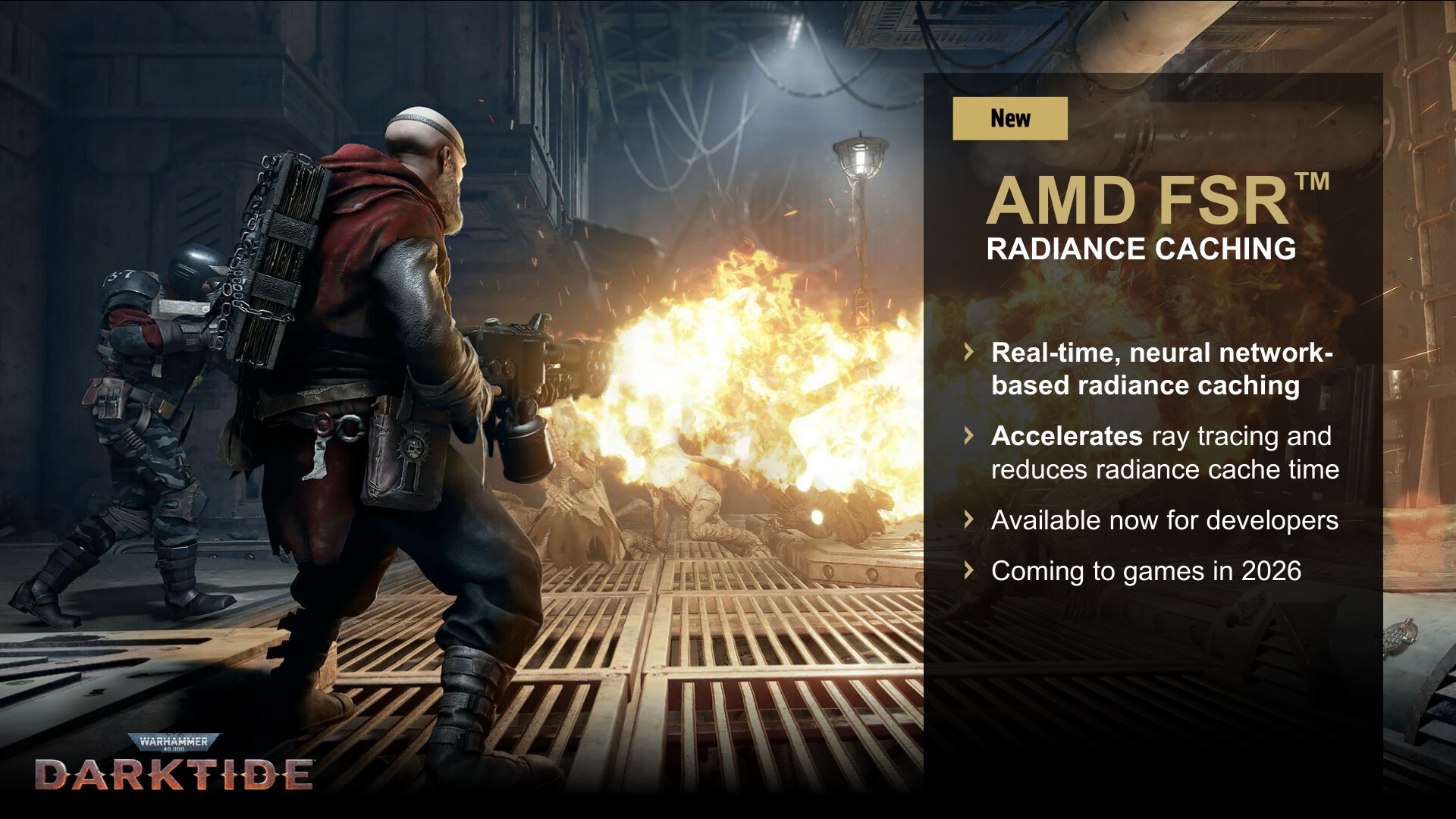
FSR Radiance Caching aims to reduce the computational load of ray tracing by handling light information in the scene more efficiently. Instead of recalculating all lighting from scratch, it stores and reuses precomputed data, supplementing them with estimates from a neural network when needed. The result is intended to be a better balance of visual quality and performance in scenes with complex lighting.


⠀