AMD FSR Redstone pushes the FidelityFX Super Resolution package for upscaling and frame generation into the machine learning era. Enhanced upscaling, frame generation, Ray Regeneration, and Radiance Caching all utilize ML on Radeon RX 9000 cards with the RDNA 4 architecture. We’ll look at what FSR Redstone adds compared to previous FSR 1–3 generations, how it works, what its limitations are, and how PC game support will shape up.
FSR Radiance Caching is a new component of Redstone that uses a neural network as a “smart” radiance cache (a buffer for radiance data in the scene) for ray tracing.
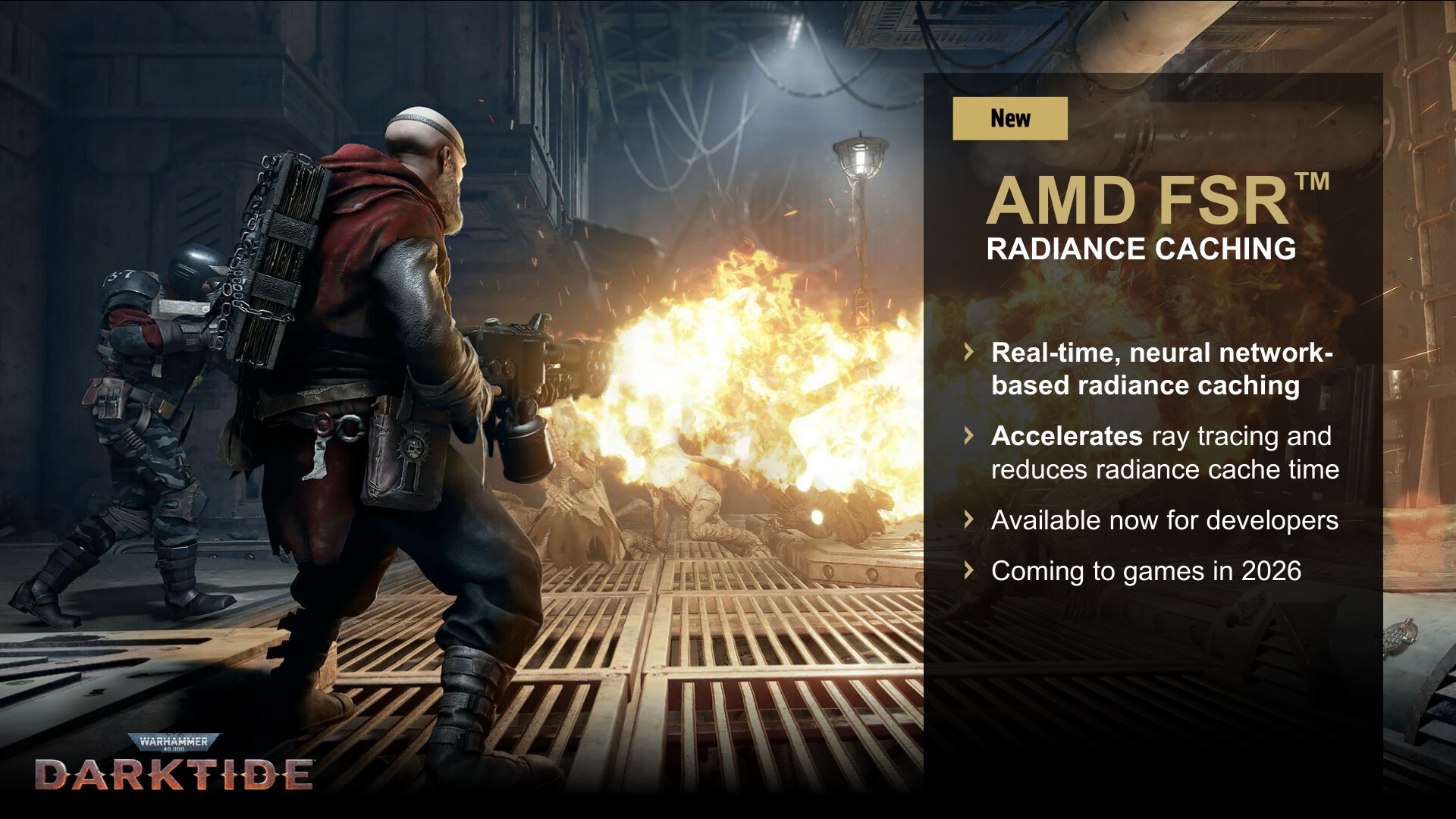
Instead of having the engine recalculate complex lighting along the entire path at every ray intersection, AMD trains a model on scene data—from the camera, the view, the surfaces, and the way indirect light propagates through the environment. When the game is running, the trained machine-learning model provides a radiance estimate as early as the second ray intersection, meaning fewer fully traced rays are needed and the coarse computation can remain simpler.

This shortens the time required to compute global illumination and indirect reflections while improving lighting quality compared to classic “analytical” methods, especially for indirect light and global illumination.
AMD is targeting modern engines with Radiance Caching, where it will be included as part of the FSR Redstone SDK. Developers should gain access to it with the release of FSR Redstone, but it is expected to appear in games in 2026.
A typical use case would be large interior environments with complex lighting, such as in Warhammer 40,000: Darktide—plenty of reflections, combinations of direct and indirect light, and at the same time a limited performance budget. In such scenes, Radiance Caching helps better preserve atmosphere and visual richness while freeing up performance for the rest of the Redstone pipeline and for higher framerates.

⠀