AMD FSR Redstone pushes the FidelityFX Super Resolution package for upscaling and frame generation into the machine learning era. Enhanced upscaling, frame generation, Ray Regeneration, and Radiance Caching all utilize ML on Radeon RX 9000 cards with the RDNA 4 architecture. We’ll look at what FSR Redstone adds compared to previous FSR 1–3 generations, how it works, what its limitations are, and how PC game support will shape up.
Frame Generation is used to insert an additional interpolated frame between two frames that were actually rendered. AMD offered frame generation in the previous generation of the suite, labeled FSR 3, already on Radeon RX 7000 GPUs.
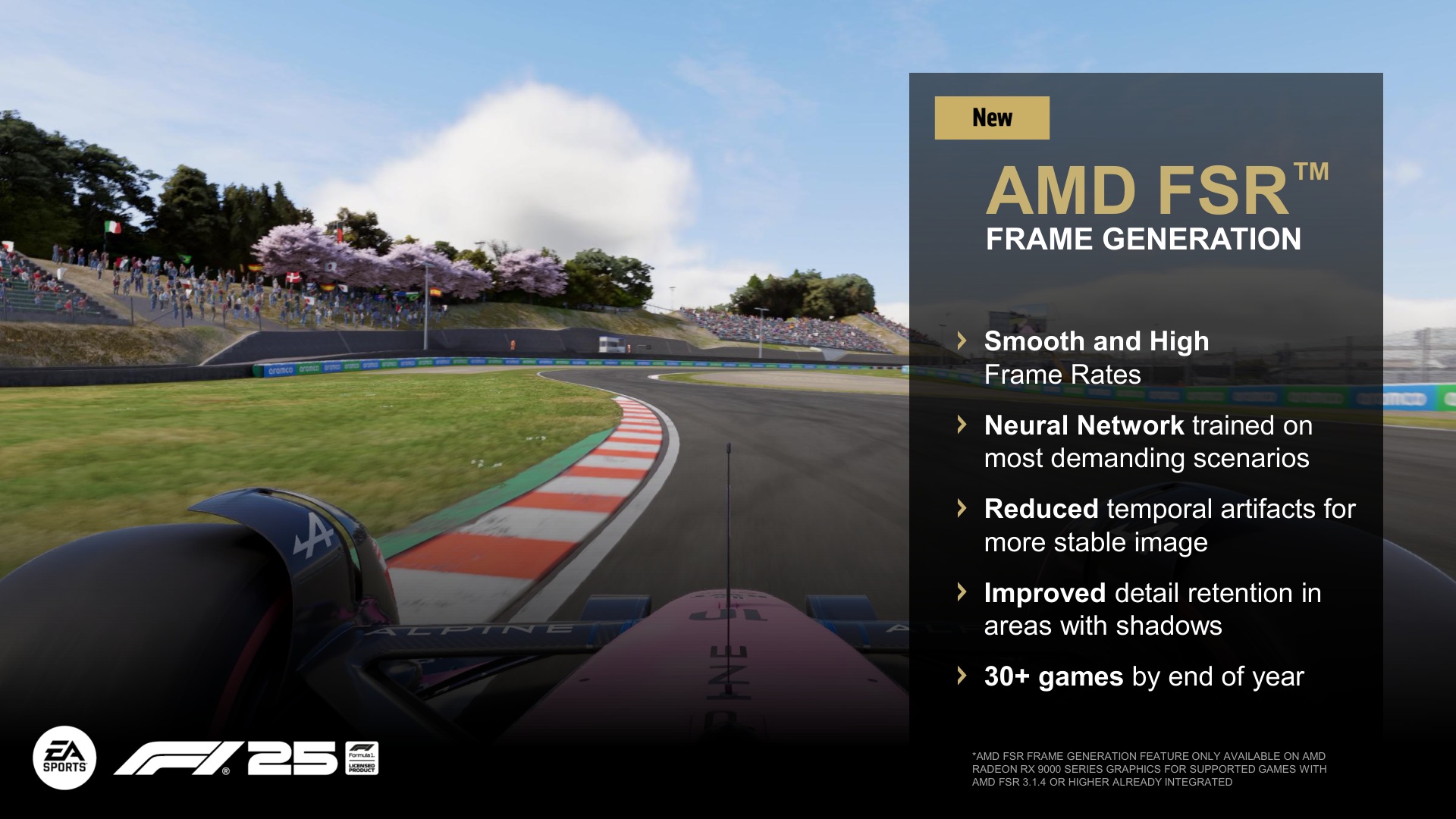
As part of the improvements in FSR Redstone, a neural network is added to frame generation, trained to achieve higher image quality—primarily more stable detail and reduced typical artifacts.
As with FSR 4 upscaling, there are two ways to use it in games: either developers integrate it directly into the game engine via the SDK, or it can be enabled through AMD Software drivers and then activated in supported games that implement FSR 3.1 with Frame Generation. Thanks to this, the following titles support ML-based frame generation as soon as the drivers are released:
| ARC Raiders | F1® 25 | Mafia: The Old Country | THE FINALS |
| Black Myth: Wukong | Farming Simulator 25 | Marvel Rivals | The Last Caretaker |
| Call of Duty®: Black Ops 7 | God of War Ragnarök | No More Room in Hell 2 | The Talos Principle: Reawakened |
| Cash Cleaner Simulator | Grand Theft Auto V Enhanced | Project Motor Racing | Titan Quest II |
| Cronos: The New Dawn | Hell is Us | Qanga | Winter Survival |
| Cyberpunk 2077 | Hogwarts Legacy | Rem Survival | Wreckfest 2 |
| Deathground | INDUSTRIA 2 (demo) | Ships At Sea | Wuthering Waves |
| EXFIL | Keeper | Squad |
However, the toggle in the drivers does not add frame generation to games whose developers did not integrate support for FSR 3 Frame Generation. It does not replace the AFMF (AMD Fluid Motion Frames) technology used to generate interpolated frames in games that do not offer FSR Frame Generation.
The FSR Frame Generation algorithm is based on a pair of consecutive frames, the scene’s depth map, and motion vectors. To these it adds an estimate of optical flow—information about how individual parts of the image move between frames. From this data, the neural network first predicts the motion and appearance of each pixel, then combines these predictions with classic motion-vector-based reprojection, and from the result it composes a new interpolated frame.
The model does not only determine “where” a pixel moves, but also what its color should be, because it takes into account temporal context (both the previous and the next frame) and motion information. The goal is for the inserted frame to visually align with both neighboring frames, maintain the shapes of objects, and reduce artifacts such as ghosting, broken edges, or flickering during fast motion.

In fast-paced games—such as the F1 25 racing title—the new version of Frame Generation with ML improves smoothness and image stability at high monitor refresh rates compared to the original frame generation from FSR 3.1.

⠀