

2027 is approaching with new generations of GPUs, although they will be delayed compared to the previous two-year cycles. AMD has GPUs with the new RDNA 5 architecture coming, which could incorporate fairly major changes compared to today’s RDNA 4 based GPUs, as well as a new manufacturing process. Thanks to the latter, clock speeds will apparently increase, although perhaps not by as much as one would have expected.
An interesting piece of information about gaming GPUs based on the RDNA 5 architecture has now surfaced on the AnandTech forum. The leaker with the nickname Kepler_L2, who tends to be well informed about GPU plans, particularly regarding semi-custom chips for PlayStation and Xbox consoles, revealed he had seen internal AMD documents in which the company lists target clock speeds of 3.1–3.4 GHz for RDNA 5.
It is not clear whether these are clock speeds that some specific standalone GPU die is supposed to reach, or those of a GPU integrated into next-generation consoles (it has already leaked that these will be derived from RDNA 5). In consoles, the clock speeds of the graphics portion are usually significantly lower than in dedicated chips. It could also be a general figure given for the RDNA 5 architecture as such, in which case it would probably correspond more closely to the architecture’s potential in standalone GPUs.
In any case, it should be emphasized that this is only a target or planned clock speed, not a result that has actually been achieved in silicon. It is quite common for final shipping chips to reach lower clock speeds than originally planned for various reasons. For example, there are slides indicating that AMD expected the RDNA 3 architecture to reach clock speeds above 3.0 GHz, but standalone Radeon RX 7000 cards ultimately had significantly lower specifications—the boost clock of the RX 7900 XTX was officially just 2.5 GHz. Therefore, there is no guarantee that we will actually see 3.1–3.4 GHz in practice with with RDNA 5 products.
How Big an Improvement Is It?
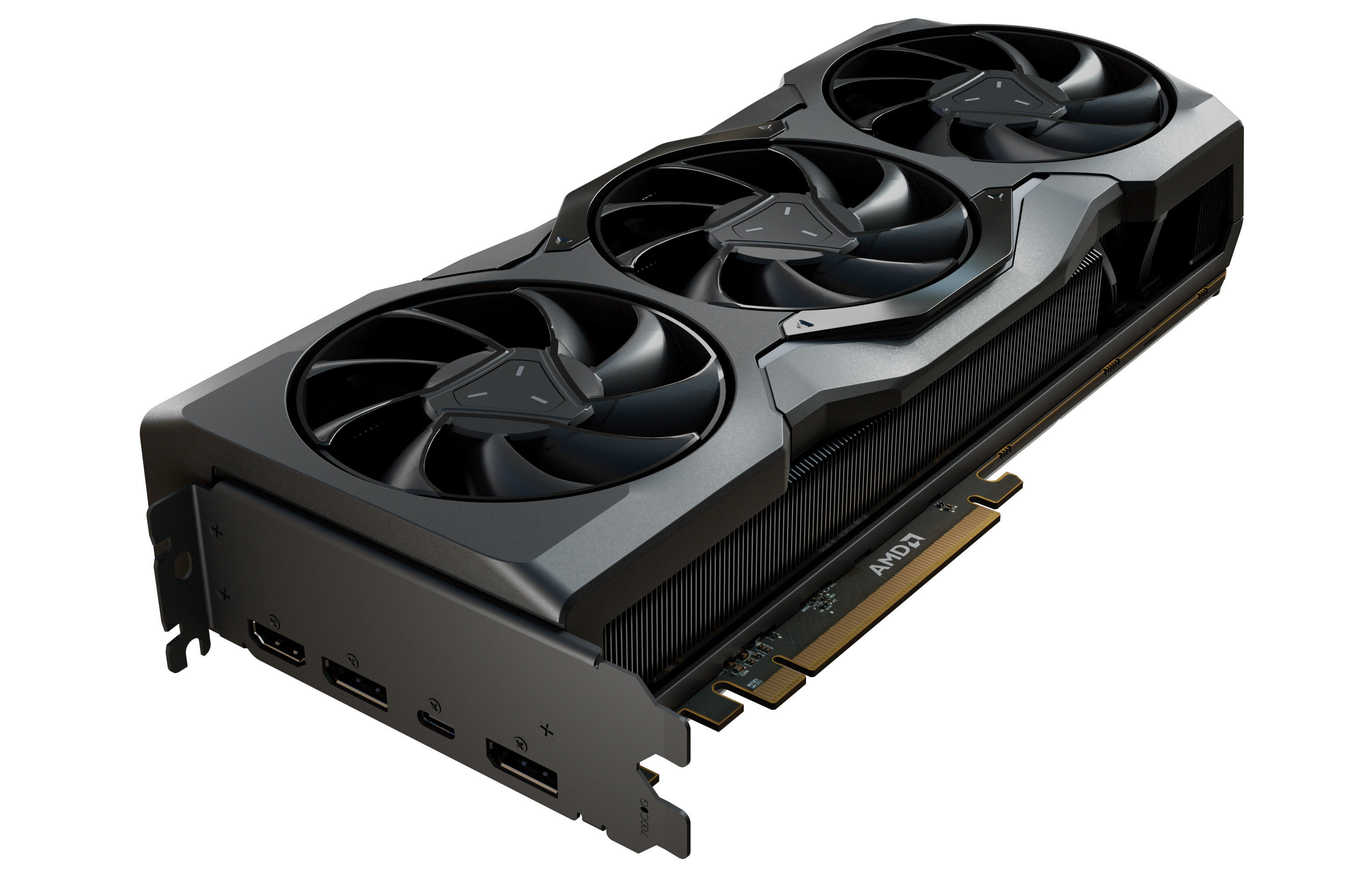
The question is what to compare this clock speed with if we want to get an approximate idea of how large an improvement in clock speeds it would represent for specific products. Standalone GPUs of the RDNA 4 generation officially have boost clocks (if this is what AMD means by the clock speeds here) of 2.97 GHz for the Navi 48 chip (in the Radeon RX 9070 XT) and 3.13 GHz for the Navi 44 chip (in the Radeon RX 9060 XT). With the RDNA 3.5 architecture, which is used only in integrated GPUs, a maximum of 2.9 GHz was initially achieved, but the Ryzen AI Max 400 refresh SKUs have managed to push the RDNA 3.5 integrated GPU clock speed to 3.0 GHz.
Overclocked Radeon RX 9000 cards sometimes reach boost clocks of up to 3.3 GHz, compared to which the aforementioned clock-speed targets would already represent practically no improvement, although this probably cannot be used as a comparison. It is to be expected that overclocked graphics card models with RDNA 5 chips would also reach even higher clock speeds. If we take stock, non-overclocked GPUs as the benchmark, achieving boost clocks of 3.4 GHz with the RDNA 4 architecture would represent a clock speed improvement of 8.6% to 14.5%, depending on which model you choose for comparison. 3.1 GHz would represent an improvement of just 0–4%.
- Tip: RDNA 5 GPU specs leaked. RX 10000 Radeons back in high-end?
- Tip: Details on Cheaper RDNA 5 GPUs: Will Radeons Switch to LPDDR6?
- Tip: What can Instinct MI455X tell us about RDNA 5 GPUs? [Analysis]
It is likely that Nvidia will also manage to increase clock speeds with their next GPU generation (probably called GeForce RTX 6000), as it is also expected to adopt a 3nm manufacturing process. AMD’s graphics cards thus will not be able to rely on having a dramatic clock-speed advantage over Nvidia’s next-gen. If AMD GPU performance is to increase significantly, they will need to improve performance per 1 MHz of clock speed and substantially broaden the GPUs to include larger numbers of units.
Source: AnandTech (Forum)
English translation and edit by Jozef Dudáš
⠀