Nvidia skipped the RTX 4050 in its GeForce RTX 40 lineup, leaving only the aging RTX 3060 and 3050 as budget options. The new GeForce RTX 5050 replaces both and adds modern features and standards. It’s the weakest—but also the cheapest—Blackwell-architecture card and can run every game at lower resolutions without without major sacrifices in image quality. That said, its price still makes the RTX 5060 the more attractive choice.
GeForce RTX 5050 is likely the last addition to the lineup of new GeForce cards based on the Blackwell architecture for the time being. It’s also the only model using the smallest GB207 chip.
A detailed description of the new technologies brought by Nvidia’s new graphics cards has been compiled by Jan Olšan in the article Blackwell: GeForce RTX 5000 architecture and innovations. It introduces the individual graphics chips Nvidia is using in the new cards, the new GDDR7 memory type, and also covers changes in cache memory, GPU compute units, updates to shaders and tensor cores, as well as improved compute units for ray tracing. The new generation of GeForce also brings support for new standards such as DisplayPort 2.1b and PCI Express 5.0.
With the new generation of cards, DLSS capabilities are evolving as well. It now supports Multi Frame Generation, which allows the generation of up to three intermediate frames, and introduces Nvidia Reflex 2, the second generation of its latency-reduction technology. This includes Frame Warp, which adjusts object and camera motion in rendered frames based on the player’s most recent input device movement data received just before the already rendered frame is displayed. A more detailed explanation can be found in the aforementioned article.
GeForce RTX 5050: smallest and cheapest, with 8 GB GDDR6
The GeForce RTX 5050 is equipped with the smallest graphics chip in the Blackwell series, designated GB207. It is manufactured using TSMC’s 5nm 4N FinFET process. The chip contains 16.9 billion transistors and covers an area of 147 mm². Compared to the GB206 used in the RTX 5060 and RTX 5060 Ti, it’s approximately 20% smaller.
The card features 2560 active stream processors, 80 texture units, and 32 raster units. Ray tracing calculations are accelerated by 20 RT cores, while tensor operations are handled by 80 dedicated units. The L2 cache has a capacity of 24 MB. The base clock speed is 2317 MHz, with a listed typical boost clock of 2572 MHz. The 130 W power limit is somewhat surprising, putting the card at a disadvantage compared to the more powerful RTX 4060, which has a 115 W TDP. Like other lower and lower-midrange GeForce models, it uses a PCI Express 5.0 ×8 interface with eight active lanes.
Unlike the more powerful next-generation GeForce models, the RTX 5050 uses older GDDR6 memory. This results in lower effective clock speeds and overall memory bandwidth, even with the same bus width. At 20 Gb/s over a 128-bit bus, the card offers a bandwidth of 320 GB/s. The pricier RTX 5060 performs noticeably better with 448 GB/s.
As a reminder, the more expensive GeForce RTX 5060 with 8 GB of memory has 48 raster units (ROPs), 3840 stream processors, 120 texture units, and 30 RT cores. Its clock speeds are slightly lower—base clock is 2280 MHz, boost clock is 2497 MHz. The memory communicates over a 128-bit bus and runs at 28 Gb/s.
The suggested retail price of the RTX 5050 is 249 USD, which currently to 262 EUR. The 8GB version of the GeForce RTX 5060 currently starts at around 317 EUR including VAT. The tested RTX 5050 Gaming OC model costs about 40 EUR more, with listings starting from around 295 EUR.
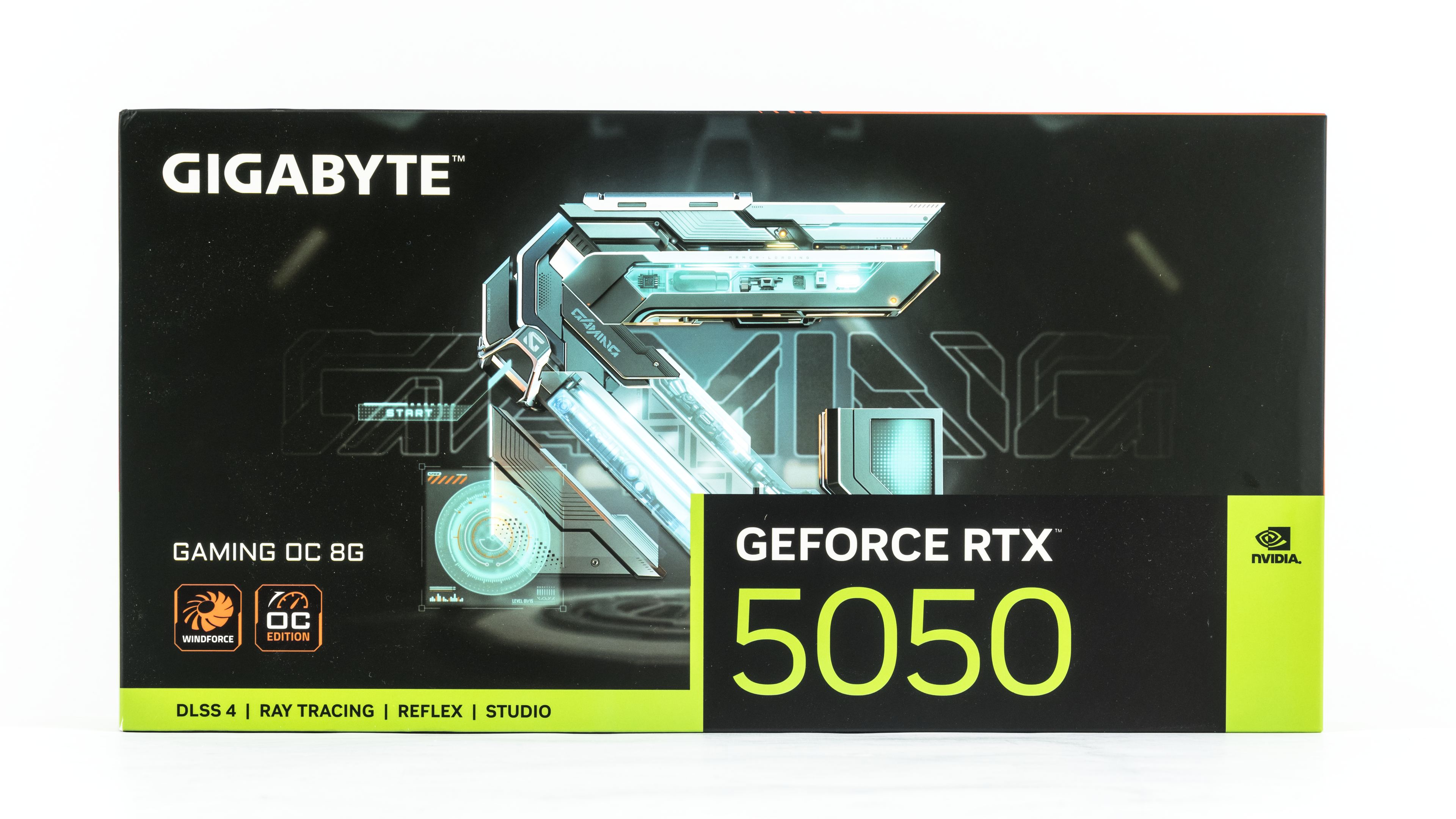
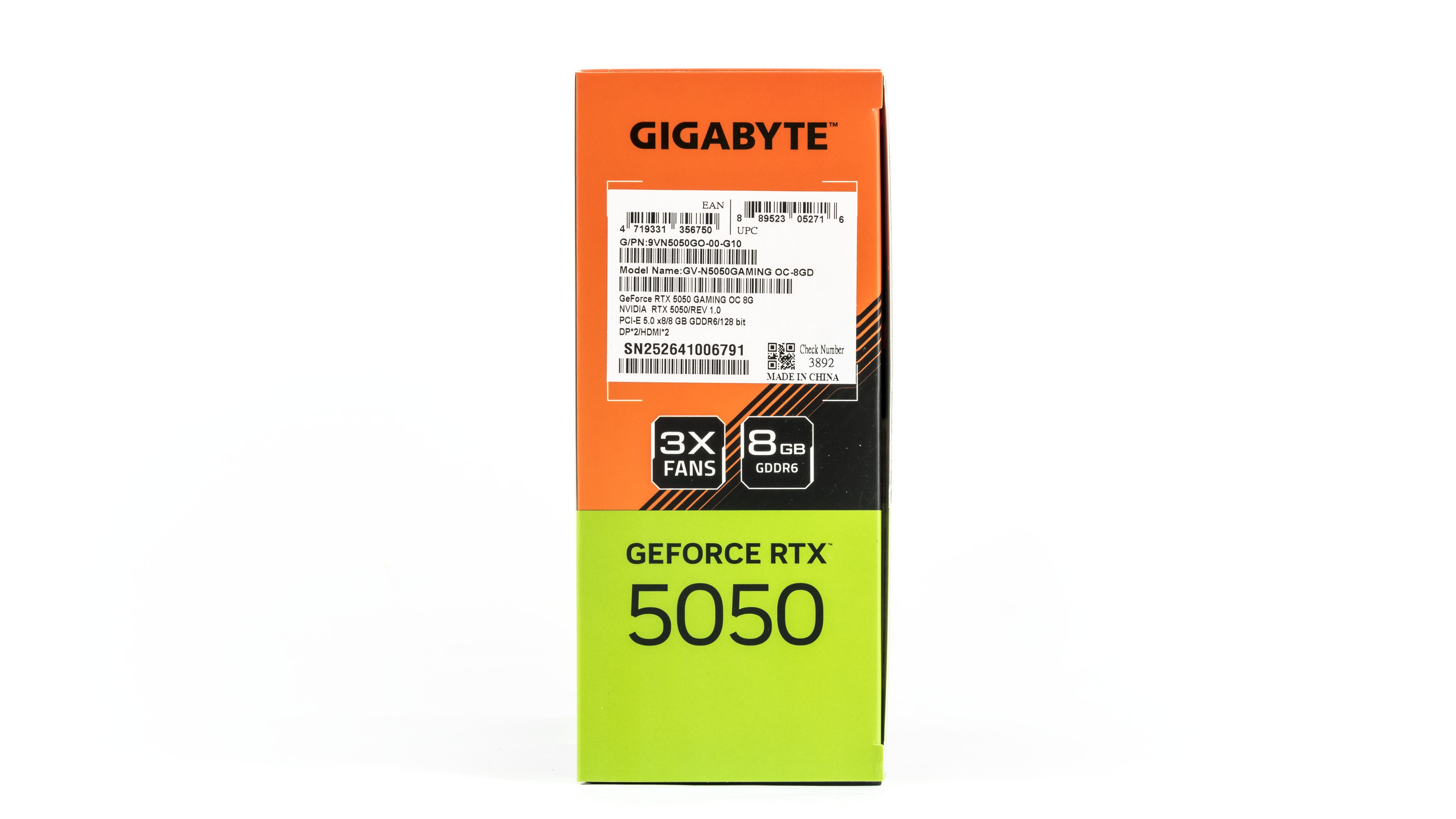
Gigabyte GeForce RTX 5050 Gaming OC (GV-N5050GAMING OC-8GD)
Gigabyte currently offers the RTX 5050 in three model lines – the highest-clocked Gaming OC, Windforce OC, and OC Low Profile.
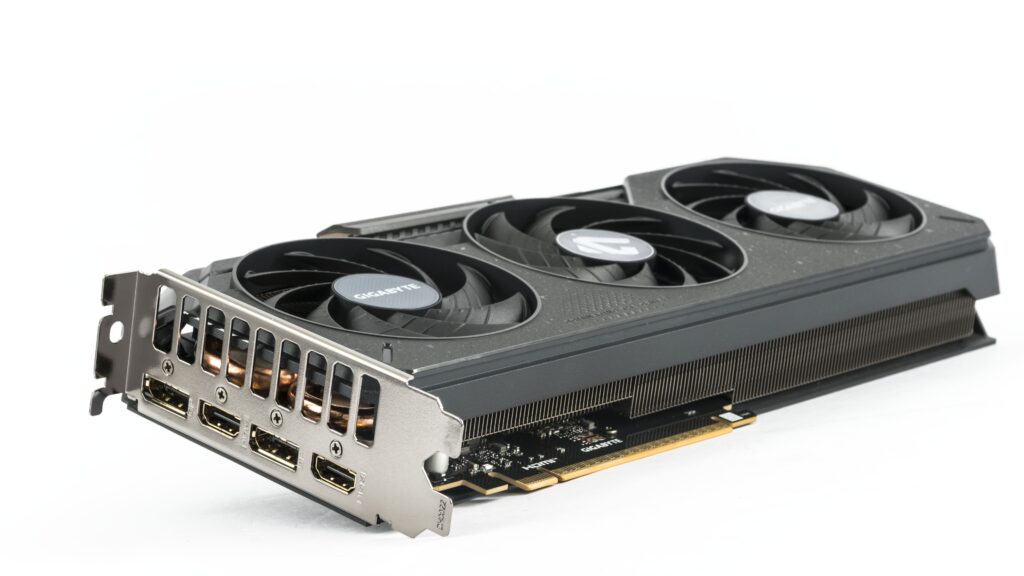
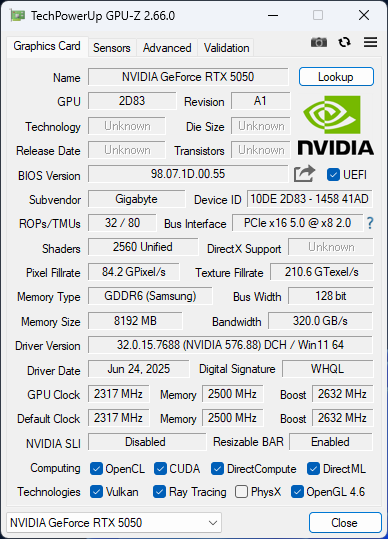
The Gigabyte GeForce RTX 5050 Gaming OC has a factory-overclocked typical boost clock increased from the reference 2572 MHz to 2632 MHz. The power limit remains at the reference 130 W but can be lowered by 15% to 110 W or increased by 15% to 150 W. GPU-Z does not yet fully support the RTX 5050, so some values are missing.
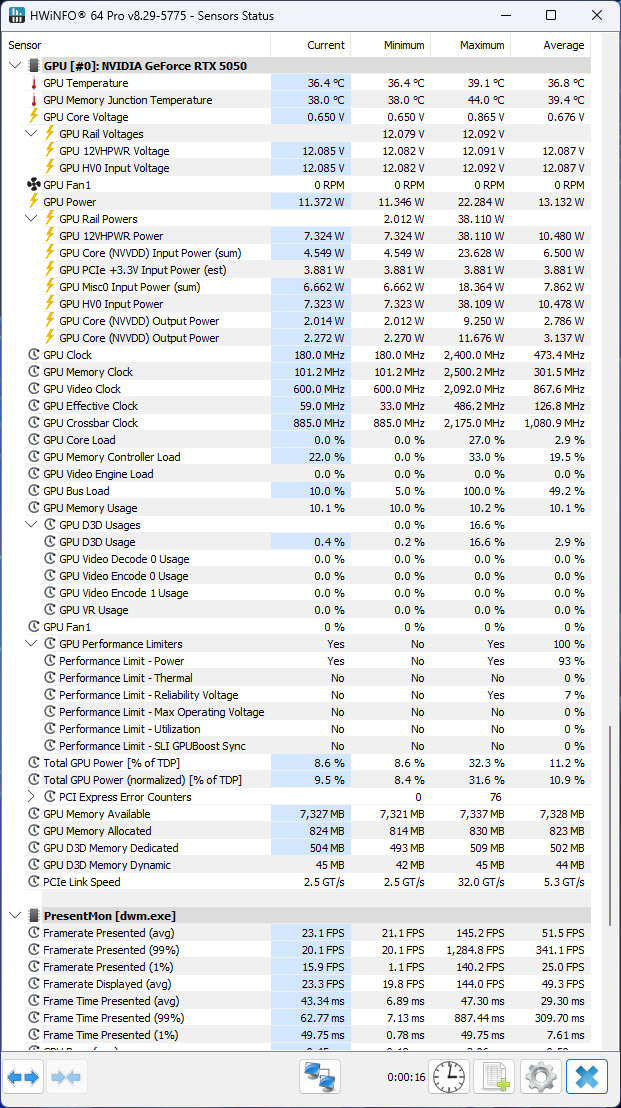
Of note in monitoring is that all fans are connected to a single Fan 1 header. In recent generations, fans are usually split across two headers.
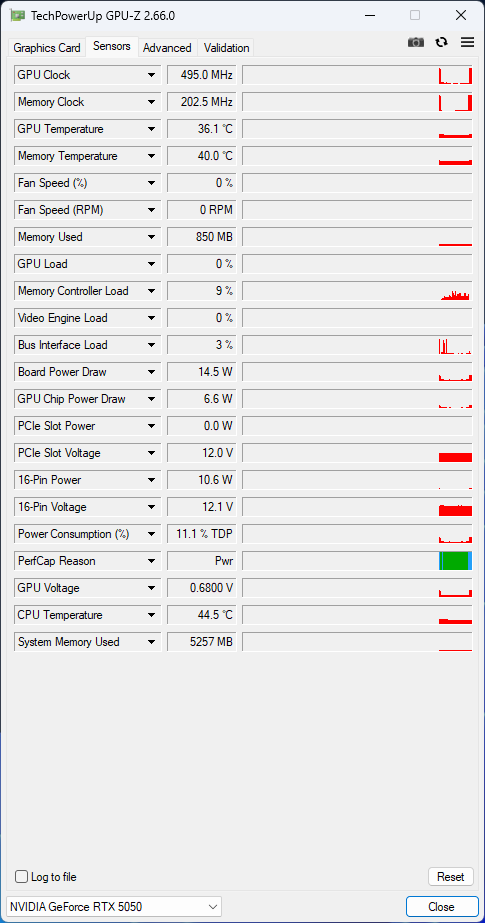
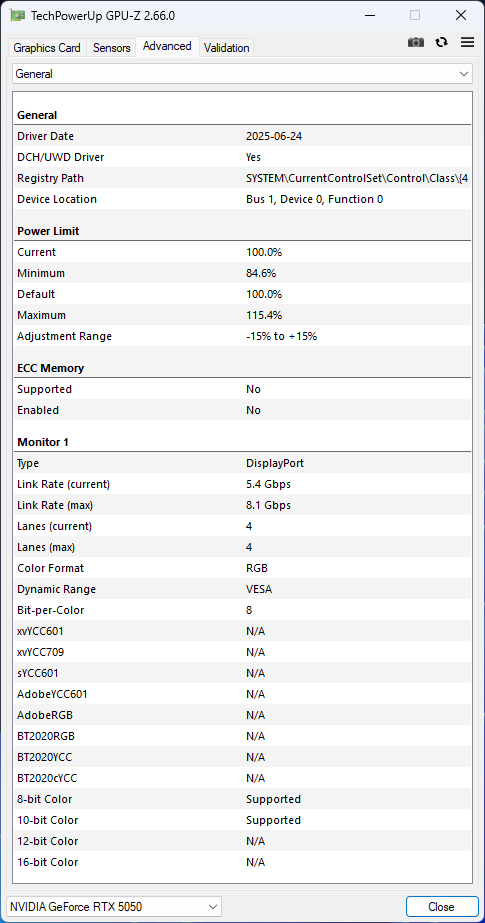
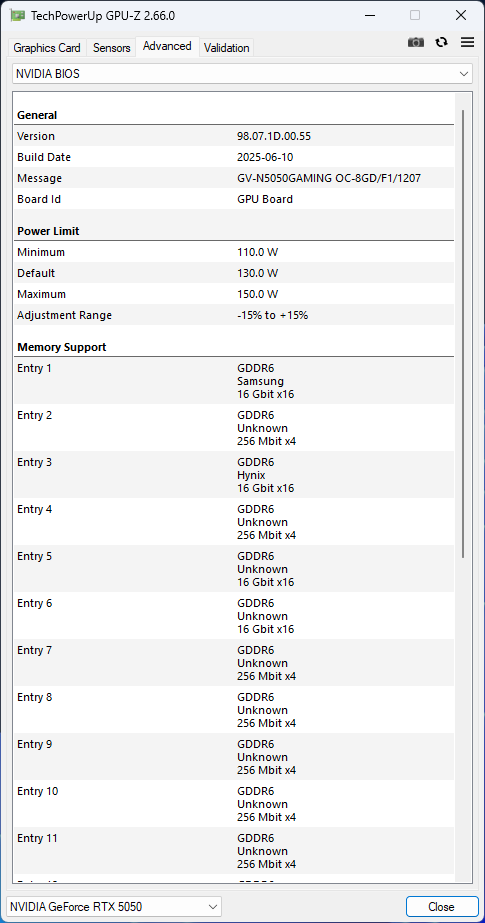
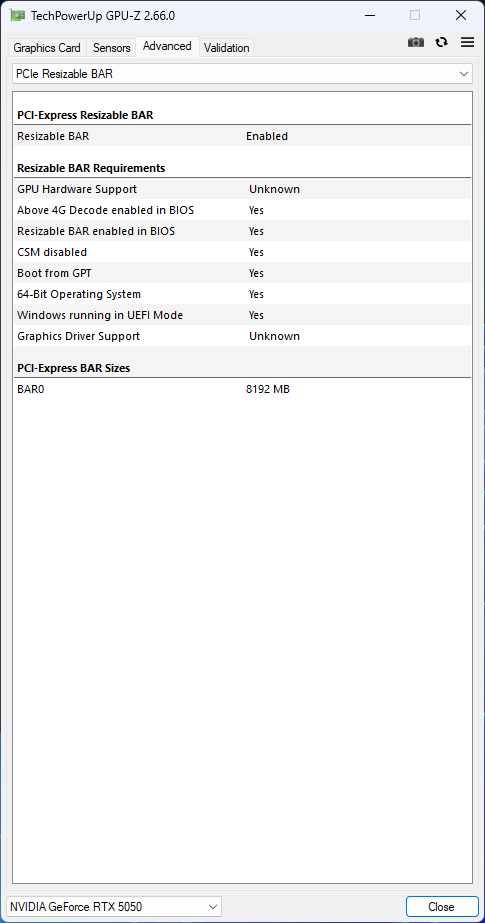
HWiNFO reads significantly more data from the card’s monitoring sensors than GPU-Z. The sensors available in the current version can be seen in the screenshot below.
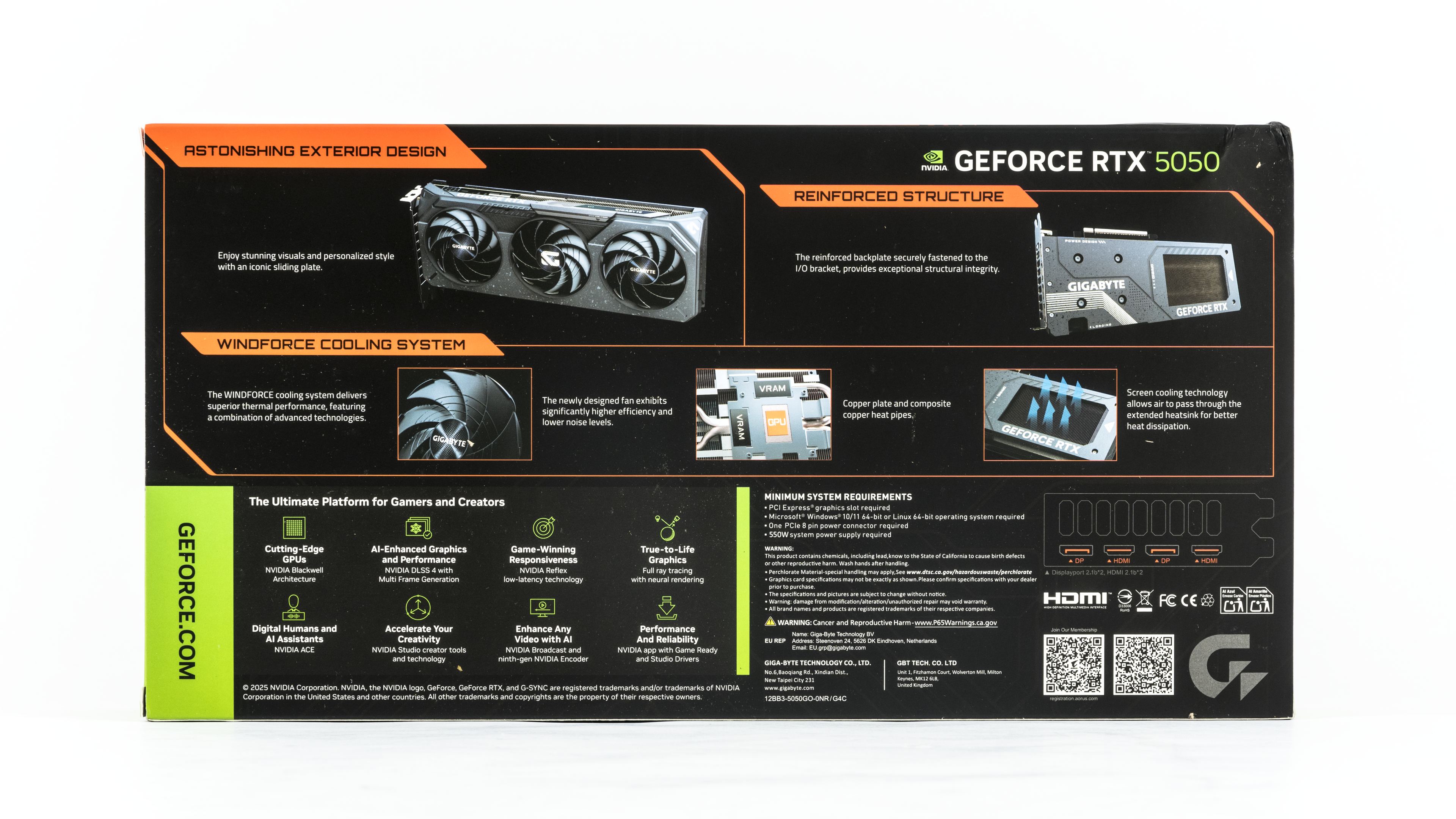
The back of the Gigabyte packaging highlights company technologies used by the card. First and foremost is the attractive design featuring Windforce cooling with a new generation of fans, a heatsink with composite heatpipes, and a large copper base that cools both the GPU and memory. The card’s construction is reinforced by a bracket that is screwed directly into the backplate—though, unfortunately, it’s made entirely of plastic. A large cutout in the rear half of the card allows warm air from the heatsink fins to exhaust freely above the card.
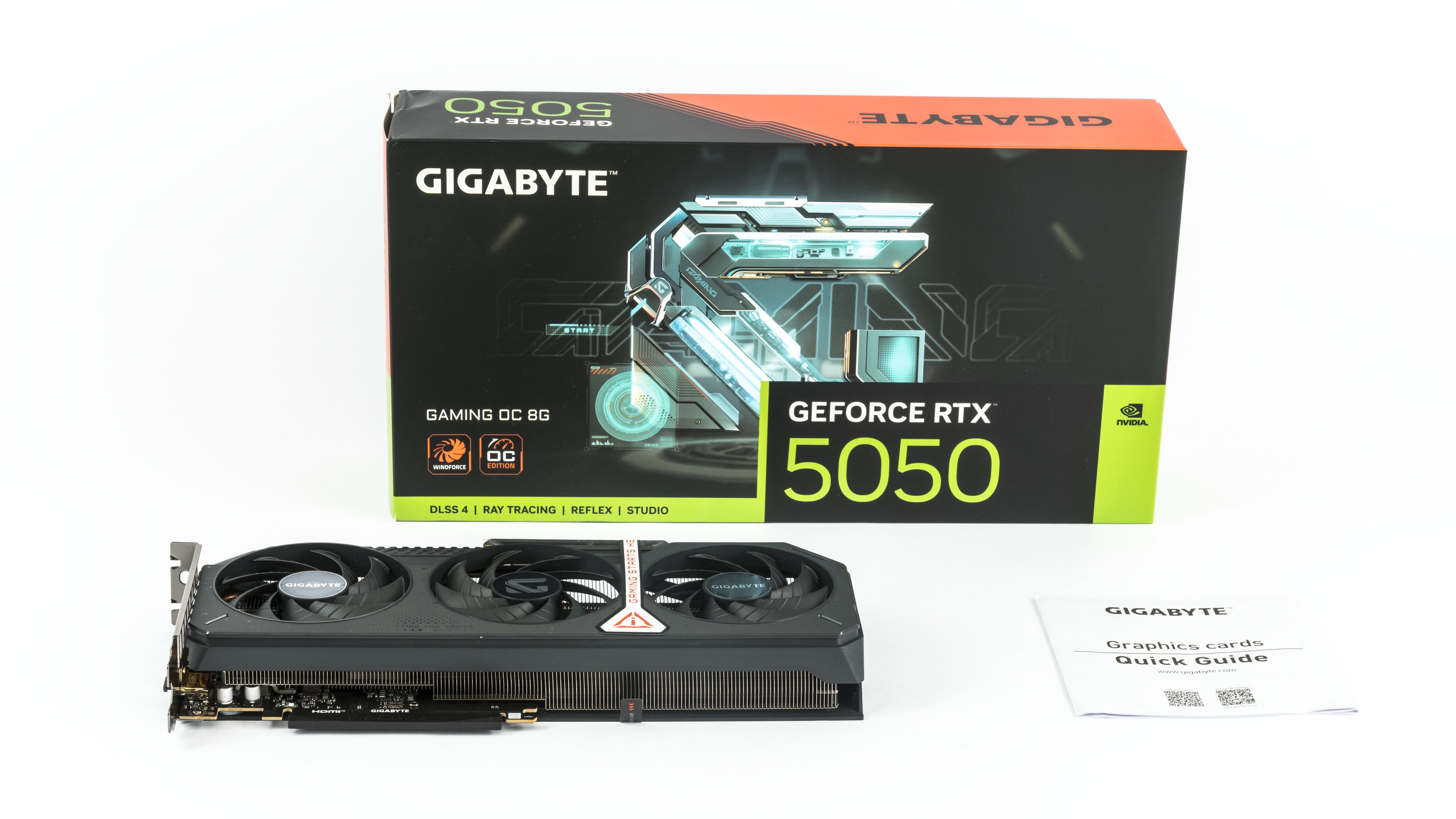
The accessories include only a brief installation guide. Auxiliary power is provided by a standard 8-pin connector, so no power adapter is needed.
⠀