Nvidia skipped the RTX 4050 in its GeForce RTX 40 lineup, leaving only the aging RTX 3060 and 3050 as budget options. The new GeForce RTX 5050 replaces both and adds modern features and standards. It’s the weakest—but also the cheapest—Blackwell-architecture card and can run every game at lower resolutions without without major sacrifices in image quality. That said, its price still makes the RTX 5060 the more attractive choice.
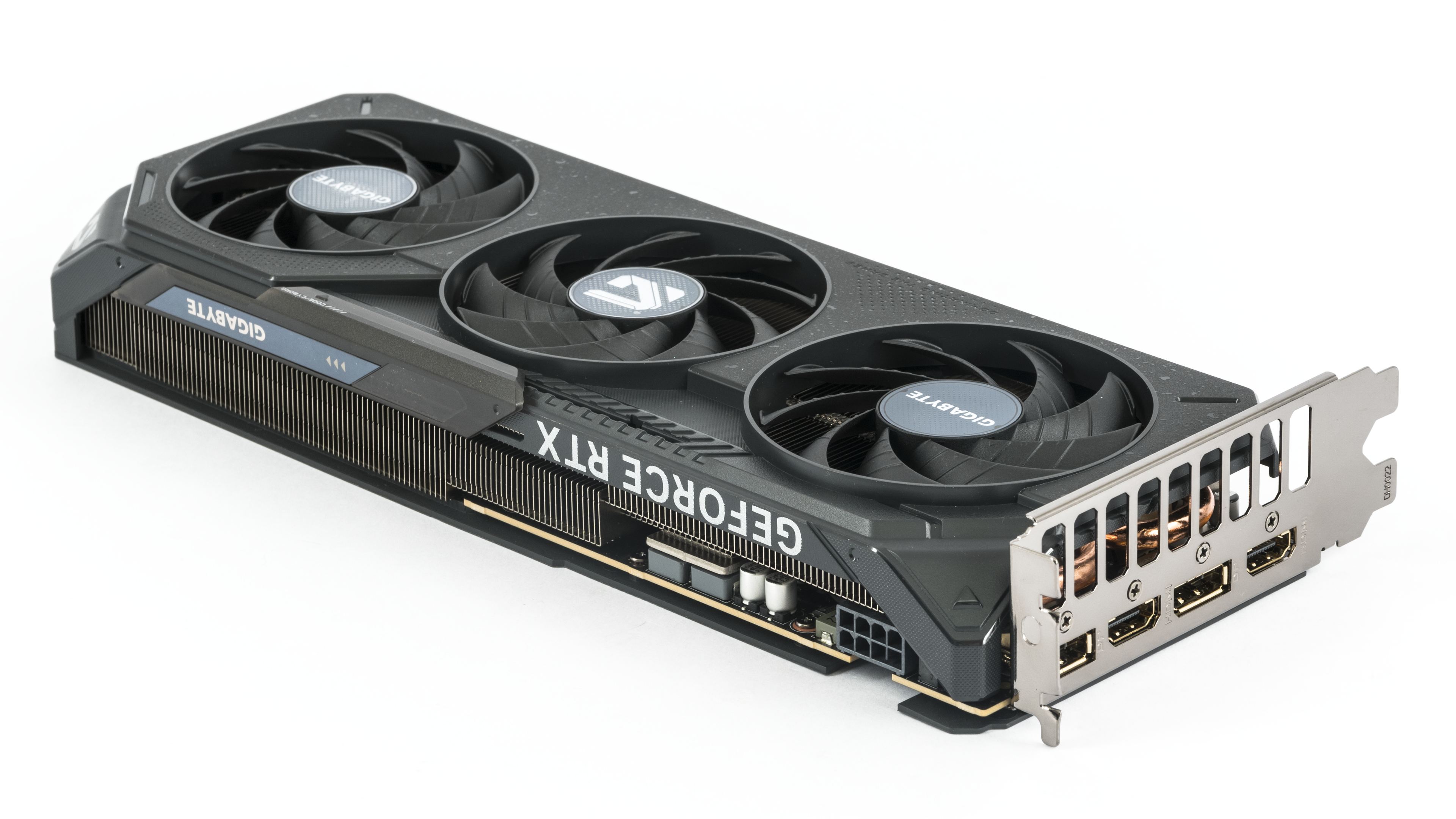
The card is equipped with a compact dual-slot cooler with three fans. The shroud is made of black-gray plastic and houses three fans blowing downward across a heatsink with transverse fins.



The back of the PCB is covered by a plastic backplate. The surface finish has a similar droplet texture as the shroud and is accented with gray and white elements.


From the top, it’s clear the heatsink is fully open under the rear fan and partially under the middle one. The middle fan spins in the opposite direction. Where the blades of adjacent fans meet, they don’t oppose each other but push air in the same direction. This reduces turbulence, stabilizes fan RPM, and results in a more balanced acoustic profile.


The heatsink neatly fills the entire space under the shroud. Especially in the card’s rear half, high fin density is evident. The fins extend below the PCB and reach the backplate. Although not a tall cooler, Gigabyte made optimal use of the available space under the shroud, which is reflected in its operating characteristics.


The cooler fits within two slots. It’s advisable to leave the third slot empty for better airflow to the fans, but even a low-profile card installed right beneath shouldn’t cause issues, considering the cooler’s efficiency and the fact that half of it is open.


The cooler features a sliding cover similar to other Gigabyte models with this design. However, it’s more useful on models with LED lighting, where the cover lets you choose between an illuminated strip or the Gigabyte logo. The budget RTX 5050 lacks any LEDs, and the lighting is replaced by a silver “GAME ON” stripe.


A close-up reveals the cooling for the MOSFETs and coils in the power delivery. Heat is conducted from the MOSFETs through thermal paste to the main heatsink base.

The fan impellers have a diameter of just 77 mm and a height of about 7–8 mm, with slim blades. Expect them to spin at higher RPMs, but this doesn’t necessarily translate to high noise levels.
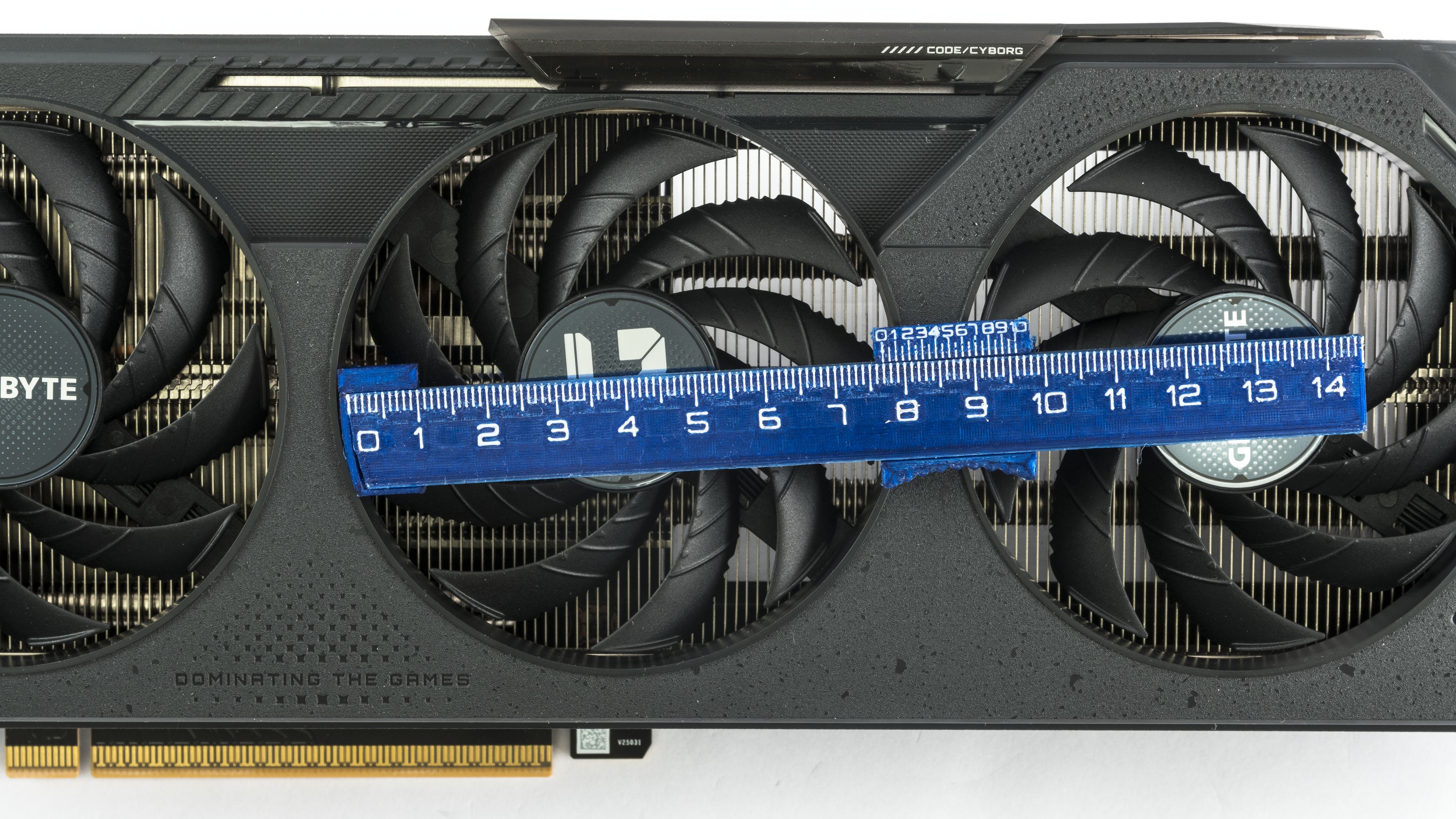

The card measures approximately 28.2 cm in length from the bracket. In width, it doesn’t extend even a centimeter beyond the bracket. Its height is just 4.2 cm.


Compared to what is commonly seen today, the card is very light, weighing just 711 g.

A close-up shows that only the first half of the PCIe ×16 connector’s pins are wired—only eight lanes are active.

Standard GeForce outputs include three DisplayPort 2.1b connectors with UHBR20 and one HDMI 2.1b. Gigabyte’s card features two HDMI and two DisplayPort connectors.

Power is supplied via a standard 8-pin connector, oriented with the latch facing upward. Its location, however, is rather unusual—right behind the bracket. For cable management, this is actually preferable, as it allows routing along the case’s rear wall instead of mid-card. It’s not the first Gigabyte card with this kind of power connector layout.

We’ve covered the design, now let’s take a look at the test build and test results.
⠀