




When the RX 9070 launched, nearly all reviews focused on pricier, factory-overclocked 245 W versions. Cards with reference clocks are far less common. We’re examining one of them—the basic Sapphire Pulse RX 9070—with stock specs: a 2520 MHz boost and a reduced 220 W power limit. In practice, though, at reference clocks the card seems to ends up a little slower in tests than it should be.
Fan behavior, noise levels
The fan speed can be set in the range of 15–100%. This corresponds to fan speeds of approximately 700–3800 rpm (29–52 dBA). At minimum speeds the fans were inaudible.
Under load, after temperatures stabilized, the fan speeds settled around 1960–2000 rpm. The card’s noise level then ranged between 35.2–35.5 dBA. The card is therefore not outright loud, but you will hear it. Possibly also because, similarly to other Sapphire cards with the same fans, at around 2000 rpm the fans generate increased noise around 220 Hz.
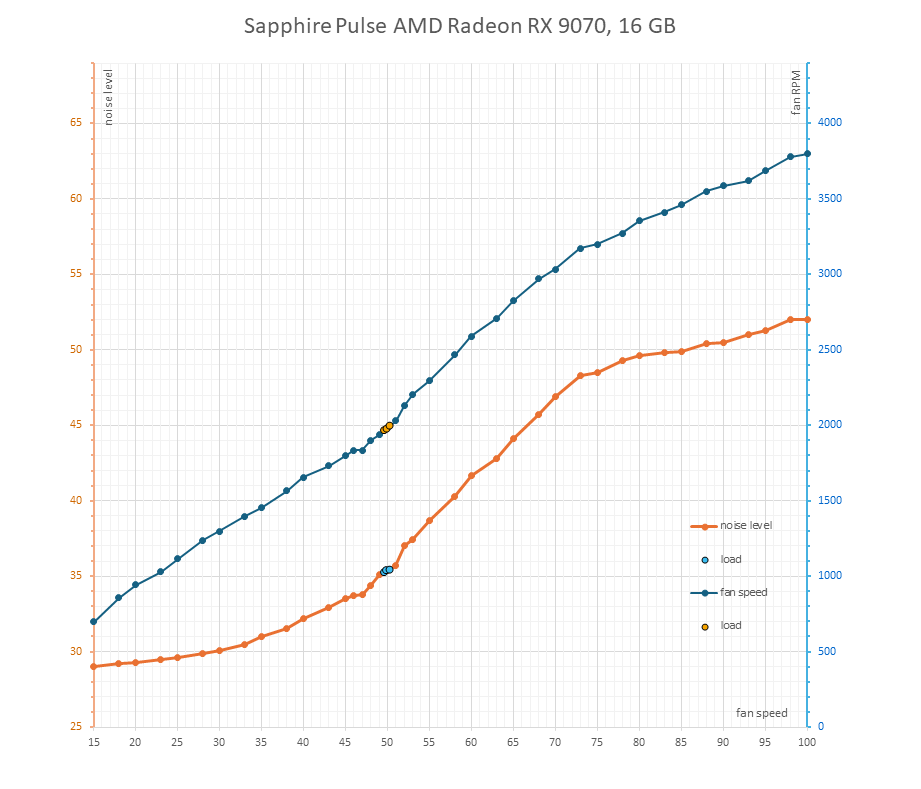
With the default fan curve you will likely hear the fans, but the cooler has enough headroom for you to reduce the fan speed and achieve a better result.
⠀





– It is obvious that a big advantage of this card are its dimensions. This is never mentioned in the review.
– I always power-limit my GPU during gameplay as a way to optimize (1) fan noise, (2) case temperate, (3) adjust for summer vs. winter room temperature and (4) to lower the electricity bill.