





When the RX 9070 launched, nearly all reviews focused on pricier, factory-overclocked 245 W versions. Cards with reference clocks are far less common. We’re examining one of them—the basic Sapphire Pulse RX 9070—with stock specs: a 2520 MHz boost and a reduced 220 W power limit. In practice, though, at reference clocks the card seems to ends up a little slower in tests than it should be.
Final thoughts
The Pulse AMD Radeon RX 9070 is one of the few models available here that comes with reference clocks. And I was surprised by how much the performance differs compared to the higher-clocked 245 W models with a 2700 MHz boost clock. The performance drop is larger than I’d expect from a card that should have only roughly 200 MHz lower clocks.
Compared to the previously tested Radeon RX 9070 cards, it also differs in the GDDR6 memory it uses. The tested unit has Samsung chips, while the Sapphire Pure Radeon RX 9070 OC and Gigabyte RX 9070 Gaming OC use Hynix. Still, I doubt this alone could be the cause of such significant performance differences. I also still can’t rule out that I made a mistake somewhere or that something changed in the system—but on two different test builds the performance is similar regardless of which drivers I use.
The card also reacts very unusually to manual overclocking settings. Increasing the power limit by 10%, which should allow higher voltage and higher clocks in exchange for more power consumption, results instead in a performance drop of about ten percent in some tests. And conversely, lowering the power limit boosts performance. It behaves the same on two different systems with both current 25.12.1 drivers and the previous 25.11.1.
Monitoring data suggests there should be no issues with temperatures or power consumption, and the reported GPU clock also doesn’t show any irregular behavior. Based on everything above, it seems there is an issue somewhere on the BIOS or driver side for this 220 W model (and possibly not just this one).
In terms of performance, the card is noticeably slower than the 245 W models I tested—more than the clock differences alone would suggest. Without the option to test the same model with Hynix memory, it’s difficult to say how much of the gap the memory contributes to. In any case, simple overclocking didn’t get me to the same performance level as the Pure RX 9070, even though theoretically it shouldn’t be a problem. In principle, you should be able to approach the Pure RX 9070 by increasing the power limit by 10% and raising the clock offset by 180 MHz. This pushes the power limit from 220 to 242 W, roughly matching the 245 W Pure Radeon, and the offset should raise the clocks. But clearly something is holding the card back, and with the increased power limit, performance actually drops. It seems I’m not the only one who has run into odd behavior with the 220 W Radeon RX 9070 models.
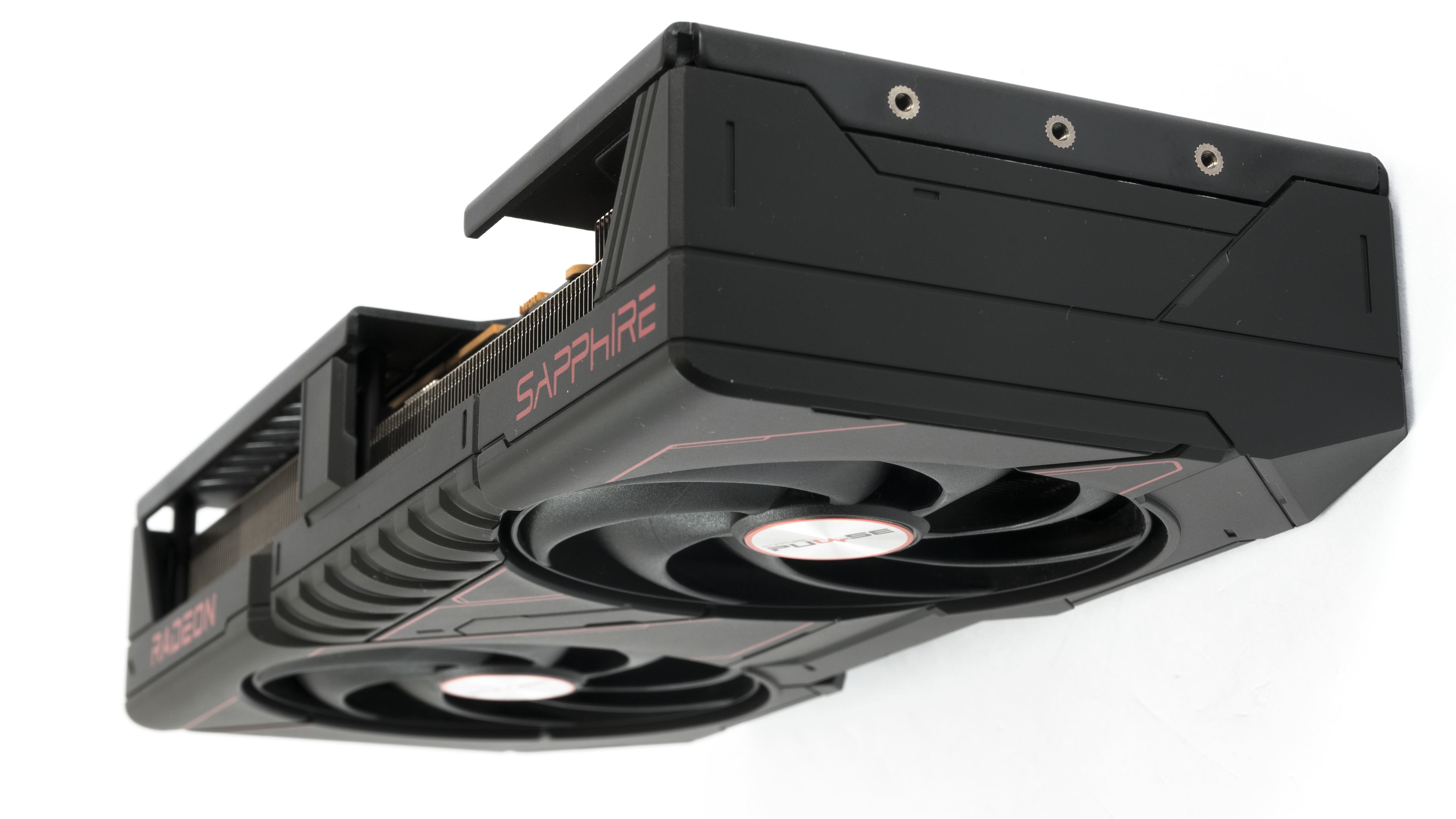
Acoustically, it ends up similar to the 245 W Pure RX 9070. The reason is partly the fan curve settings and partly the fact that the Pure has higher power draw but also a larger cooler. For a baseline model, its operating characteristics are good, though I’d prefer higher temperatures in exchange for quieter cooling. That can, however, be tuned manually in the drivers.
The card itself is well-made structurally, and the cooling is more than sufficiently dimensioned. Theoretically it should be an excellent product, but the firmware or driver behavior is, at the very least, unusual.
Given that the current minimum-price difference is around 20 EUR, I would definitely recommend paying extra for the three-fan Pure RX 9070 and avoiding the Pulse. Even though writing something like this based on a single sample always carries some uncertainty, it’s still possible I ended up with an abnormal unit.
| Sapphire Pure AMD Radeon RX 9070 16GB (11349-03-20G) |
|
+ 16 GB memory − Lower performance than the 245 W RX 9070, the difference larger than usual (possibly also due to the memory) |
| Approximate retail price (incl. VAT): 590 EUR |
English translation and edit by Jozef Dudáš





– It is obvious that a big advantage of this card are its dimensions. This is never mentioned in the review.
– I always power-limit my GPU during gameplay as a way to optimize (1) fan noise, (2) case temperate, (3) adjust for summer vs. winter room temperature and (4) to lower the electricity bill.