





When the RX 9070 launched, nearly all reviews focused on pricier, factory-overclocked 245 W versions. Cards with reference clocks are far less common. We’re examining one of them—the basic Sapphire Pulse RX 9070—with stock specs: a 2520 MHz boost and a reduced 220 W power limit. In practice, though, at reference clocks the card seems to ends up a little slower in tests than it should be.
Noise level, operating characteristics—Metro Exodus Enhanced Edition
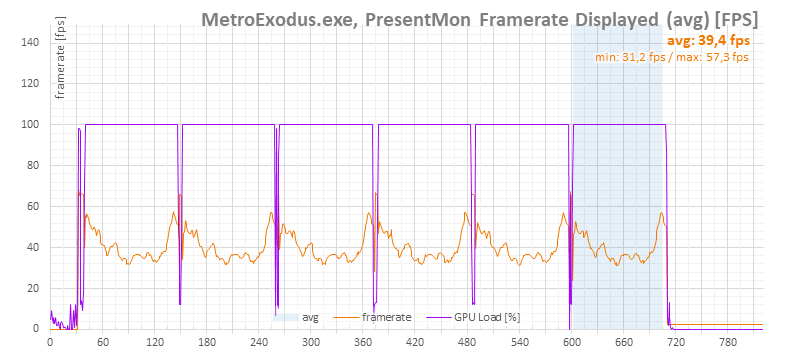
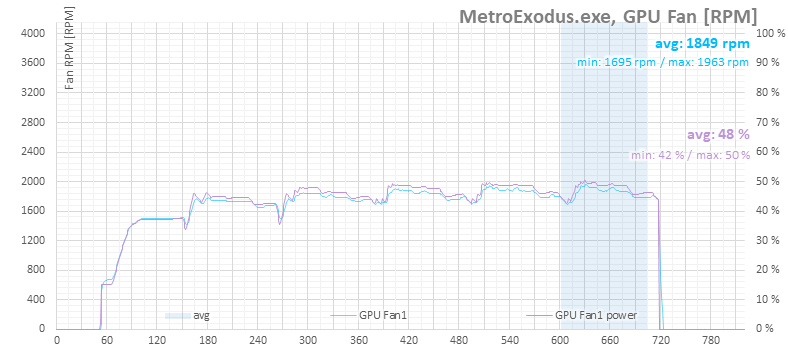
The next set comes from the Metro Exodus Enhanced Edition benchmark with Extreme settings at 3840 × 2160.
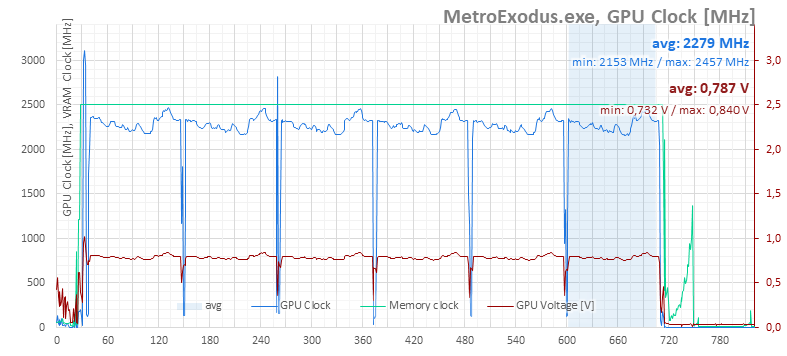
The GPU clock speed ranges between 2153 and 2457 MHz with an average of 2279 MHz.
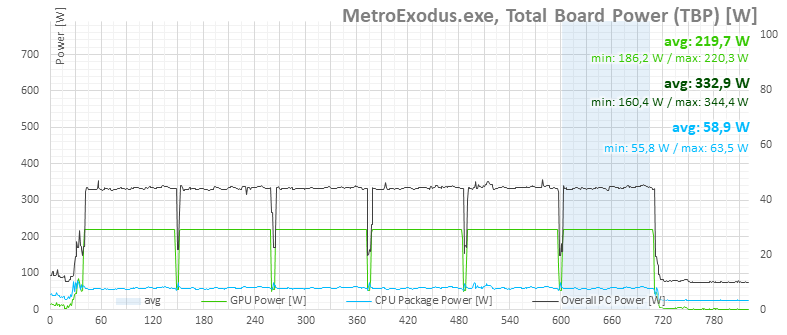
The card’s power draw according to monitoring stays at an average of 219.7 W, matching the set power limit. The average system draw is around 333 W.
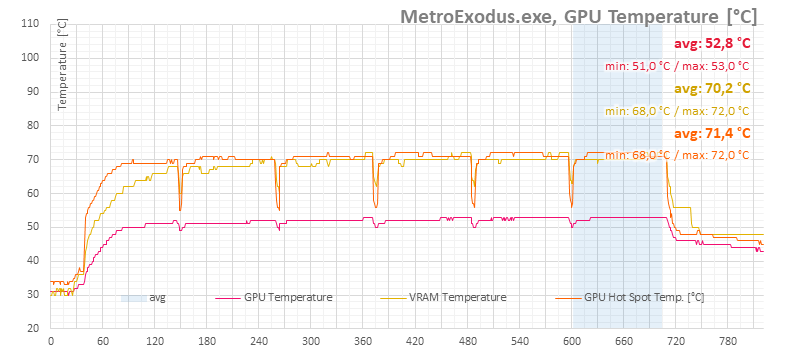
The average GPU temperature topped out at 53 °C, memory reached 72 °C, and the GPU hotspot reached 72 °C.
In this set of measurements the fan fluctuations are the largest—towards the end the test loop starts at 1960 rpm and over roughly two minutes of the test drops to 1695 rpm.
⠀
⠀





– It is obvious that a big advantage of this card are its dimensions. This is never mentioned in the review.
– I always power-limit my GPU during gameplay as a way to optimize (1) fan noise, (2) case temperate, (3) adjust for summer vs. winter room temperature and (4) to lower the electricity bill.