





When the RX 9070 launched, nearly all reviews focused on pricier, factory-overclocked 245 W versions. Cards with reference clocks are far less common. We’re examining one of them—the basic Sapphire Pulse RX 9070—with stock specs: a 2520 MHz boost and a reduced 220 W power limit. In practice, though, at reference clocks the card seems to ends up a little slower in tests than it should be.
Noise level, operating characteristics—F1 24
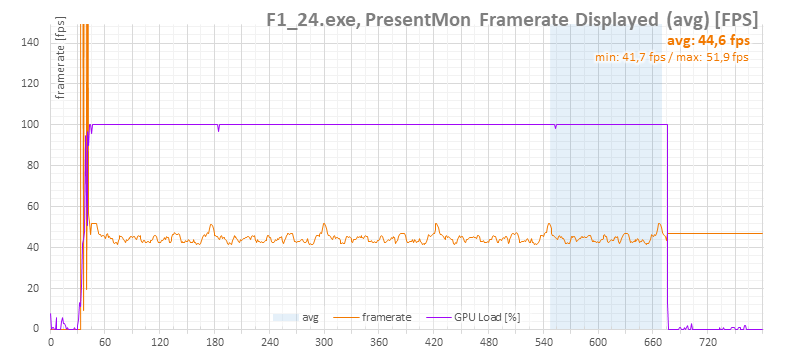
The next tests come from the F1 24 benchmark at 3840 × 2160 with Ultra settings. It is a five-lap test on the Singapore track in wet conditions. Unlike other benchmarks, it is a continuous load—there is no decrease in load between test loops and the card remains warmed up the entire time.
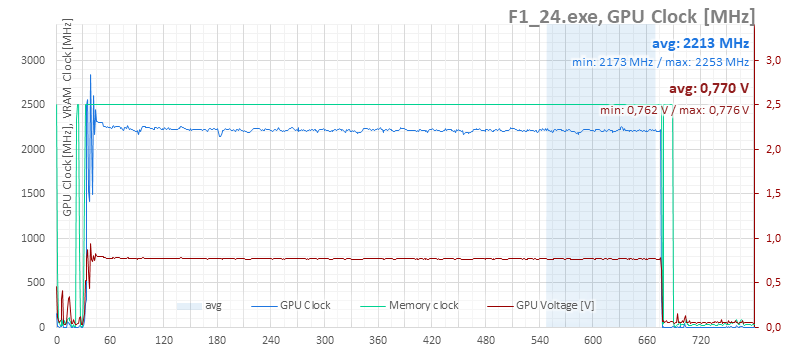
Clock speeds dropped by about 80 MHz compared to Cyberpunk. The warmed-up card holds a clock in the range of 2173 to 2253 MHz with an average of 2213 MHz in the measured segment.
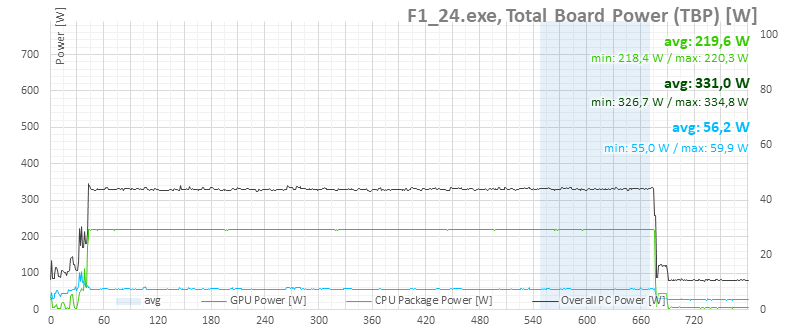
The power draw according to monitoring (light-green) remains at the set 220 W power limit. The total system power draw averages 331 W.
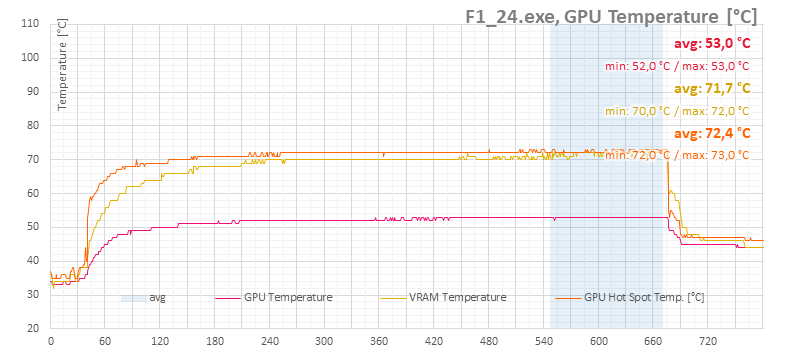
The average warmed-up GPU temperature peaks at 53 °C according to monitoring, memory reaches 72 °C, and hotspot is at 73 °C.
Fan speed during the first two minutes after load starts is between 1600–1680 rpm, but as temperatures stabilize the speed gradually rises to around 1980 rpm.

⠀





– It is obvious that a big advantage of this card are its dimensions. This is never mentioned in the review.
– I always power-limit my GPU during gameplay as a way to optimize (1) fan noise, (2) case temperate, (3) adjust for summer vs. winter room temperature and (4) to lower the electricity bill.